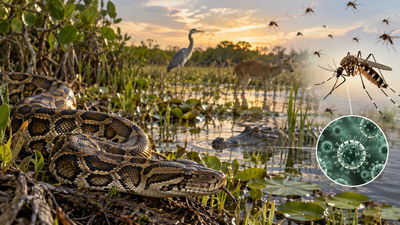
In the Everglades, the disappearance of mammals is changing more than the animals that remain. Burmese pythons have spread through southern Florida and prey heavily on medium-sized and larger mammals, leaving a wildlife community that is less varied than it once was. That change may also be altering the way mosquitoes encounter the animals they feed on. Cotton rats are important hosts for Everglades virus, a mosquito-borne pathogen found in Florida. As other mammals become scarcer, mosquitoes appear to be feeding on these rodents more often. The result is a chain of ecological changes in which an invasive predator may be influencing the circulation of a disease without carrying the pathogen itself.
How Burmese pythons changed the Everglades mammal community
Burmese pythons (Python bivittatus) are an introduced predator in southern Florida, where they have become established across parts of the Everglades. Their presence has been associated with steep reductions in several mammal populations, particularly among larger and medium-sized species.That matters because mosquitoes do not feed on a single type of animal. Their blood meals can come from a range of mammals, and varied species available to them can affect how efficiently a pathogen moves through the ecosystem.When many potential hosts are present, a mosquito may feed on animals that do not support the pathogen particularly well. Those species can effectively divert some mosquito bites away from animals that are better at maintaining infection.
Disappearance of other mammals changed mosquito feeding habits
The research examined areas of southern Florida where Burmese pythons were found at higher and lower densities. The aim was not simply to measure how many animals were left behind, but to examine what happened to the relationships between wildlife, mosquitoes and Everglades virus.Where there was greater diversity among non-rodent mammals, mosquitoes took fewer blood meals from cotton rats. The issue was not simply whether cotton rats existed in an area. Their importance to the mosquito population changed depending on what other mammals were available.As the range of alternative hosts narrowed, cotton rats accounted for a greater share of mosquito feeding.
Cotton rats play a different role in the disease cycle
Cotton rats are not just another mammal in this system. They are amplifying hosts for Everglades virus, meaning they can support the pathogen in a way that helps mosquitoes acquire it and pass it on during subsequent feeding.Everglades virus, or EVEV, is endemic to Florida and circulates naturally through a mosquito-rodent cycle. Mosquitoes become infected after feeding on an infected amplifying host. The virus can then be carried to other animals through later blood meals. That makes the identity of a mosquito’s meal significant.A mosquito feeding on a mammal that does not contribute strongly to the virus cycle has a different epidemiological consequence from one feeding on a cotton rat capable of amplifying EVEV.The Communications Biology 2021 study, titled ‘Invasive Burmese pythons alter host use and virus infection in the vector of a zoonotic virus’ found that increasing use of cotton rats by mosquitoes was associated with increasing EVEV infection prevalence in the mosquito population.
How the python’s impact reaches mosquitoes and disease
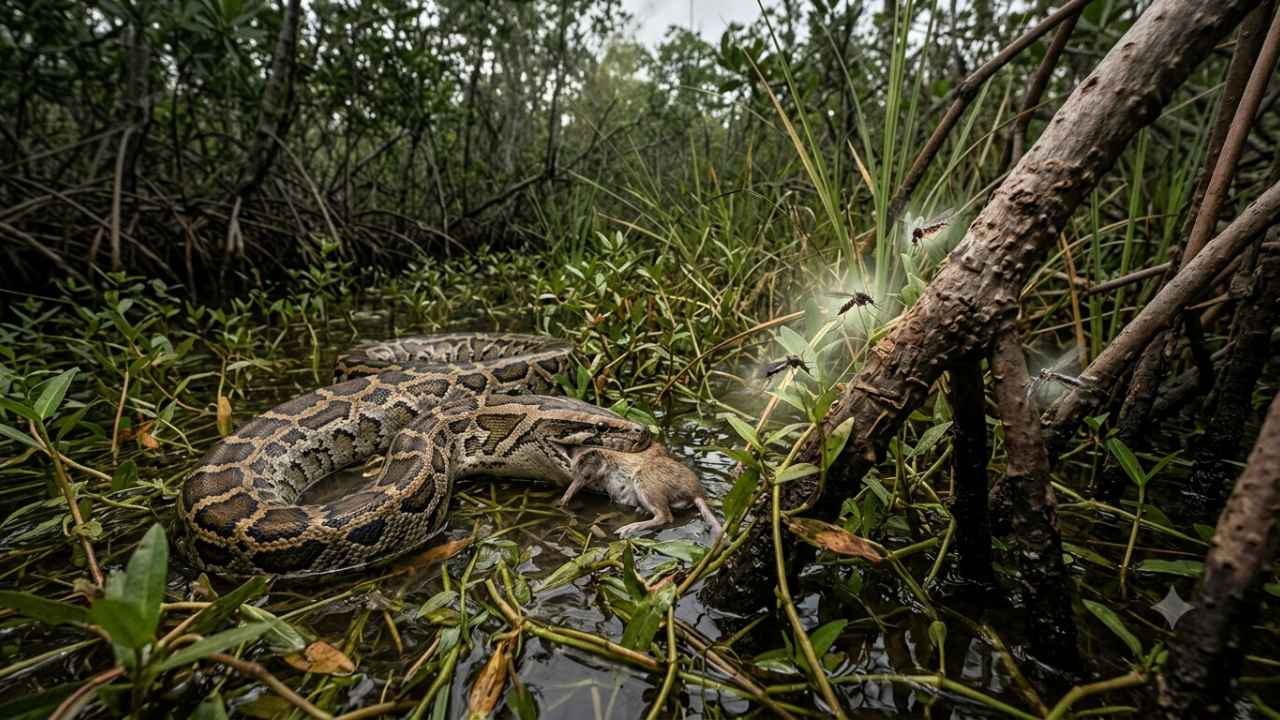
Burmese pythons reduce the diversity of mammals in the landscape. With fewer non-rodent mammals available, mosquitoes shift some of their feeding towards cotton rats. Because cotton rats are important amplifying hosts for EVEV, that change in feeding behaviour is linked with greater infection prevalence among the mosquitoes.The python does not need to carry Everglades virus for this to happen. Its ecological influence can operate indirectly, through the wildlife community it leaves behind. That is what makes the finding relevant beyond the question of invasive snakes. Predator-driven changes in animal communities can alter disease dynamics even when the predator itself has no direct role in transmitting the pathogen.
Why losing species can change disease transmission
The idea behind the dilution effect is relatively straightforward, although its effects can vary between ecosystems and diseases.A mosquito looking for a blood meal encounters whatever suitable hosts are present. If the community contains many different mammals, some bites will fall on species that are poor hosts for a particular pathogen. If those species disappear, the proportion of bites reaching competent hosts can rise. In the Everglades, cotton rats appear to occupy that more important position for EVEV.The research therefore connects biodiversity with the composition of mosquito blood meals. It is not simply a case of having more species being automatically safer from disease. What matters is which species are present, how abundant they are and how they interact with the vectors and pathogens moving through the ecosystem.
How changes in Everglades wildlife may affect human virus risk
Everglades virus is a zoonotic pathogen, which means it can move between animals and humans. The virus is maintained in wildlife through its natural transmission cycle, while mosquitoes act as the vectors.The study’s findings raise the possibility that changes caused by Burmese pythons could increase the prevalence of EVEV in mosquitoes and, in turn, potentially affect the risk of transmission to people.That does not mean the research demonstrates an increase in human cases caused by Burmese pythons. The study examined wildlife, mosquito feeding patterns and infection prevalence rather than establishing a direct rise in human disease. The human-health connection is therefore an ecological pathway rather than a measured outbreak.