The next time India faces a major security challenge from Pakistan, would the Mecca defence pact change the choices before New Delhi?The question has gained significance after Saudi Arabia, Pakistan and Turkiye agreed to treat an armed attack on any one of them as an attack on all three.On paper, that gives Islamabad a new collective-security arrangement, but the details of the pact, and the very different strategic interests of its three signatories, make its implications for a future India-Pakistan confrontation less straightforward.
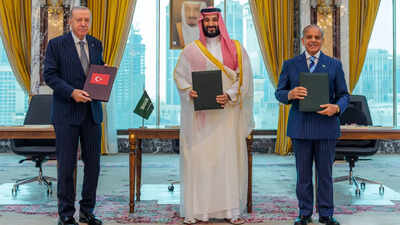
Signed in Jeddah by Saudi Crown Prince Mohammed bin Salman, Turkish President Recep Tayyip Erdogan and Pakistan Prime Minister Shehbaz Sharif, the agreement comes at a time when the three countries are seeking closer coordination over a rapidly changing security environment in West Asia.
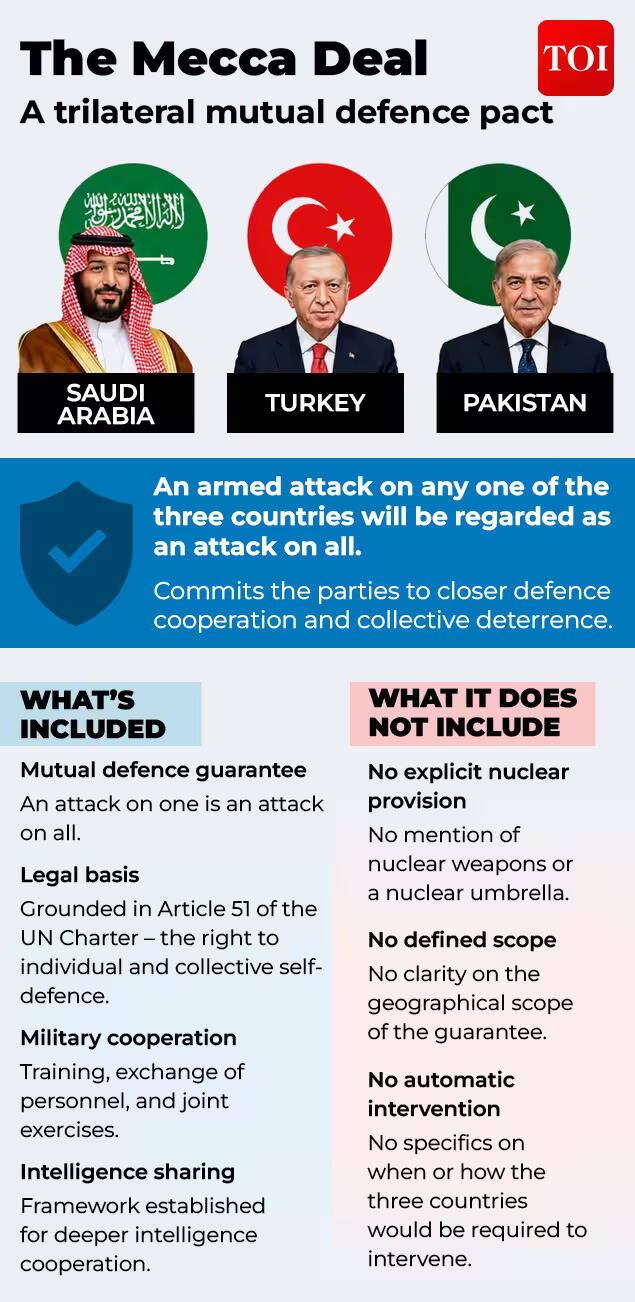
Mecca deal is a trilateral defence pact between Saudi Arabia, Turkey and Pakistan.
While Pakistan is at the heart of the new arrangement, the immediate strategic focus of the pact is the regional balance involving Iran, the Gulf and the wider West Asia.For India, however, that raises a more specific question — if another crisis were to trigger a military response similar to Operation Sindoor, would Saudi Arabia and Turkiye see it as a conflict covered by their new defence commitment to Pakistan?The circumstances surrounding the pact offer some clues.
Iran, not India, is at the centre
The agreement comes as Saudi Arabia faces a difficult regional security environment shaped by the conflict involving Iran, Israel and the United States, threats from Iran-aligned groups and continuing concerns over the safety of energy infrastructure and maritime routes.Saudi Arabia has traditionally relied heavily on the United States for security but the recent regional crises have increased the emphasis in Gulf capitals on developing additional security partnerships and greater regional burden-sharing.Pakistan brings longstanding military ties with the Kingdom and a large military capable of providing manpower. Turkiye brings Nato experience and a growing defence industry, while Saudi Arabia contributes financial resources and significant geopolitical weight.“Any deal between Turkey, Pakistan and Saudi Arabia actually triangulates with Iran at the center. Their primary focus is Iran and that’s the primary focus of Saudi Arabia. And these are all Sunni countries. And now they feel that this war is about to end in some manner in the deal. And the deal which favors Iran, they have this fear that Iran will become too big to handle for them. No one country can handle it” Lt Gen PR Shankar (Retd) told TOI.“That is why they have done this deal. And they want to use the technology which is available with Turkey. Pakistan has the nuclear capability and the boots which it can put on ground. And Saudi Arabia has the money,” he further said.The focus on Iran is also reflected in the wider security relationships of the three countries. Saudi Arabia and Iran remain sworn rivals despite the plausible ironing out of the tensions in 2023. Turkiye maintains relations with Tehran while pursuing its own regional ambitions. Pakistan, meanwhile, shares a long border with Iran and has its own security interests in the region.There is therefore a clear regional rationale for closer coordination between the three countries that does not depend on India.
What changes for Pakistan
Practically it does one thing. Nothing. For Islamabad, the pact only formalises security relationships that were already written on the wall.Pakistan and Saudi Arabia have maintained close military ties for decades, with Pakistani personnel training and supporting Saudi security forces, with Islamabad also expanding its military presence in the Kingdom in recent months.Turkiye and Pakistan, meanwhile, have developed extensive defence cooperation covering military equipment, training and defence technology. While, Ankara’s support for Islamabad therefore predates the new agreement.This is significant when assessing what the pact could add to Pakistan’s military position vis-a-vis India.“If you look at it, Pakistan always had Turkey’s help even during Op Sindoor. So, what will formalisation give him additionally over what he has already given. What can Saudi Arabia give Pakistan except money? So, it won’t change anything for India?” Gen PR Shankar said.The agreement could nevertheless provide Pakistan with greater diplomatic weight and potentially improve access to Saudi financial resources and Turkish defence technology. Pakistan could also benefit from being positioned at the centre of a security framework connecting South Asia with the Gulf and Turkiye.ALSO READ | Iran hails Saudi-Pak-Turkey defence pact, calls for Muslim unity amid West Asia tensionsBut the collective-defence provision does not publicly identify India as a common adversary of the three signatories. That distinction, therefore, becomes important in assessing whether the agreement would automatically apply in an India-Pakistan conflict.
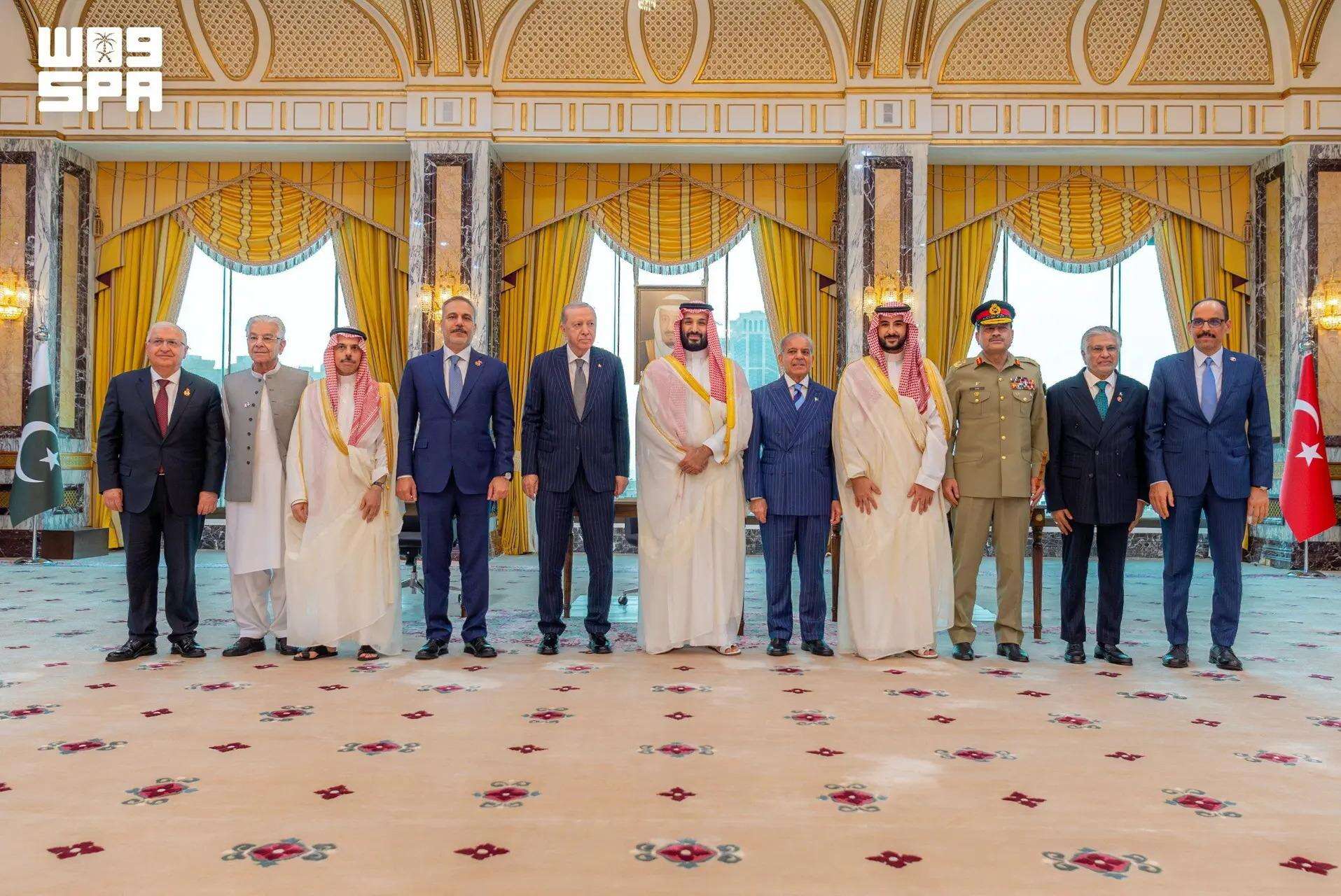
Turkish President Tayyip Erdogan, Saudi Crown Prince Mohammed bin Salman, and Pakistan’s Prime Minister Shehbaz Sharif, accompanied by their ministers of Foreign Affairs and Defence, pose after signing a joint defence agreement in Mecca.
Why Nato comparison has limits
The reference to Nato’s Article 5 has given the agreement considerable attention, but the two arrangements are not institutionally equivalent.The Mecca agreement does not currently establish a unified military command, a permanently deployed joint force, an integrated headquarters or the institutional structures that have developed within Nato over decades. More importantly, the three countries do not have identical security priorities.Saudi Arabia’s immediate concerns are centred on Gulf security, Iran, maritime routes and threats from regional armed groups. Turkiye has interests spanning West Asia, Europe and the wider Muslim world, while also maintaining its Nato membership and relations with Iran. Whereas, only Pakistan’s principal strategic rivalry remains with India.
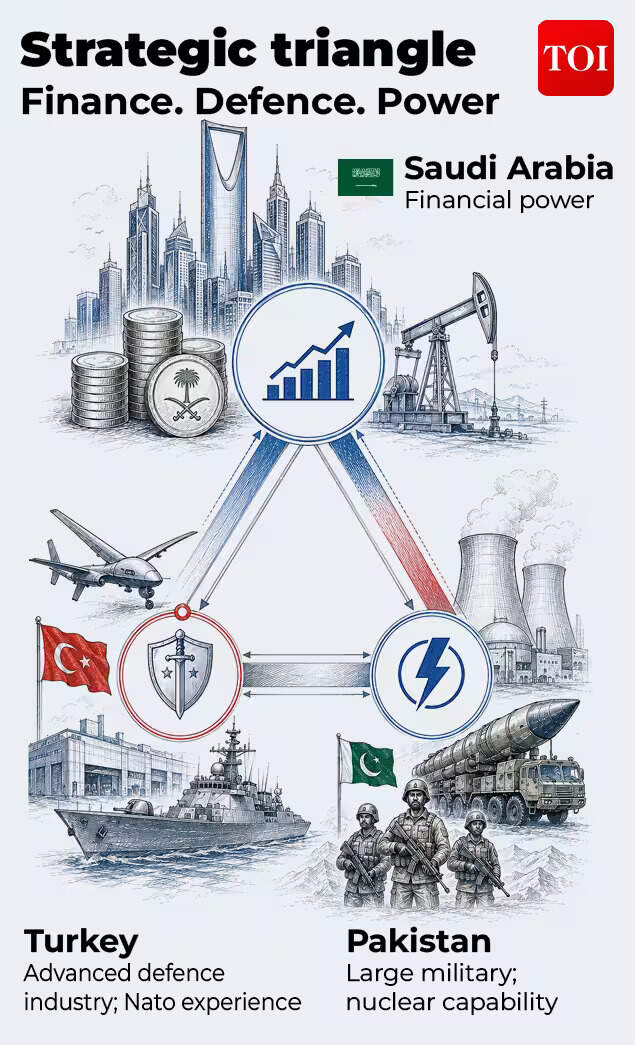
The deal hinges on strategic triangle of finance, defence and power.
However, that does not make the agreement irrelevant to India. It means that any future military confrontation involving Pakistan would have to be assessed against the individual interests of Saudi Arabia and Turkiye, rather than assuming that the collective-defence clause would automatically result in their military involvement.Saudi Arabia’s extensive economic relationship with India is also a factor. Riyadh and New Delhi have developed significant ties in energy, trade, investment and strategic cooperation. Saudi Arabia has also maintained a policy of expanding its relationship with India while retaining its longstanding partnership with Pakistan.ALSO READ |‘Shouldn’t be exclusive club’: Pak minister seeks Nato-like Islamic military alliance
Could it affect India’s wider regional role?
The more significant implications for India could emerge outside the immediate India-Pakistan military equation. Saudi Arabia occupies an important position around the Red Sea and Persian Gulf.Turkiye has an increasingly capable indigenous defence industry and growing influence across West Asia. Pakistan provides military manpower, operational experience and nuclear capability. A closer and more institutionalised relationship among the three could therefore influence the emerging security architecture of the region. It could also increase Pakistan’s role in Gulf security at a time when Saudi Arabia is seeking greater regional responsibility for its own defence.
For India, this matters because its interests in the Gulf extend well beyond its relationship with Pakistan. Energy security, trade, the safety of Indian citizens working in the region and maritime connectivity link India’s interests directly to developments stretching from the Gulf and Red Sea into the wider Indian Ocean.“This pact does not affect India’s national sovereignty or territorial integrity. It does not matter because for that the country has adequate strength already. But this pact might impact country’s larger role as a regional power where its interests are from the Gulf of Aden to the Strait of Malacca and, of course, this entire Indian Ocean region,” Gen Shankar told TOI.The distinction between India’s immediate security and its wider regional interests is therefore central to understanding the agreement.
What it means for another Operation Sindoor
The Mecca agreement does not explicitly provide Pakistan with a collective military guarantee against India. Nor does the publicly available information indicate that Saudi Arabia or Turkiye has committed to entering a future India-Pakistan conflict on Islamabad’s behalf.That does not rule out political, diplomatic, financial or military assistance to Pakistan. Both countries already have established relationships with Islamabad, and the new framework could, if it does, only deepen those ties.But any future Indian military response to a Pakistani provocation would remain a separate strategic calculation. The response of Saudi Arabia and Turkiye would depend on the circumstances, their assessment of the conflict and their respective national interests.Pakistan itself remains focused on a range of domestic and regional challenges that has emerged in the POJK, Balochistan and Sindh, with Asif Munir-controlled Islamabad choking the dissent with brute force to ensure, especially in POJK, to get away with the rigged election in its occupied territory.ALSO READ |‘There needs to be accountability’: UN warns Pakistan over crackdown on peaceful PoK protesters“Pakistan will always try some misadventure or the other. Look at the first misadventure he has to do is with his own people. Let him come out of it. You have to see it in the current context of what’s happening in POJK,” Gen Shankar said.For New Delhi, the immediate significance of the pact therefore lies in monitoring how the new framework develops rather than treating its announcement as a fundamental change in the India-Pakistan military balance.For now, the agreement represents a formalisation of existing defence relationships at a time of major uncertainty in West Asia. Pakistan gains another platform for strategic engagement, Saudi Arabia gains additional security partnerships and Turkiye expands its role in regional defence cooperation.Whether that translates into a constraint on India’s ability to respond to a future security crisis with Pakistan will depend not simply on the wording of the pact, but on how each of its three signatories interprets its interests when such a crisis actually arises.ALSO READ | Egypt may join new defence alliance: Turkey expects Cairo to sign pact with Pakistan, Saudi Arabia