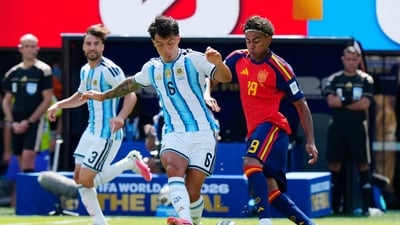
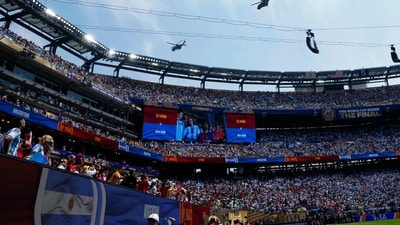
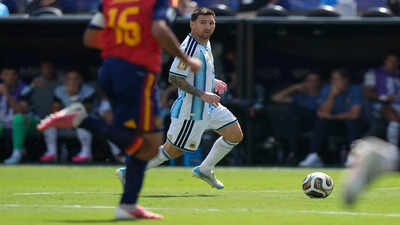
THE WORLD CUP began amid controversies five weeks ago, but the men’s football tournament should enjoy a fitting finale, if smoke from wildfires permits, on Sunday when Spain take on Argentina in New Jersey. This contest has seen several innovations, not all of them welcome. Fans have grumbled about “hydration pauses” and many will complain about the 25-minute half-time show planned for Sunday’s match. But nobody can begrudge either team their place in the final. Spain won the World Cup in 2010 and Argentina in 2022. With more or less the same teams, Spain won the European championship two summers ago, while Argentina won the Copa América, the equivalent tournament, in the same year.
The World Cup finalists are strikingly different teams (REUTERS)
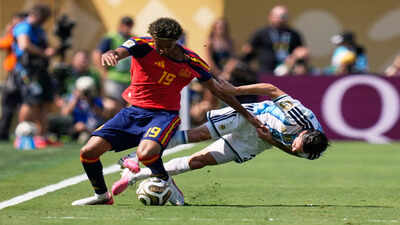
While both sides are Spanish-speaking, they are strikingly different. Take Spain first. In an era of sporting individualism, its squad is a collective. As Luis de la Fuente, the manager, said in a dressing-room talk before they went out to take on France in the semi-final, “we face the best assortment of players, but we are the best team.” He said he selects “normal people” rather than superstars. Still, Spain has a rising star in Lamine Yamal, a clever winger who is returning to form after injury. But their most influential player is Rodrigo “Rodri” Hernández, an unobtrusive midfield general. The team includes no players from star-studded Real Madrid. In this World Cup, swaggering egos such as Cristiano Ronaldo of Portugal and Kylian Mbappé of France—the pre-tournament favourite—failed to different degrees.
Spain’s success is based on denying the opposition possession of the ball and defending high up the pitch. They also show excellent close control and inter-passing when attacking. Their second goal against France featured a score of passes around the pitch before Dani Olmo struck it home. It was an elegant exercise in applied geometry. Perhaps because several of the players have performed together in Spain youth teams coached by Mr de la Fuente, before he took over the top job in 2022, they seem instinctively to know where each other will be. The team is young: aged 19, Mr Yamal and Pau Cubarsí, a centre-half, are the third- and fourth-youngest players ever to grace a World Cup final.
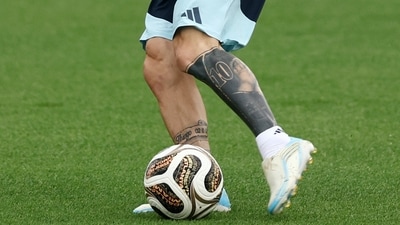
Argentina, by contrast, is a team built around the genius of Lionel Messi, who for most of his career played for Barcelona. Aged 39, he walks for most of a match, until he spots an opportunity. He is backed by a bone-crunching midfield, an ageing defence and a great goalkeeper in Emiliano Martínez. In their semi-final against England, Argentina spent the first half fouling their opponents; only after falling a goal behind did they switch on the surging attacking football of which they are capable. Though Mr Messi is the greatest footballer of the 21st century, he is also a modest man of the people. That means his team-mates are prepared to make sacrifices for him, according to La Nación, an Argentine newspaper. Lionel Scaloni, their coach, has found a way of melding Mr Messi with the rest of the team, something that eluded his predecessors.
What they sometimes lack in finesse, they make up for with passion, commitment and belief. “The Argentine team never becomes anxious,” concludes La Nación. “They never get desperate.” Against Egypt, they won 3-2 despite trailing 2-0 with only 11 minutes of normal time to go. Similarly, they were losing to England until the 85th minute. But Spain, too, have scored some late goals. Though the two sides are closely matched, Spain look to have the edge, especially if the Slovenian referee protects Mr Hernández and his teammates from any excessive aggression.
This World Cup will be remembered for highs and lows. The expanded format, with 48 teams instead of the previous 32, produced some tedious matches involving mediocre teams, but also the glorious feats of Cape Verde (population: 490,000), who drew with Spain and lost to Argentina only in extra time. Fears that high ticket prices and transport costs would keep fans away proved groundless. Most matches were well-attended by supporters from diasporas. But the United States, the main host, drew criticism for banning a Somali referee and refusing to allow the Iranian team to sleep overnight in the country.
Many would like to see the end of the “hydration pause” at the midpoint of each half of matches—a thinly disguised commercial break for television. Football is supposed to be free, too, of government interference. Gianni Infantino, the president of FIFA, the tournament organiser, crossed a line when after a call from Donald Trump he rescinded a red card given to Folarin Balogun, an American player, allowing him to play in a match against Belgium. Fortunately, Belgium thumped the United States 4-1.
Many would like to see the back of Mr Infantino, who has obsequiously courted strongmen around the world. But much of world football’s officialdom is addicted to the money he has brought with his unbridled commercialism. He is likely to be re-elected next year. In a not untypical case, the president of Argentina’s football federation, Claudio “Chiqui” Tapia, is being investigated for receiving kickbacks on contracts (he denies wrongdoing). Argentine supporters are likely to forgive him if their side wins. And despite all the grubbiness, football fans around the world will probably look back on the tournament and think more about the marvels on the pitch than what happened off it.