Scientists uncover ‘space glass’ in Brazil linked to a 6-million-year-old meteorite impact |

Scientists uncover ‘space glass’ in Brazil linked to a 6-million-year-old meteorite impact |

A team of researchers has discovered a field of tektites in Brazil, providing evidence of a powerful meteorite impact that occurred approximately 6 million years ago. This field contains natural glasses formed by the high-energy impact of extraterrestrial bodies against the Earth’s surface. These structures, named ‘geraisites’ in honour of the Brazilian state of Minas…
Read More

Chickpeas Grow In Moon Soil: Can chickpeas grow in Moon soil? New study reveals surprising results for space farming |

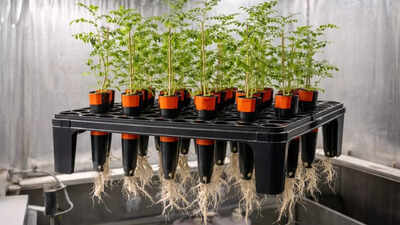
As the US plans a long-duration mission to the Moon under the Artemis Programme, one of the biggest challenges that the scientists face is what astronauts will eat in space. This challenge has led researchers to explore whether crops can be grown directly using material present on the Moon.A recent study led by researchers from…

Read More

What is black rain? How oil fires, smoke, and atmospheric pollution can turn rainfall dark and potentially harmful |

Recently, the rare scientific phenomenon received global attention after reports from Tehran in March 2026 indicated that residents observed ‘dark rain’ following airstrikes on oil storage facilities. This led to massive fires that released thick smoke into the atmosphere. When rain clouds formed over the city, the raindrops fell into the clouds, thus forming dark…

Read More

Floating ‘snowmen’ in space explained: MSU student solves a billion-year-old Kuiper Belt puzzle |

Ever wondered how those weird, floating “snowmen” way out in the deep freeze of the Kuiper Belt beyond Neptune’s orbit manage to stick around? These oddly shaped, double-lobed rocks called contact binaries, like the famous Arrokoth look fragile, yet they’ve survived billions of years without crumbling apart. Astronomers have been searching for an answer for…

Read More

Plastic Waste Into Vinegar: Scientists turn plastic waste into vinegar using only sunlight at the University of Waterloo |

PC: University of Waterloo In this world, plastic is the most stubborn waste. Normally, the plastic waste gets disposed of via municipal collection, which leads to open-pit burning or dumping in local waterways. However, no one must have imagined that plastic waste can even be turned into vinegar (acetic acid). Remarkably, this is now a…

Read More

Did scientists miscalculate rising oceans? New analysis of hundreds of studies raises concerns |

Credit: NationalGeographic Most of the research conducted around rising oceans might have misjudged the rising coastal hazards by an approximate of 20 to 30 centimetres. Out of 385 expert-reviewed studies published between 2009 and 2025, around 99 percent incorrectly estimated ocean height. Researchers suggest this might have caused a lag of almost a hundred years…

Read More