Can salt save the planet? UK scientists test radical ‘cloud brightening’ to fight global warming |

Can salt save the planet? UK scientists test radical ‘cloud brightening’ to fight global warming |

Researchers in the UK are investigating a revolutionary geoengineering method called ‘cloud brightening.’ Researchers from the University of Manchester are investigating whether the application of tiny sea salt particles could be sprayed into the atmosphere to enhance the reflectivity of clouds by increasing their ability to reflect sunlight into space. This study, which is funded…

Read More
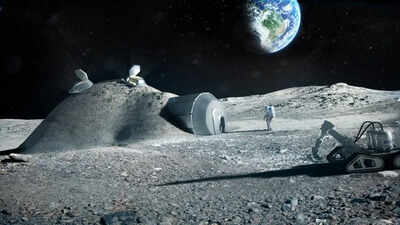
‘Humans may soon live and work on the Moon’: Experts reveal bold plan for permanent lunar life by 2030 |

‘Humans may soon live and work on the Moon’: Experts reveal bold plan for permanent lunar life by 2030 |

The idea of humans living on the Moon has slowly moved from distant imagination to something that now feels within reach. Recent statements from Dylan Taylor during the CNBC interview indicate that the timeline may be much closer than previously expected. Speaking at an industry event, he suggested that humans could return to the lunar…

Read More
China develops a new fuel cell that turns coal directly into electricity without burning |

China develops a new fuel cell that turns coal directly into electricity without burning |

Chinese researchers have unveiled a groundbreaking ‘Zero-Carbon-Emission Direct Coal Fuel Cell’ (ZC-DCFC) that fundamentally transforms coal-based energy. Led by Xie Heping at Shenzhen University, this innovation bypasses traditional combustion – the process responsible for massive carbon emissions and energy loss in conventional power plants. By utilising electrochemical oxidation, the system converts coal’s chemical energy directly…

Read More
Scientists may have uncovered the secret behind the universe’s first supermassive black holes |

Scientists may have uncovered the secret behind the universe’s first supermassive black holes |

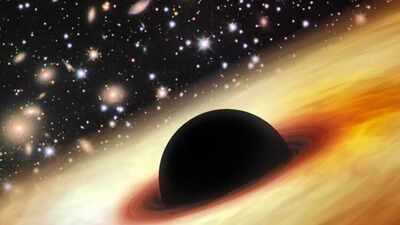
For years now, astronomers have been witnessing what seems like an ever-growing puzzle regarding the early formation of the universe. According to recent findings, some supermassive black holes, with masses ranging up to one billion times larger than the sun’s, were formed within less than a billion years following the formation of the universe itself….

Read More
Scientists reveal the real source of airborne microplastics and it’s not the ocean |

Scientists reveal the real source of airborne microplastics and it’s not the ocean |

A new study by the Department of Meteorology and Geophysics at the University of Vienna has challenged many of the existing beliefs about where airborne microplastics originate from. In previous years, it was believed that most microplastics originated from the ocean, and this assumption has been refuted, based on a study published in Nature that…

Read More
n 2020, researchers tracking a dry lakebed spotted shallow marks in the silt and found human footprints from 120,000 years ago |

n 2020, researchers tracking a dry lakebed spotted shallow marks in the silt and found human footprints from 120,000 years ago |

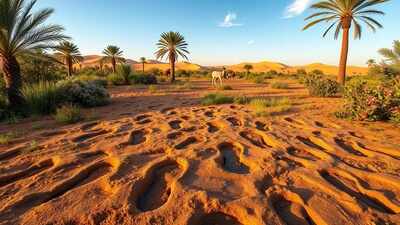
Archaeologists discovered 120,000-year-old human footprints in northern Saudi Arabia, revealing a wetter, greener past. These prints, alongside those of ancient animals, suggest early humans ventured inland from Africa much earlier than previously believed, following natural waterways. The Arabian Peninsula is typically depicted as a sprawling area marked by shifting seas of golden sand and dry…

Read More
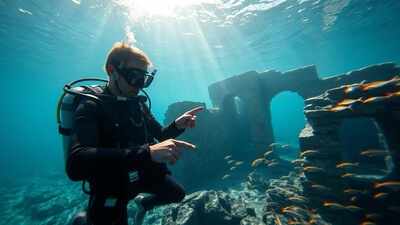
In 2026, divers in Lake Issyk-Kul followed a trail of ancient brickwork to a submerged city hidden for seven centuries |

In 2026, divers in Lake Issyk-Kul followed a trail of ancient brickwork to a submerged city hidden for seven centuries |

A recent underwater expedition in Kyrgyzstan’s Issyk-Kul lake has unearthed a vast, 700-year-old lost city. Researchers discovered a remarkably preserved medieval cemetery with intricate architecture and visible inscriptions, hinting at a thriving Silk Road civilization. The “Pearl of Central Asia” is an aptly named lake located in the upper reaches of the Tien Shan range…

Read More
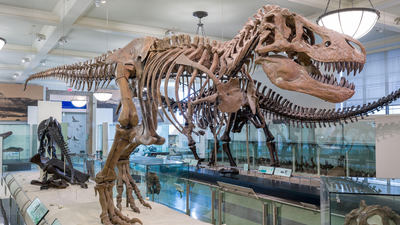
Jurassic Park got T. rex wrong: Scientists say it moved more like a bird than a beast |

Jurassic Park got T. rex wrong: Scientists say it moved more like a bird than a beast |

For decades, the image of Tyrannosaurus rex has been defined by thunderous footsteps and earth-shaking chases, immortalised by films like Jurassic Park. The towering predator was imagined as a heavy, reptile-like creature, pounding across the ground with unstoppable force. New research is now challenging that long-held picture. A recent study suggests that T. rex may…

Read More