
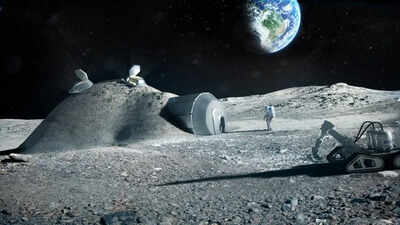
The idea of humans living on the Moon has slowly moved from distant imagination to something that now feels within reach. Recent statements from Dylan Taylor during the CNBC interview indicate that the timeline may be much closer than previously expected. Speaking at an industry event, he suggested that humans could return to the lunar surface before the end of this decade, with the possibility of staying there for extended periods. This points towards a future where people could live and work on the Moon. The statement reflects a broader shift in the space sector, where both governments and private companies are accelerating plans to establish a sustained presence beyond Earth.
‘Living and working’ on the moon may begin with early lunar bases
The first phase of this plan appears to focus on building a functional base rather than a large settlement. According to CNBC’s CONVERGE LIVE, Taylor indicated that an inflatable habitat could be operational by the end of the 2020s. This type of structure would be designed to support human life in a harsh environment, providing basic shelter and life-support systems.Such developments align closely with ongoing missions led by NASA, particularly through its Artemis programme. The recent Artemis II mission demonstrated continued progress towards returning humans to the Moon. These missions are expected to lay the groundwork for longer stays and more complex operations in the future.
SpaceX and Blue Origin are redefining long-term ambitions for life beyond Earth
Private companies are playing a major role in accelerating these plans. Organisations like SpaceX and Blue Origin have invested heavily in technologies designed for long-term space exploration.SpaceX has outlined ambitions that include developing a self-sustaining presence on the Moon. This could involve infrastructure that supports human habitation and resource utilisation over time. Blue Origin has also shifted its focus, pausing some of its tourism-related activities to concentrate on building a permanent lunar presence.
Technical challenges remain significant
Living on the Moon involves many difficulties. Such difficulties arise from the fact that the Moon is characterized by extremely high levels of radiation, temperature fluctuations, and the absence of raw materials.At the same time, moving goods and maintaining technological devices for a certain period can be complicated as well. For example, even such a progressive proposal as the establishment of data centers in outer space implies certain difficulties. One of them relates to heat exchange in space.Experts state that although there are already some existing solutions, their scaling remains to be improved.
The reality of living on the lunar surface
The Moon is Earth’s closest neighbour, sitting at a distance of about 238,855 miles (394,500 km). Even though it feels “near” in space terms, it is actually a very harsh place for humans, according to Northwest Earth & Space Sciences Pathways. It is only around a quarter the size of Earth and has much weaker gravity, about 16% of Earth’s. Without an atmosphere, the Moon experiences extreme temperature swings. A single lunar day and night cycle lasts just over 28 Earth days, and during that time temperatures can drop to around -400°F (-250°C) in darkness and rise up to about 250°F (120°C) in direct sunlight. Over billions of years, countless meteorite strikes have also broken down its surface into a fine grey dust called lunar regolith.For a long time, scientists believed the Moon was completely dry. That view has changed over the last couple of decades. Space missions have now found signs of water ice in permanently shadowed areas inside craters, especially near the poles, where sunlight never reaches.The upcoming Artemis III mission is expected to focus on the Moon’s South Pole for exactly this reason. The region has a unique setup some crater floors stay in permanent shadow and may hold ice that could be turned into water or even rocket fuel. At the same time, nearby crater rims get regular sunlight, which makes them useful for solar energy. These conditions together make the South Pole one of the most promising places for future human activity on the Moon.