
For the June quarter, CEAT’s consolidated net profit plunged 96% to ₹4 crore from ₹112 crore a year ago. Its revenue rose 22% to ₹4,318 crore, supported by robust demand across original equipment manufacturers (OEM) and replacement segments.
However, higher input costs hurt profitability. The company’s earnings before interest, taxes, depreciation and amortisation (EBITDA) declined nearly 6% to ₹365 crore from the previous year, while its EBITDA margin contracted 250 basis points to 8.5% from 11% in the year-ago period. Its gross margin also fell 300 basis points during the quarter.
CEAT’s managing director and CEO Arnab Banerjee told CNBC-TV18 that raw material prices are expected to be another 8-10% higher in the second quarter compared with the first, with additional price hikes planned in July and August. He said margins are likely to remain in the same range as the June quarter before recovering in the second half of FY27.
Calling the June quarter “challenging”, he said, “The continuing West Asia crisis led to significant raw material cost inflation, which weighed on our gross and operating margins. We responded with calibrated price increases to partly offset the impact, while staying focused on demand and market share.”
The company also approved a ₹1,205 crore investment to expand capacity at its Nagpur plant by 53,000 tyres per day. The expansion will be executed in phases and is expected to be completed by FY31.
Despite near-term cost pressures, the management said demand remains robust across both OEM and replacement businesses, premiumisation continues, and double-digit revenue growth remains achievable for FY27.
CEAT also expects the acquisition of Camso to be completed by September 2026, with customer integration set to begin in the second half of the financial year.
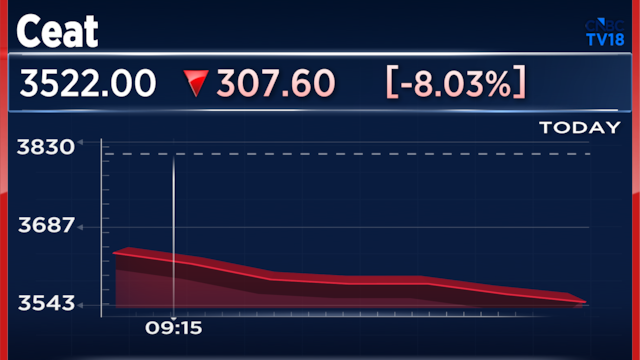
The stock hit an intraday low of ₹3,471.10 and was trading 7.2% lower at ₹3,554.80 around 10:12 am. The current price levels stand about 18.5% above the stock’s 52-week low of ₹3,000.50 and nearly 20% below the 52-week high of ₹4,438 in October 2025.
Also Read: ₹150 Or ₹530? BHEL bulls cite execution improvement while bears warn of order inflow peak