
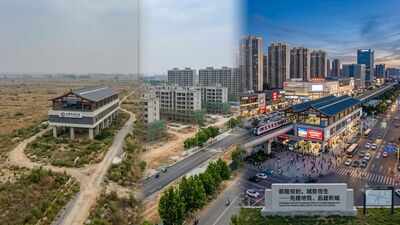
For years, China’s empty subway stations became some of the internet’s favourite examples of “ghost cities” and questionable urban planning. Images of polished platforms, escalators and station entrances surrounded by fields appeared to show infrastructure built far ahead of demand. Among the most famous examples was Caojiawan Station in Chongqing, which seemed to stand alone in the middle of nowhere after opening in 2015.But the story did not end there. Over time, roads, housing developments and businesses began moving closer, turning once-isolated areas into growing urban districts. What many critics saw as a costly mistake was part of a larger strategy: building the foundations of cities before the people arrived.
China’s most famous “ghost station” stood alone for years
Reportedly, when Caojiawan Station opened in Chongqing in 2015, it seemed almost impossible to explain. Passengers leaving the platform found themselves surrounded by undeveloped land rather than the busy neighbourhoods usually associated with urban rail.The station had all the signs of a modern transport network: underground platforms, escalators, lighting and multiple exits. Yet outside, there were few signs of daily life. There were no rows of shops, no crowded streets and no obvious stream of commuters heading home. Photographs of the station quickly spread online. To many observers, it represented a strange contradiction; a piece of expensive city infrastructure sitting in an area that did not appear to be a city at all.The criticism was not only about one station. Across China, several newly built districts had gained reputations as “ghost cities” because housing developments and public infrastructure appeared before large numbers of residents moved in. But urban development rarely follows a straight line.
How empty landscapes were prepared for future cities
China’s approach to expansion has often relied on preparing the foundations of a city before demand becomes visible. Instead of waiting for population growth to force new transport links, planners frequently built roads, rail networks and utilities as part of a wider attempt to attract development.The thinking was that infrastructure could become the starting point rather than the final stage of urban growth.A subway connection changes how attractive an area becomes for developers and residents. Land near stations becomes more valuable, businesses gain easier access, and housing projects become easier to market. In rapidly expanding cities, a transport line can act as a signal that an empty patch of land is intended to become part of the urban landscape.This approach became especially visible after years of heavy infrastructure investment following the 2008 Beijing Olympics. Metro networks expanded dramatically, with new lines reaching areas that were still sparsely populated.For local governments, transport projects also carried economic importance. Land development became a major source of revenue, and improved connectivity helped turn previously overlooked areas into potential commercial zones.The station was not always built because people were already there. Sometimes it was built because authorities expected people to come later.
How China’s “ghost stations” began to lose their ghostly image
For several years, Caojiawan remained one of the most photographed examples of an apparently abandoned metro station. The contrast was striking: a polished transport facility surrounded by unfinished land.The situation began changing as development moved outward from Chongqing’s established urban areas. Roads were constructed, housing projects appeared and the surrounding district gradually became more connected to the wider city. The station that once looked isolated became part of a growing suburban network.Its story was repeated elsewhere, though not always in exactly the same way. Some planned districts that initially struggled to attract residents eventually developed into functioning urban areas. Places such as Xiong’an New Area and parts of Lanzhou New Area went through similar periods where infrastructure appeared before everyday activity followed.The early emptiness became less a sign of failure and more a reflection of the timeline involved in building new districts.Cities are not always created in the same order. Sometimes people arrive first and infrastructure catches up. In other cases, the concrete arrives before the crowds.
The financial burden behind the expansion
The success stories, however, do not erase the challenges created by such an ambitious building programme.China’s metro expansion has come with enormous financial commitments. Transit systems require constant maintenance, staffing and upgrades long after construction ends. A station that helps transform an area may still struggle financially if passenger numbers remain below expectations.Many urban rail operators have accumulated significant debt while trying to expand networks at remarkable speed. Some newer lines have faced criticism for low usage, expensive operations and designs that do not always match passenger demand.There have also been practical problems. Certain stations opened with limited access points or inconvenient connections. In some places, transport networks expanded faster than surrounding communities could fully develop.The 2021 flooding disaster in Zhengzhou exposed some of the vulnerabilities that can come with rapid urban construction. Extreme weather placed pressure on infrastructure systems and raised questions about whether expansion had always been matched with sufficient resilience planning.Building first can create opportunities, but it also creates obligations that last for decades.
What made China’s urban experiment different
China’s infrastructure strategy developed under conditions that are difficult to reproduce elsewhere. Large-scale land planning, government control over development and long-term investment decisions allowed projects to move forward in ways that would be challenging in many other countries.A city deciding to build a subway line through undeveloped land requires confidence that future growth will actually happen. If that growth fails to arrive, the result can be an expensive network serving fewer people than expected.Yet the idea behind the strategy has attracted attention beyond China. Many growing cities around the world face similar pressures: rising housing demand, overcrowded urban centres and the need to prepare for future populations.