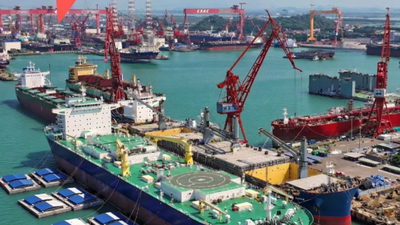
China appears close to be launching what could become the world’s largest naval support vessel, based on new images released by a state-owned shipbuilder and subsequent analysis by military observers.On Thursday, the China State Shipbuilding Corporation shared a photograph of one of its shipyards on social media as part of a post marking a Chinese solar term. The image showed a massive ship hull inside a dry dock in the background.Military observers said the structure in the image appears to be an auxiliary or support vessel, triggering discussion about the expanding logistical capabilities of the People’s Liberation Army Navy (PLAN), according to South China Morning Post. According to analysts, the upper deck and island superstructure of the vessel appear largely complete, suggesting the ship may soon be ready for final outfitting before leaving dry dock.The speculation is linked to China’s growing focus on blue-water naval operations, which require long-range deployment capabilities across open seas.Because China has limited overseas military bases, its navy depends heavily on auxiliary support ships to supply fuel, food, water, ammunition and other essentials during extended missions.At present, the PLA Navy’s carrier groups are supported mainly by two 45,000-tonne Type 901 Fuyu-class fast combat support ships and smaller Type 903 Fuchi-class vessels.However, satellite imagery and defence assessments suggest China may be developing a much larger next-generation replenishment ship to support its expanding carrier fleet, including what analysts believe could be a new ‘super carrier’.The existence of the vessel first came to wider attention last month after a report by defence intelligence firm Janes, based on commercial satellite images taken in March at the Longxue shipyard in Guangzhou.Janes estimated that the ship is approximately 271 metres long and 37 metres wide and appears designed to carry fuel, dry stores and ammunition for carrier strike groups.Defence analysts further estimate that the vessel could have a displacement of 60,000 to 65,000 tonnes, which would make it larger than the retired United States Navy Sacramento-class fast combat support ships, which displaced around 53,000 tonnes.Satellite images from March indicated that the ship was still missing its superstructure at the time, suggesting that significant construction progress has taken place in recent months.Analysts said that if construction continues at the current pace, the vessel could be completed by the end of this year and may enter service between 2027 and 2028.