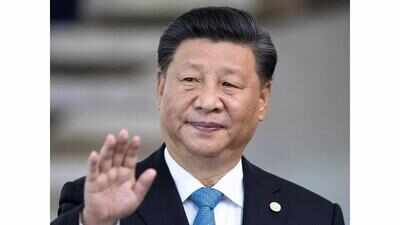
Chinese President Xi Jinping used China’s biggest tech stage to draw a sharp line between how Beijing and Washington think about artificial intelligence—and the difference comes down to one word: openness. Speaking at the opening of the World Artificial Intelligence Conference in Shanghai on Friday, Xi urged countries to grab the “historic opportunity” of open-source AI and warned against letting a single nation dominate the technology.He never named the United States. He didn’t need to. With American labs like OpenAI and Anthropic guarding their frontier models behind closed doors, Xi’s pitch landed as a direct challenge to the way Silicon Valley operates. “China is ready to be more open, take more practical actions, and assume a more visionary perspective,” he said. His framing was blunt elsewhere too: AI development, he argued, “should not be a solo performance by a single country but a symphony of global collaboration.”
Why open-source has become China’s biggest AI weapon
The message carries weight because Chinese open-weight models are no longer playing catch-up quietly. On the same day Xi spoke, Beijing-based Moonshot unveiled Kimi K3, which it called the world’s largest open AI model by parameter count. That arrival, alongside buzzy rivals like Z.ai’s GLM 5.2 and the earlier DeepSeek shock, shows how fast the gap with ChatGPT, Claude and Gemini is narrowing.American labs have taken the opposite route. Meta open-sourced its general Llama models but kept its proprietary Muse Spark private. OpenAI, despite the name, runs closed models. Anthropic does too—CEO Dario Amodei called open-source a “dangerous path” back in 2023, arguing companies lose the ability to moderate usage or revoke access once weights are public.
China’s new AI alliance and what it means for the US
Behind the speech sits real institutional muscle. A day earlier, Beijing launched the World Artificial Intelligence Cooperation Organisation, or WAICO, a 29-nation coalition headquartered in Shanghai that includes Indonesia, Brazil, Russia, South Africa and Pakistan. Xi called it a “milestone in the history of world AI development,” pitching it as a home for Global South nations wanting a bigger say in how AI gets governed.That puts it in direct competition with Washington’s AI Opportunity Statement, which has drawn 35 countries. Only Kazakhstan appears on both lists—a sign that most nations haven’t hedged their bets yet.Xi also spent unusual time on AI safety, calling for systems to stay under human control and for early-warning and emergency-response mechanisms to guard against loss-of-control scenarios. He pledged 5,000 AI training and seminar slots for less advanced countries.That said, the openness has limits. Reuters reported this month that Beijing is weighing restrictions on overseas access to some of its top AI models, underscoring the tension between China’s open-source push and its national security agenda.