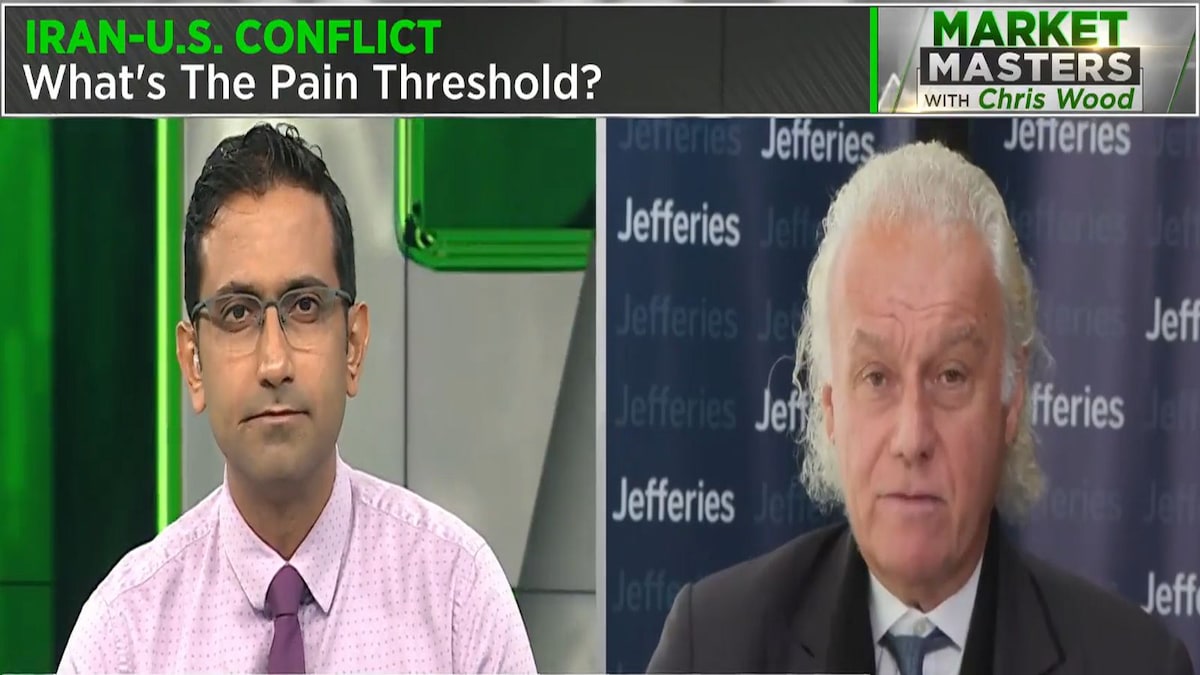
Speaking on the sidelines of the Jefferies India Forum 2026, Wood said the bond market’s reaction to the US Federal Reserve’s 25-basis-point rate hike on September 16 was important. While the market did not rally, it also did not sell off, which he sees as a positive outcome for the Fed.
Wood also weighed in on the US sanctions bill targeting buyers of Russian oil, saying it would be a big negative for India if Washington imposes the measures. However, the impact could be less severe if the US and Russia move toward a deal on Ukraine, since US President Donald Trump has taken a less confrontational line on Russia than the US Congress.
He expects the standoff between the US and Iran to stretch past the November midterm elections, and investors should expect oil prices to stay high or climb further. “the only practical way investors have to hedge this geopolitical risk, this issue in the West Asia, is to own energy,” he said, noting that current oil levels still look low.
Wood named China as the swing factor: Beijing has been running down stockpiles instead of buying oil, and could tighten the market again if it resumes purchases to pressure President Trump.
These are edited excerpts from the interview.
Q: It’s a tricky macro situation once again. Lots of stuff is happening. The US 10-year yield is above 5%, oil is above $100 per barrel on Brent, and of course, politically things are moving as well. I want to go to what is most important from an Indian perspective as we start this conversation, which is oil. Oil prices are at $105-106 per barrel as we speak. The way I want to frame this question is: What is the pain threshold for the US and Iran? And how does this resolve? Because what’s the off-ramp here? That’s what everybody is asking, and there are no answers. Your thoughts?
A: The pain threshold for Iran is that the Iranians have the ability to take quite a lot of pain, and I see no incentive for the Iranians to do anything prior to the midterms to keep the pressure on the US president.
The formal Iranian position – I’m taking the Iranians at face value because they’ve had a tendency throughout this whole drama of the last several months to do exactly what they say they’re going to do, whereas, with the US president, we have the absolute opposite situation.
So, the formal Iranian stance is clear in that they are saying they will only talk to the Americans again if the Americans talk on the basis of the MoU, which President Trump signed. Unless that happens, I don’t think we should expect any agreement from Iran to talk.
So that really puts the ball in the US president’s court. He’s in a trap of his own making. I’m sure he massively regrets embarking on this joint military attack with Israel on Iran.
His problem is that he can do a deal with Iran, but even he will find it very hard to sell such a deal, as outlined in the MoU, as a victory for America or as a win. So that’s the standoff we now have.
Q: What is your base case? Does this get resolved before the midterms, or will this drag on after the midterms?
A: My base case is that this does not get resolved before the midterms because, from an Iran standpoint, it makes total sense to keep the leverage on the US president.
But there’s got to be an off-ramp, given the fact that the war is extremely unpopular. In fact, it’s been unpopular in the US ever since it began. So politically, it looks like a disaster for the US president, as reflected in the polling ratings. But at the end of the day, he’s not running again as president. So, in that sense, the midterms are not as important as they might be.
But my base case is that Iran will not back off from its current stance until the midterms. So that puts the ball firmly in the US president’s court.
I saw him quoted on TV this morning saying, “Iran is talking, and we’re getting near a deal,” and that was flatly denied by Tehran.
The other problem for the US president is that the more moderate side of the Iranian government—the people who were advocating talking to America—would have been discredited because the MoU was broken almost the day after it was signed.
So, if you were advocating talks with the US, you would have been discredited, and so the hardliners are firmly in control.
Q: I would have thought that before the midterms Iran has leverage, and after the midterms, the US has leverage. But you’re not seeing it that way.
A: Why does the US have leverage after the midterms?
Q: Once the midterms are over, whichever way they go, the point is, wouldn’t Iran want to solve this with the pressure of the midterms in front of President Trump?
A: No. There is a risk after the midterms. Let’s say it goes very badly for President Trump. He can either react in two ways. He can give up on the whole project and abandon the whole war, or he can choose to escalate it on the assumption that he has nothing to lose.
So, I agree there is a binary risk. But it all depends on whether Iran feels it has the ability to maintain the Strait of Hormuz in an essentially partially closed environment, which is the reality today.
The situation has clearly been further exacerbated by what’s happened in terms of Yemen and access to the Red Sea.
So, this is a material development that has happened over the past week. It has nothing to do with Iran. It’s to do with the Houthis.
It’s quite extraordinary that Saudi Arabia chose to reignite this conflict with the Houthis, given the fact that Saudi Arabia was getting its oil via the Red Sea pipeline. So, this has made the situation even worse.
But my base case is firmly that Iran will maintain its current stance until the midterms.
Q: What does it mean for oil? What’s your base case for the end of the year?
A: By the way, the financial markets are looking at oil, but in the real world, we need to be looking at the diesel crack spread because, in real life, diesel and other refined products are what matter. So actually, the remarkable thing is that oil is not higher.
I’ve been saying all year, from a portfolio standpoint, that the only practical way investors have to hedge this geopolitical risk—this issue in the West Asia—is to own energy.
It’s amazing that oil is not higher. One reason oil is not higher in recent months is because the Chinese stopped buying oil.
The Chinese have large stockpiles of oil, and they did the global economy a favour in recent months by slowing down their purchases of oil.
But if the Chinese suddenly want to put leverage on President Trump then all they have to do is start buying oil again. So, I think the swing factor is China.
Q: Oil around these levels till this conflict resolves? Is that what you would think?
A: Well, it could go higher. My key point is that you want to own energy stocks as a hedge.
It’s quite a 50-50 situation. But let’s say we go into the midterms, and let’s say it goes badly for the US president. Then it’s completely binary. It’s 50-50 whether he chooses to exit the whole situation or escalate it. I would say it’s completely binary.
Q: Just one more point with regard to oil, and then we’ll move on to bond yields, because that’s the other leg of this entire story. The sanctions bill, which was passed last night, is now at President Trump’s desk. It is what Lindsey Graham had been pushing. What do you make of it? What are the chances it’ll pass, and what will it mean if it passes? It doesn’t name countries specifically, but, of course, here in India and other countries which buy Russian oil, there is worry.
A: I have to say, if that passes and President Trump acts on it, which is completely uncertain at this point, that obviously is a big negative for India because clearly India is buying Russian oil.
But from an Indian standpoint, it’s worth remembering that Lindsey Graham has had an extreme anti-Russian position throughout this whole Russia-Ukraine conflict, whereas Donald Trump has had a far more nuanced, if not completely different, view on the Russia-Ukraine situation. So, it doesn’t have to work out as badly for India as it might appear this morning.
The other point to bear in mind is that the focus of markets and media has primarily been on the West Asia, for very understandable reasons, but the Russia-Ukraine conflict is still going on.
In recent times, the Western media has been painting a picture that Ukraine’s doing very well and Russia’s on the brink of blowing up. In my view, that is nonsense. I think the Western media is now beginning to admit that the Russian side is making advances.
In recent months Russia has taken out a lot of the Black Sea ports, in the sense that Ukraine is landlocked.
In my view, President Trump doesn’t want to fund Ukraine. He’s putting that role on Europe. So, there is the potential for some kind of deal between the US and Russia, which could reduce the risk India is looking at this morning. So, it’s not necessarily as negative as it looks.
Q: We don’t know which way this is going to go, but obviously, immediately it’ll be negative. But for the reasons you described, if there are chances of a deal directly between the US and Russia, that reduces the risk, is what you’re saying. But that’s down the line.
A: Yeah, because it’s a bit like with China. The US Congress is going to be much more partisan and anti-China than President Trump.
President Trump is due to meet again with the Chinese president. He’s always got a good word to say about his relationship with the Chinese president.
And frankly, it’s a similar story with President Putin.
Donald Trump is much less anti-Russia and anti-the Russian president than both sides of the US Congress.
After all, it’s not that long ago that his son-in-law was in the Kremlin. It was only about a week ago.
Q: Let’s get to the other leg of this whole story, which is rising bond yields, right? We’ve got a Fed hike, as expected. Kevin Warsh is sounding hawkish. Perhaps more is coming. And the US 10-year yield—we were all told for a long time that the pain threshold for equities, in terms of Treasury yields on the 10-year, is 5%. We are at 5%, but we seem to be in an okayish place. Your thoughts?
A: I think the most important price in world financial markets remains the 10-year bond yield. The 10-year bond yield is much more important than the federal funds rate.
The interesting point is that three months ago I would not have expected Warsh to raise rates, given his rhetoric. So, he’s basically done a pretty significant U-turn in terms of his language, based on what he said in his first press conference.
But the key point is the reaction of the bond market. Textbook economists believe that if the Fed raises rates, bond yields should go up, and if the Fed cuts rates, bond yields should go down. But it doesn’t work like that anymore.
So, if Kevin Warsh had not raised rates yesterday, there would have been a risk of a bigger bond market sell-off.
In fact, my base case would have been a bond market sell-off, and then you would have comprehensively broken the 5% level, which in my view is definitely a negative signal for equities.
But because he has raised rates, albeit only by 25 basis points, the bond market has held steady.
He probably would have liked to have seen a bond market rally. That hasn’t happened, but it’s good news for him that the bond market hasn’t sold off.
The way I’ve been looking at the 10-year—and what I wrote at the beginning of this quarter—is that you should look at this like a traffic light. Breaking 4.5% for the US 10-year was the equivalent of a yellow warning light. A comprehensive break above 5% would be like a red signal, and we’re right at that level.
So, yes, further rises in bond yields from here are negative for equities.
But the US stock market’s instinct will be to ignore rising yields for as long as it can because what’s been supporting the US equity market all year is this very strong EPS growth, which is primarily driven by this AI capex cycle.
It’s incredibly earnings-accretive.
The reason it’s so earnings-accretive is because the picks-and-shovels plays, like the DRAM companies, book their profits upfront, whereas the companies paying for the capex, like the hyperscalers, are in no hurry to account for it because they’ve got extended depreciation schedules.
They’ve also kept a lot of the data centre construction leases off their balance sheets. So, basically the whole thing is very front-end loaded.
For now, earnings estimates remain very robust.
Q: So if earnings estimates continue to stay very robust, will rising bond yields matter to equities?
A: Rising bond yields from here definitely matter for equities. Basically, Kevin Warsh has bought time by holding up the bond market. He would have liked the bond market to rally, but at least it hasn’t sold off.
But further rises in yields from here are a reason to put hedges on equities.
I’m talking about the US market.
Q: What’s the relationship to emerging markets? Here in India, for example, if bond yields stay at 5% or above 5%…
A: No, it’s a totally different story in emerging markets. My view on G7 government bonds is very simple. No, it’s a totally different story in emerging markets.
My view on G7 government bonds is very simple. It’s been the same view since March 2020, when the 40-year bull market in Treasuries and other G7 government bonds ended, when the Federal Reserve went bonkers and printed all that money because there was a pandemic.
I’ve been saying since then: Do not own any G7 government bonds. That remains my view today.
There’s no reason for anybody to own Treasury bonds, particularly if you’re here in India.
I’ve been saying that if you have to own bonds, you should own local-currency emerging market government bonds.
I have a Greed & Fear global sovereign debt portfolio, which currently consists of the Chinese government bond, the Singapore government bond, the Indian government bond, and the Brazilian government bond.
These are all local-currency government bonds. My portfolio, since March 2020, has outperformed G7 government bonds in US dollar terms by about 65%, from memory.
So, the bottom line is that you want to own emerging market government bonds because their fiscal situations are much healthier than those in the G7 world.
Q: What about equities in emerging markets? We’ve got the picture on bonds—emerging market bonds, not G7 bonds. What about equities?
A: Emerging market equities are fine, but for them to outperform, you need the market to realise—which I think it will sooner or later—that the Fed doesn’t have the ability to raise rates significantly.
Eventually, it will have to suppress bond yields, because the US fiscal situation is so extreme that America can’t deal with these higher bond yields, because it doesn’t have the political will to cut entitlements.
At that point, it will seek to manage bond yields.
You’ve already seen evidence of Treasury Secretary Bessent trying to influence bond yields.
At some point between 5% and 6%, my long-standing view is that they will fix bond yields if the bond market doesn’t succumb to Bessent’s efforts and continues selling off.
When they fix bond yields, that means the dollar is entering a long-term weakening trend.
That will be fantastic news for emerging market equities and gold.
Q: You really think it’ll come to that—that they will actually have to fix bond yields?
A: Yeah. I’ve always thought that. Actually, the only surprise is that it hasn’t happened already. They would rather manipulate the market through the various measures Mr. Bessent is taking.
First, by relying on massive funding at the short end. Second, by buying back the long end. Third, by introducing more policies to encourage US banks to own more Treasuries.
Rather than do a crude fixing. But if the situation warrants it, they will end up fixing bond yields. They would rather not do that, but that will be the endgame. America has done that before. It did that during the Second World War, when it was financing a war.
Q: You’re saying it’ll be somewhere between 5% and 6%.
A: That would be extremely positive for India because of the huge amount of gold held by Indian households, which, as you know better than me, has begun to be monetized by the booming gold-lending market.
Gold at $10,000 per ounce, which is entirely feasible in the environment I’ve outlined, would massively monetize Indian household balance sheets.
Q: What you’re saying is that if you see a fix coming, gold prices will rally. You’re saying gold prices can hit $10,000. Because Indians own so much gold, it’s a huge household asset.
A: Yeah. There’s also another potential option available to the US authorities. It’s not really manipulation; it’s a form of creative accounting.
They could revalue the US gold reserves, which are currently valued at $42 per ounce. They could then use some of the proceeds from that revaluation to buy back US Treasury debt.
Q: So, it’s going to be a graded approach, not a straight fix? Some intermediate steps first, but eventually it’ll come to that. Do you see it happening in the next year or two?
A: Yes, it definitely could happen. But it all depends on the bond market. If Kevin Warsh tightens monetary policy, proceeds with a genuine tightening cycle, and materially shrinks the Fed’s balance sheet, then I will be wrong.
You’ll get a strong dollar. You’ll get a big rally in the bond market. Gold will fall. But that would have all kinds of negative consequences for the US stock market.
Frankly, I won’t believe that’s happening until I actually see it, because it would hurt a lot of powerful vested interests.
Q: But it’s not impossible.
A: Yeah.
Q: India—large caps have delivered almost no returns for over two years, while small and midcaps have done much better. Foreign investors have largely stayed away. What will it take for large caps to participate?
A: I think the most interesting part of the market remains the small- and mid-cap space because India has many interesting smaller companies and dynamic entrepreneurs.
That’s undoubtedly the healthiest and most interesting area of the Indian stock market.
It’s also different from most markets globally, where large caps have driven performance and small caps have been completely out of favour.
Although I admit valuations are currently expensive. The problem for Indian large caps is that they are no longer the exciting secular growth stories they were from 2000 to 2020.
Indian banks are perfectly good investments, but they aren’t the same structural growth stories. The second issue is that as long as the DRAM cycle continues and semiconductor companies continue generating enormous profits, foreign investors have little incentive to return to India.
The quickest way foreign money returns to India is if the AI semiconductor capex cycle implodes. Without that, you won’t get major inflows regardless of domestic fundamentals.
Today, three stocks account for almost 30% of the MSCI Emerging Markets Index—TSMC, Samsung Electronics and SK Hynix.
The last time I checked, their projected profits this year were almost three times the estimated profits of the Nifty 50.
Q: Do you see the AI investment cycle eventually imploding?
A: Yes, at some point. US hyperscalers are investing enormous sums.
My base case remains that they will not generate returns sufficient to justify those investments. Ultimately there will be significant capital destruction.
However, as long as markets remain willing to finance AI capex, the cycle continues and semiconductor companies will continue making large profits.
The key difference now is that this investment is increasingly being financed through debt rather than cash.
The moment credit markets effectively withdraw funding, the entire AI trade could unravel.
When that happens, you’ll see substantial capital flowing back into India.
Q: Is there any timeline?
A: No. At the beginning of the year, I thought the cycle could peak this year. Today there’s absolutely no evidence of that. In fact, all the evidence suggests AI capex is accelerating. We simply have to keep monitoring it. It’s probably the single most important issue for global equity markets today. Technically it’s not even a macro issue. It’s really the question of AI capex itself. The numbers involved are enormous.
For the full interview, watch the accompanying video
Catch all the latest updates from the stock market here