
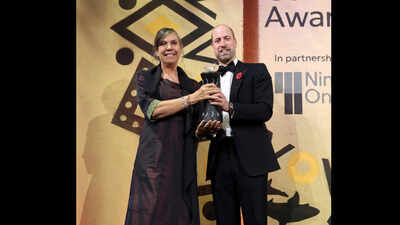
Congratulations are in order for Dr Colleen Begg, a conservationist who arrived in Mozambique more than two decades ago to study honey badgers and ended up dedicating much of her life to protecting some of Africa’s most important wildlife populations. The co-founder and managing director of the Niassa Carnivore Project has won the 2026 Prince William Award for Conservation in Africa, becoming the first woman to receive the lifetime achievement honour.Presented by Prince William at the annual Tusk Conservation Awards in London on November 11, 2026, the award recognises more than 30 years of Begg’s work in wildlife conservation. But her story in Mozambique began with a rather different animal.
From studying honey badgers to protecting lions
Raised in South Africa, Begg developed her career in conservation through scientific research, according to Niassa. She completed her doctorate in zoology with the first in-depth study of the honey badger, an animal known for its remarkable adaptability and famously fearless nature. Her research also explored ways of reducing conflict between honey badgers and beekeepers.In 2002, Begg travelled to the Niassa region of northern Mozambique to study honey badgers, honeyguide birds and traditional honey-gathering practices. What began as a research project soon introduced her to a much bigger conservation challenge.The region was home to an extraordinary variety of wildlife, including lions, leopards, spotted hyenas and African wild dogs. However, there was very little scientific information about these large carnivores, making it difficult to understand their populations and the threats they faced. Recognising this gap, Begg and her husband, fellow conservationist Keith Begg, began surveying the region’s carnivores. Their research eventually led to the establishment of the Niassa Carnivore Project in 2003.
Protecting wildlife by working with people
The Niassa Special Reserve, where the project operates, stretches across approximately 42,000 square kilometres in northern Mozambique. It is one of Africa’s largest protected areas and home to one of the continent’s largest lion populations, alongside significant populations of African wild dogs, leopards and spotted hyenas.Protecting wildlife across such a vast landscape is no small task. Lions and other large carnivores frequently come into contact with people living in and around the reserve. Livestock losses, attacks on families and competition over natural resources can create conflict, sometimes resulting in animals being killed in retaliation. Rather than treating local communities as separate from conservation efforts, Begg’s approach has been to involve them in protecting the wildlife they share their home with. The Niassa Carnivore Project works with Mozambican authorities, tourism operators and residents to tackle poaching, illegal trapping and poisoning while finding practical ways for people and animals to coexist.One of the most interesting initiatives involved bringing back traditional raised houses known as sanja. Built above ground, these structures help protect families from dangerous wildlife encounters. The project also supports environmental education, alternative livelihoods and community wildlife guardians who help monitor animal populations and identify threats.Its work has also created opportunities for local people to become conservation professionals themselves. Today, the project employs more than 100 Mozambicans, approximately 85 per cent of whom come from communities within the reserve. It also works with seasonal employees and more than 40 community guardians. Begg shows how protecting wildlife cannot work if the people living alongside it are left out of the conversation.
A difficult road to conservation
The work has not always been easy. Northern Mozambique has faced serious security challenges, and the Niassa Carnivore Project experienced a devastating attack in April 2025.Wildlife Conservation Network reports insurgents attacked the Mariri Environmental Centre and the project’s facilities, killing four rangers involved in anti-poaching operations. The incident was a huge blow to the conservation team and the families of the dead. But after the attack, Begg and her team went back into the field. They supported the affected families, continued their conservation programs and started rebuilding the damaged infrastructure.Beyond her work in Niassa, Begg has also been involved in creating opportunities for other women in conservation. In 2017, she co-founded Women for the Environment Africa, an initiative that connects and supports African women working in environmental leadership. The organisation aims to strengthen women’s influence in conservation, research and decision-making.
About the Prince William Award
The Prince William Award for Conservation in Africa is presented as part of the annual Awards function organised by the British conservation charity Tusk. Established in 2013, in partnership with investment manager Ninety One and in conjunction with Prince William, the awards recognise individuals making significant contributions to protecting Africa’s natural heritage.The Prince William Award is the program’s lifetime achievement award. Previous recipients have included conservationists from Zimbabwe, Kenya, Namibia, Mozambique, Uganda and Ethiopia. Begg is the first woman to win the award since it was introduced in 2013.The award was presented by Prince William in London on November 11, 2026, and recognizes her 30 year plus dedication to conservation as well as the work of the teams and communities that have helped make the Niassa Carnivore Project what it is today.