
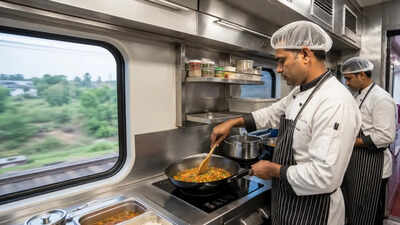
The Middle East crisis has hit the way Indian Railways prepares its meals for trains. A sharp shortage of commercial LPG cylinders has prompted the Indian Railway Catering and Tourism Corporation (IRCTC) to restart onboard meal preparation in moving trains. The practice had been discontinued several years ago. This time, however, cooking is being carried out using electric induction stoves.The shortage emerged after disruptions to energy supplies moving through the Strait of Hormuz, a critical route for oil and gas exports from West Asia, following the outbreak of the US-Israel conflict with Iran on February 28. To maintain catering services across 1,400 trains serving around 1.7 million meals daily, the railway catering arm has begun preparing food inside Linke Hofmann Busch (LHB) pantry cars using electricity. Induction-based cooking facilities have also been installed at major railway stations. Most premium services, including Rajdhani, Shatabdi, Duronto and Vande Bharat trains, operate with LHB coaches.Also Read | With better than Rajdhani experience & 160 kmph speed, can Vande Bharat sleeper trains be a game-changer for Indian Railways?
IRCTC brings back cooking on board trains
IRCTC Chairman and Managing Director Sanjay Kumar Jain told ET that vendors have been permitted to cook inside pantry cars, which are already equipped with safety infrastructure. As a result, LHB pantry cars are now capable of preparing meals onboard while trains are in motion using electric power. Jain added that induction cooking has also been introduced at large stations. He further said IRCTC has coordinated with Indian Oil Corporation (IOCL), Bharat Petroleum Corporation (BPCL) and Hindustan Petroleum Corporation (HPCL) to ensure priority supply in line with government directives.Railway officials said the nationwide catering network requires about 1,000 commercial LPG cylinders every day to run cluster kitchens, base kitchens and other food service facilities. In response to the shortage, IRCTC had directed operators of food plazas, refreshment rooms and Jan Ahaar outlets at railway stations to adopt induction cooktops and microwave ovens. As a result, nearly 60% of food preparation in railway kitchens has gradually shifted to electricity-based cooking.The supply disruption has also affected IRCTC’s financial performance. The catering business reported an earnings-before-interest-and-taxes margin of 6.3% in the fourth quarter of 2025-26, down from 10.4% a year earlier, largely due to rising input costs. Analysts pointed to a broader challenge. The last revision in catering prices took place in 2019. With cooking gas becoming more expensive and licensees facing pressure from higher costs, IRCTC will need either higher tariffs or continued growth in volumes to protect margins,” said a Mumbai-based analyst who tracks the company.The situation has also highlighted gaps in railway catering infrastructure. Parliamentary data shows that 341 trains across the country still operate without pantry service facilities.