
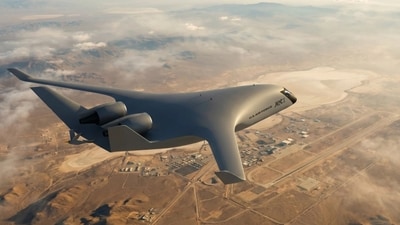
The U.S. government is swinging behind a fledgling startup’s moonshot bid to dislodge Boeing as America’s only major maker of commercial airliners.
The aircraft that JetZero wants to do it with is no less radical than its ambition. It looks more like a manta ray than the tube-with-wings blueprint that has been the default for over 70 years. If JetZero can cross the line, the blended-wing aircraft would mark the biggest shift in passenger-jetliner design since the supersonic Concorde.
Forget one or two aisles, this one has four and is set to fly about 10,000 feet higher than today’s airliners. Initial designs replace passenger windows with digital screens and, to compensate, a skylight in the ceiling to flood the cabin with natural light. Each seat, the company says, has its own overhead luggage compartment. And each toilet has a dedicated waiting space.
JetZero, based in Long Beach, Calif., last week reached an early deal with the U.S. Export-Import Bank as part of its Make More in America Initiative for as much as $3 billion in loans and guarantees that the company needs to build its first factory. The preliminary agreement is helping JetZero’s chief executive answer a question that has been plaguing him for years: Is this thing even real?
“The question’s a good one…is it real?” Chief Executive Tom O’Leary said in an interview. He is targeting a first prototype flight of the aircraft, known as the Z4, by the end of next year. “How real it is is effectively, ‘Where’s all the money coming from?’ ”
The company’s ambition comes after a bruising few decades for American planemaking. Once dominated by three industrial titans that produced about 90% of the world’s airliners, Boeing now fights solo. Its European rival, Airbus, controls more than half the market.
There is also a new competitor in China, Comac, which is steadily getting aircraft into the hands of regional carriers and has set its sights on its own new blended-wing design.
O’Leary was speaking from JetZero’s corporate chalet at the U.K.’s Farnborough International Air Show last week, where startups showed off flying taxis, hydrogen-powered jet engines and electric planes for a future that each claimed was just around the corner.
The trick up JetZero’s sleeve is that its radical, new aircraft isn’t actually that new at all. Almost all of the Z4’s components—from controls to the use of previous-generation engines on its demonstrator—are taken from existing planes, meaning they have already obtained sign-off from the Federal Aviation Administration. The main new thing about his aircraft is the shape in which JetZero is piecing those components together, O’Leary said.
Even that shape, the blended-wing concept, stretches back to the early days of aviation. The National Aeronautics and Space Administration began updating research into it about 30 years ago, spending more than $1 billion and test-flying prototypes. Working with Boeing, NASA sought to learn how much fuel efficiency researchers could extract by designing a profoundly more aerodynamic aircraft that maximized lift and sharply reduced weight and drag.
The answer, according to JetZero, is about 30%, compared with later-generation jets like the 787, O’Leary said.
That said, there have long been skeptics of the blended-wing design and reasons an actual commercial plane has never come to fruition. Critics point out that passengers in the wings could be exposed to higher levels of uncomfortable gravitational force when the plane turns.
The lack of physical windows might exacerbate feelings of motion sickness. A quad-aisle layout changes how an evacuation would play out. Airport jetways weren’t designed to handle such planes.
JetZero says it has answers for those concerns. It has also managed to convert a growing lineup of believers, including probably its most important, the U.S. government. The Ex-Im Bank chairman said he wants the loan deal fast-tracked. The company separately has $235 million from the U.S. Air Force to build its prototype, and is backed by Northrop Grumman and RTX, which is providing Pratt & Whitney engines for the first demonstrator.
JetZero has also lured the backing of about 20 airlines including Delta Air Lines, Alaska and United, which has a conditional order for 200 of the Z4.
In closed-door sessions each quarter, JetZero’s team preaches to specialists from those airlines about specific elements of the aircraft, such as cabin layout, flight controls and cargo doors. At the end of each two-day briefing, JetZero’s team steps away and the airline representatives talk privately about what they hate about the aircraft.
“When this was suggested to me, I was quite shocked,” O’Leary said. “We’re going to take all of our customers, tell them some of the most intimate challenges of our business, put them in a room, leave the room, and let them discuss amongst themselves?”
But the sessions have become critical, he said, helping JetZero to tweak the aircraft so that it not only flies, but meshes with decades-old airport infrastructure and operating norms dating back to the first jetliners of the 1950s.
In June, JetZero broke ground on a manufacturing facility in Greensboro, N.C., that is slated to produce the first Z4s by 2030 for use in testing and certification. The full-scale prototype is set to fly toward the end of 2027, with entry into service possible from the early 2030s. But O’Leary is secretive about exactly when passengers might see the aircraft at their gates, largely because that will depend on the FAA’s safety approvals.
The proposed airplane would seat about 250 passengers and fly about 5,000 nautical miles, fitting between the biggest narrowbodies and the smallest wide-bodies that Boeing and Airbus currently sell. That segment has largely gone unserved after Boeing halted plans to replace its popular 757 and 767 at the pinnacle of the 737 MAX crisis, which followed a pair of crashes in 2018 and 2019.
The gap in the market is a consequence of designing airplanes around a cylindrical cabin and having to choose between a bigger- or a smaller-diameter tube, O’Leary said. He compares JetZero’s proposition to selling a medium-size shirt in a shop that stocks only smalls and larges.
Blended-wing fuselages aren’t necessarily an obvious solution. Airbus had promoted a similar-style jet as one of the futuristic concepts it was studying alongside a hydrogen-powered aircraft. The plane maker ultimately decided the jet would need to be too big to take advantage of the aerodynamic efficiencies, according to a person familiar with its decision to shelve the plans.
Natilus, another California-based startup, is working on a similar, but smaller blended-wing aircraft that would compete more directly with the narrowbodies that dominate Airbus and Boeing’s order backlogs.
“If you look at the industry as a whole, I think everybody’s ready for something new,” said Natilus CEO Aleksey Matyushev from his company’s stall on the other side of the air show.
Write to Benjamin Katz at ben.katz@wsj.com