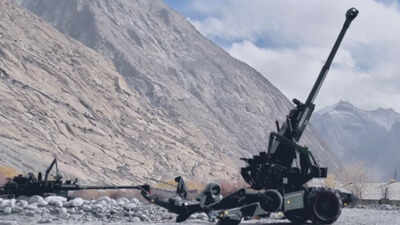
The Public Accounts Committee (PAC) has rapped the ministry of defence over delays in the procurement of the Dhanush artillery gun. The committee’s report, tabled in Parliament, highlights a two-decade gap between the Army’s urgent requirement for modern artillery and the eventual induction of upgraded systems, leaving formations reliant on ageing Bofors guns that were inducted in the 1980s and are now showing their age.The Army inducted the 155mm Bofors guns in 1986 under a transfer of technology agreement with Sweden’s AB Bofors. But the Original Equipment Manufacturer (OEM) was banned in 1989, as a result of the now infamous Bofors Scandal. The PAC notes that this indecision created a capability vacuum, compelling the Army to operate with obsolete systems well into the 21st century. In 2013, the Ordnance Factory Board was tasked with producing electronically upgraded prototypes of the Bofors gun. Yet, the order was placed three years after the Ministry had cleared bulk purchases, and the Dhanush was inducted only in 2022.The Dhanush artillery gun is manufactured by the Advanced Weapons and Equipment India (AWEIL), which used to be a part of the erstwhile Ordnance Factory Board, that was restructured and corporatized by the centre. The gun is an improvement on the original Bofors artillery gun. The gun boasts of an extended range of 38km as compared to the range of 27 km of the original gun. The Dhanush is also upgraded with modern electronics, which makes the gun more accurate and allows it to engage targets faster. It is also compatible with artillery command and control system that helps achieve precise ballistic calculation, making the platform more accurate.The committee observes that it took the ministry of defence nearly twenty years to finalise procurement and induction of the new artillery weapon platform, resulting in what the report calls a “huge deficiency in stock.” The report also mentions what it calls structural flaws in India’s defence acquisition process. It points to the absence of expertise in ballistics, electronics for guns and advanced sighting systems for these weapons. Mentioning that these gaps should have been identified during the planning stage rather than after execution. The PAC also recommends the introduction of specialised defence manufacturing courses in IITs and other technical institutions.The PAC has urged the defence ministry to institute mechanisms for periodic review of capability gaps and to timely acquire critical equipment in an effort to ensure operational readiness. The panel has called for comprehensive assessments of domestic manufacturing capabilities before launching major defence projects, in a bid to avoid time and cost overruns. Equally important is its emphasis on supply chain management and clear guidelines to ensure suppliers meet operational criteria.The panel has warned that ‘Considering the current geopolitical scenario, the Army cannot function with obsolete artilleries for such long periods of time’. This statement reflects the reality of India’s security environment, where the Line of Actual Control with China and the Line of Control with Pakistan demand credible deterrence. Artillery remains a backbone of land warfare and deficiencies in this arm directly impact the Army’s ability to deliver sustained firepower in a high-intensity conflict. The army has in this time frame has received the M-777 artillery gun and the K-9 self propelled artillery guns.The broader lesson is that defence preparedness cannot be hostage to bureaucratic inertia. The PAC has urged the defence ministry to take steps towards structural transformation of its decision-making process.