
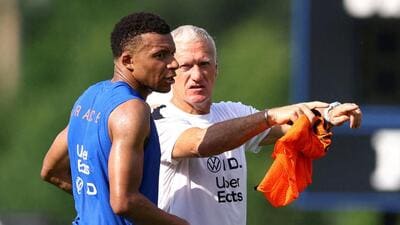
Kolkata: There have been football men who became symbols of revolution, style and legacy. Didier Deschamps became something rarer: a symbol of permanence. World Cup winner in 1998, and now 14 years at the job in July—just behind Óscar Tabárez (Uruguay) and Joachim Löw (Germany) on the list of longest serving international managers—Deschamps does not so much inspire devotion as command acceptance. His story is not of romance but of control that gave France a World Cup in 2018 and a runners-up finish in 2022, making one of the most revered managers ever in the modern history of football. In his fourth World Cup as manager, Deschamps is undeniably on the cusp of greatness.
Which is quite a story in itself because Deschamps was never the most gifted player in a French generation bursting with artistry. He did not possess the languid elegance of Zinedine Zidane, the velvet touch of Thierry Henry, or the volcanic charisma of Eric Cantona who had famously labelled Deschamps le porteur d’eau (a water carrier), implying he was only capable of winning back the ball and passing it to more talented players.
As a manager, too, Deschamps has often been accused of functionalism, conservatism, even joylessness. And yet, by the cold, unforgiving measure that elite sport ultimately respects above all else, he stands as one of the most successful figures. Apparently, by building a career on resisting seduction. Football, to him, has always been less about expression than organisation; less about the poetry of the game than the discipline required to survive it. It is why, even now, Deschamps is a riddle to many.
His rise was modest, from Bayonne (in France’s Basque southwest) into the academy of Nantes. Under the influence of legendary coach Jean-Claude Suaudeau, Deschamps absorbed the values that would define him forever: positional supremacy, collective sacrifice and tactical obedience. It made him spiritually older than he looked. Teammates spoke of a player who behaved like the team elder before he had earned the right. He organised dressing rooms, studied opponents obsessively and treated football less as play and more as conducive labour.
There was little glamour in Deschamps, but immense reliability, and a stirring need to protect his group. Marcel Desailly, his teammate of 1998, mentions it in a column he wrote for the Guardian during the 2018 World Cup. “At the end of our conversation I told him to keep the players under control ahead of the final and he replied: “I managed to keep you out of trouble 20 years ago, so I don’t think this bunch will cause me any headaches!” This confidence made Deschamps almost indispensable as a player, and formidable as a manager.
But first, his career as a player. By the time Marseille won the 1993 European Cup, Deschamps was already the emotional axis of the side. Later, at Juventus, he became the embodiment of the Italian obsession with defensive intelligence, Marcello Lippi trusting him with the job of maintaining their structural endurance. It made Deschamps boring, but also the most important cog of the wheel.
The same vein of trust ran through the great French side that conquered the 1998 World Cup and the Euro 2000, Deschamps stabilising the room when egos swelled and pressure thickened. He was the captain not because he dazzled, but because he endured without caring for flair—something that has become the defining theme of his managerial life.
In his early days as manager, first at Monaco and later at Juventus, Deschamps valued compactness over chaos, hierarchy over improvisation. And much like Alex Ferguson, Deschamps rarely gave into public display of emotion. It was identified as indifference but actually it masked a fierce instinct for protection. He shields squads from noise, he absorbs pressure. That understanding was the need of the hour after player revolts and internal strife left France’s 2010 World Cup campaign in tatters. Fractured by ego, politics and mutual distrust, they needed Deschamps as a stabiliser more than a visionary.
But he was also a master tactician at rebuilding authority without openly declaring war on individuality. Pragmatic but precise, demanding yet attentive to his players’ needs, Deschamps navigated generational transitions to build a squad that wasn’t always exhilarating but definitely emotionally controlled, tactically flexible and devastatingly efficient. The 2018 World Cup, thus, in many ways, was the ultimate Deschamps tournament because France refused to sacrifice their sense of structure on the altar of individual talent and ego.
It rendered the football mechanical, many complained, but Deschamps wasn’t interested. He had become only the third man, after Mário Zagallo and Franz Beckenbauer, to win the World Cup as player and manager. And yet perhaps the most revealing chapter of his managerial career came not in victory but in defeat. That final in 2022 should have been over at half time when France were trailing 0-2. But Deschamps’s substitutions altered the match with Kylian Mbappe scoring a hattrick to force one of football’s greatest finals into penalties. France lost, but Deschamps emerged larger.
It’s this man France have understandably turned to for 2026 as well. His teams rarely panic and lose shape. They bend, absorb blows, wait and strike. Perhaps that’s why Deschamps is an outlier in world football. No philosophical manifestos, no flamboyant touchline persona, no obsession with legacy, Deschamps treats football as work, and himself as a custodian temporarily responsible for maintaining order. It was to maintain order that he kept Karim Benzema out for six years when the striker was accused of blackmailing a teammate. But it was also proof of his pragmatism that Benzema was recalled ahead of the 2020 Euros.
Deschamps isn’t modern French football’s greatest artist, nor even its most beloved figure, but he is the man who made winning feel systematic. And France emotionally unbreakable.