
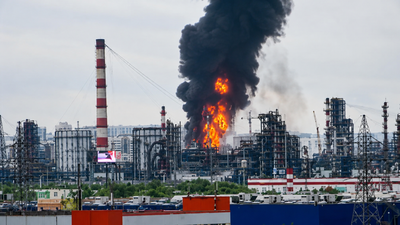
NEW DELHI: More than four years into the war and now longer than the duration of World War I, the Russia-Ukraine conflict continues with no signs of slowing down. Ukraine on Tuesday launched a drone strike on an oil refinery in the Moscow region, with Russian authorities confirming damage to the facility.Moscow mayor Sergei Sobyanin said a Ukrainian drone attack hit a facility at the Moscow oil refinery owned by Gazpromneft.“There were no casualties. Emergency services are working at the scene,” Sobyanin wrote on Telegram.The mayor did not say whether the refinery’s operations had been affected by the strike.Videos circulating on social media showed a massive plume of dark smoke rising high into the sky from the refinery complex following the attack.Ukrainian President Volodymyr Zelenskyy also shared footage of the strike and boasted Ukraine’s long-range strike capabilities.He wrote on X: “This time, the Moscow region felt the reach of Ukraine’s long-range capabilities. An oil refinery was hit at a distance of 500 kilometers. I thank the warriors of the Security Service of Ukraine, the Unmanned Systems Forces, the Special Operations Forces, the Defense Intelligence of Ukraine, and the Missile Forces for their effective work.”“Russia must be forced to end its war against our people. And Ukraine’s long-range weapons are one of the important components of such pressure. This is a just response to Russian strikes – and to the dragging out of a war that must be ended,” he added.The refinery is the largest in the Moscow region and processed 11.6 million tonnes of oil in 2024, according to the latest available data. According to Reuters, It produced 2.9 million tonnes of petrol and 3.2 million tonnes of diesel during the year, making it a key supplier of fuel to the Russian capital and surrounding areas.The strike comes amid a sharp increase in Ukrainian drone attacks on Russian energy infrastructure. According to official data, social media reports and Reuters calculations, the number of drone strikes on Russian refineries has doubled since the beginning of 2026.These attacks have led to full or partial shutdowns at several facilities, affecting the production of gasoline, diesel and jet fuel across parts of Russia.The Gazpromneft refinery primarily serves the Moscow region, which until now had largely avoided the fuel supply disruptions seen in several other Russian regions targeted by Ukrainian strikes.