He expects passenger vehicle and two-wheeler sales to grow 7-10% during the September-November festive period, slower than the 18-22% growth the industry clocked between April and August.
Why growth is expected to slow
Kale broke the next seven months into two halves. The festive stretch — September to November — should hold up reasonably well, helped by demand momentum built through the year. But what comes after is where the real test lies.
Last year’s December-March period actually accelerated more than expected, on the back of GST cuts, which means this year’s comparison base is unusually high. Elara is building in just 2-3% growth for that stretch.
Kale expects the festive season to still deliver 7-10% growth, working out to roughly a 12% CAGR over two years. That said, if festive demand comes in stronger than that, OEMs are reportedly targeting double-digit growth, which could act as a trigger for the stocks.
The market appears to already be pricing in some of this caution — Kale pointed out that passenger vehicle OEM stocks have fallen 5-10% over the past month, alongside a broader decline in the auto index.
Stock picks
Given the expectation of slower growth ahead, Kale said Elara is favouring companies gaining market share and those with strong export exposure, since two-wheeler exports have held up well.
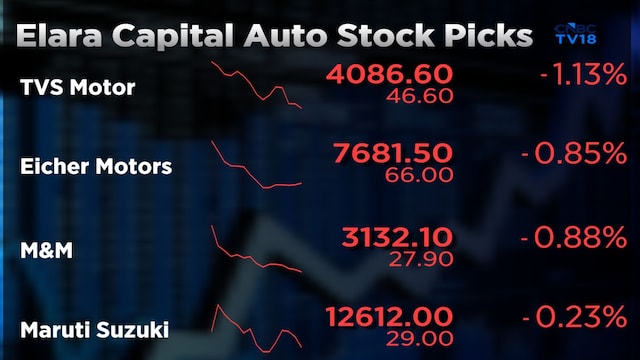
Among two-wheelers, the brokerage likes TVS Motor and Eicher Motors, while in passenger vehicles, its top picks are Maruti Suzuki and Mahindra & Mahindra.
The bigger story: fuel mix is shifting fast
Separately, FADA data for August showed something that hadn’t happened before — alternate fuel vehicles (CNG, hybrid and EV combined) outsold petrol and ethanol vehicles in the passenger vehicle segment. CNG made up 25.3% of retail sales, hybrids 9%, and EVs close to 7.5-8%, adding up to about 42% of the mix versus 41% for petrol and ethanol.
Kale expects this to only build from here. “Easily over the next two to three years, this is expected to go above 50%,” he said, adding that Elara’s own EV estimate for FY30 — around 15-16% share — may need to be revised higher, since the industry is already tracking close to 7-8% today.
He said the shift is being driven by buyers rather than being forced onto them. “We are seeing a demand pull rather than a demand push,” Kale said, noting that most EV variants across two-wheelers and passenger vehicles currently have waiting periods. In his words, “capacity is more of a problem right now than demand, which is a good problem to have.”
On whether other states might follow Delhi’s stricter EV policy, Kale said that isn’t part of Elara’s base case, though he didn’t rule it out given the government’s consistent push on alternate fuels.
For the entire discussion, watch the accompanying video