The company’s total debt currently stands at about ₹3,400 crore. After the ₹750 crore reduction, it will fall to roughly ₹2,600-2,700 crore. On a historical basis, debt-to-EBITDA — a common measure of how leveraged a company is, calculated by dividing total debt by annual earnings before interest, tax, depreciation and amortisation — will drop from 6-7 times to around 5 times.
Once EBITDA growth expected by March 2027 is factored in, Tiwari said the ratio should move closer to 4 times.
CEO Narasimha Jayakumar said profit margins should keep improving as the debt reduction lowers interest costs. “We would like to maintain the same trajectory going forward,” he said, pointing to three straight years of margin expansion from a current base of 19-20%.
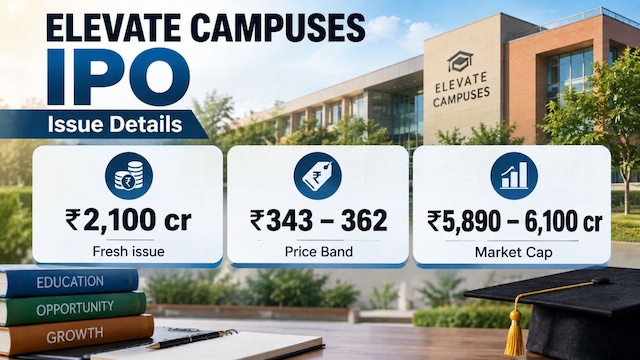
Elevate Campuses has set the price band for its IPO at ₹343-362 per share, seeking a market capitalisation of ₹6,100 crore. The issue is entirely a fresh equity raise, with no offer-for-sale (OFS) component from existing shareholders. It opens for subscription on September 23 and closes on September 25.
The Hillhouse-backed company runs India’s largest education infrastructure and services business, according to Jayakumar. It was founded in 2017. Elevate Campuses owns and manages on-campus student housing for universities including Manipal and OP Jindal, and separately owns K-12 schools that it leases to outside operators to run. “This is a very operations-intensive business, not just real estate,” Jayakumar said, noting the company also handles services like laundry, cafeterias and gyms for students.
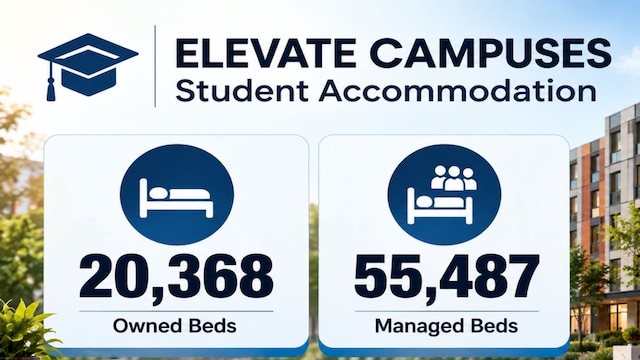
In the most recent year, the company posted revenue of about ₹807 crore. Student accommodation contributed 55% of EBITDA, while K-12 schools accounted for 45%. A smaller share of revenue comes from a managed-beds business, where Elevate Campuses runs housing on behalf of universities directly. Blended EBITDA margin stands at 78%, with revenue growing at a 20% compound annual rate over recent years against 26% EBITDA growth.
Tiwari attributed the company’s access to long-tenure debt — typically 15 to 20 years — to predictable cash flows tied to underserved demand for private schools and colleges in India, which he said lenders have historically rewarded with loans of 7-8 times EBITDA per asset.
For the full interview, watch the accompanying video

Catch all the latest updates from the stock market here
(Edited by : alphadesk)
First Published: Sept 18, 2026 3:05 PM IST