
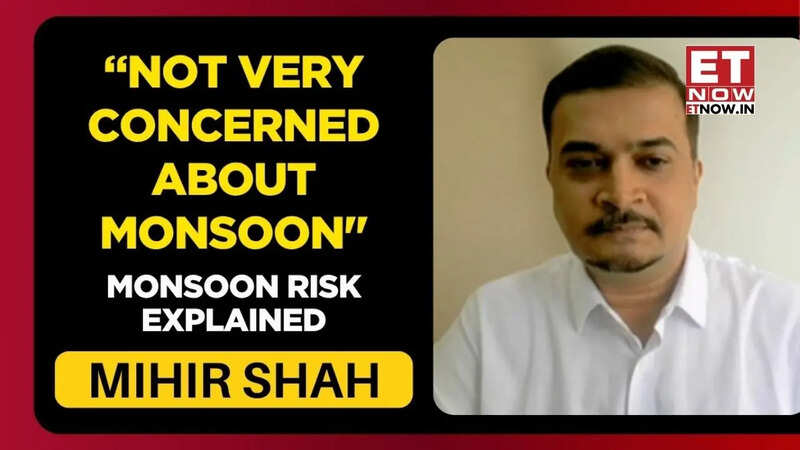
India’s consumer demand outlook remains resilient despite expectations of a below-normal monsoon, with mitigating factors likely to cushion the impact on rural consumption, according to Mihir Shah, Vice President and Research Analyst for India Consumers at Nomura. In an exclusive interview with ET Now, Shah also shared his outlook on ITC, Asian Paints and consumption trends, while highlighting key sectors expected to benefit and those likely to face near-term headwinds.
Monsoon and rural resilience
Despite a predicted below-normal monsoon, the impact is cushioned by reservoir levels, high government buffer stocks and improved irrigation infrastructure, said Shah.
He said, “After seeing two consecutive years of above-normal monsoon, we are likely to see a below-normal monsoon this year. Secondly, it is expected to be an El Niño year, so there will be some impact from that as well. How concerned are we? Not overly. While there will be some challenges, we are not very concerned. This is largely because the El Niño, which is expected to result in weaker-than-normal monsoon conditions, is likely to remain in the weak-to-moderate range through June, July and August, and is expected to strengthen only in September, toward the end of the monsoon season.”
“At the same time, when you look at the Indian Ocean Dipole (IOD), it is currently in the neutral zone. If the IOD turns positive over the coming month or so, it could offset the impact of El Niño. So, while an El Niño is expected, there are certain mitigating factors that we will be watching, which could support rainfall despite expectations of a below-normal monsoon. This would also be the first below-normal monsoon after two consecutive years of above-normal rainfall. Reservoir levels are currently about 15 per cent above the 10-year average. In addition, the government’s buffer stocks are around twice the normal level. There are also district-level mitigation measures being implemented by the government, which should support the rural economy.”
“So, while we may see weaker-than-expected kharif output, there are several mitigating factors in place, and we are not as concerned as one might otherwise expect,” he said.
“Rural demand has seen some moderation since the fourth quarter, while urban demand, on the other hand, has shown an initial pickup. As a result, the gap between rural and urban demand has been narrowing. Although rural demand continues to outpace urban demand, we expect this gap to keep narrowing. At the same time, if you look at many staple categories, several companies have implemented low- to mid-single-digit price hikes. Combined with the likelihood of weaker kharif output and a gradual rise in inflation, this could put some pressure on rural demand,” said Shah, adding, “that said, while the improving trajectory in rural demand may pause, we expect it to remain largely range-bound rather than deteriorate significantly.”
“More importantly, margins are also likely to come under pressure because the tax increase is higher than the price hikes the company has been able to implement. As a result, we expect earnings before interest and tax (EBIT) from the cigarette business to decline by around 20 per cent,” he said, adding, “while this is a sharp decline and is already reflected in the stock price, we believe the worst could largely be over after the first quarter. The high single-digit volume decline and around 20 per cent decline in EBIT are expected to moderate from the first quarter onwards.”
“However, on a two-year CAGR basis, we continue to expect flat earnings growth for ITC, and therefore maintain a reduced rating on the stock,” Shah added.
“More importantly, Asian Paints is benefiting from a favourable base. Last year, above-normal monsoons affected the number of painting days. This year, with El Niño conditions expected, there could be more painting days available for the industry. In addition, last year saw some disruption due to elections, including labour availability issues, which are unlikely to recur this year. The company has also announced a sharp price increase of around 13-14 per cent this quarter. However, because of the timing of these hikes, we expect the effective price increase to be closer to 7 per cent during the quarter, with the full 13-14 per cent pricing benefit likely to flow through in the next quarter.”
“On margins, commodity costs remained relatively soft in January and February, and companies typically carry two to three months of inventory. As a result, we do not expect significant margin pressure in the first quarter — only a modest impact. While most of the cost inflation is likely to be reflected in the second quarter, companies have already implemented sharp price increases to mitigate those pressures. Therefore, the margin impact in the second quarter should also remain relatively limited,” Shah said, adding, “overall, we expect strong growth to continue with limited margin pressure. Combined with easing competitive intensity and the potential for a valuation re-rating, we believe Asian Paints can continue to perform well and remains one of our top stock picks.”
Talking about the beverages sector, Shah said, “as far as categories are concerned, each company has exposure to multiple segments, so there are both positives and negatives within individual businesses. While one may prefer companies with greater exposure to summer-centric categories, we believe it is better to adopt a bottom-up stock selection approach rather than focus solely on categories.”
“Categories such as soft drinks, carbonated beverages, ice creams and cooling hair oils are expected to perform better. At the same time, there could be headwinds for tea and certain quick-service restaurant (QSR) businesses. Overall, there are both positive and negative factors at play, which are likely to offset each other to some extent,” he added.
(Disclaimer: The above article is meant for informational purposes only and should not be considered as any investment advice. ET NOW DIGITAL suggests its readers/audience to consult their financial advisors before making any money-related decisions.)