
If you have been tracking the financial news closely, you probably would have noticed one name showing up everywhere: GIFT City.
HDFC is launching funds there. So are DSP, PPFAS, Aditya Birla Sun Life, Tata, Edelweiss and JioBlackRock. By IFSCA’s count, more than 200 fund managers and 349 funds have registered in a business district in Gujarat that most of us associate with a tall tower and a tax-break headline.
Why now? And why there?
Meanwhile, many international funds you could buy last year have quietly stopped taking your money. And NRIs who once needed weeks of paperwork to invest in India can now potentially do it in days.
The thread connecting all of this has a name.
First, what is GIFT City?
GIFT stands for Gujarat International Finance Tec-City. It sits between Ahmedabad and Gandhinagar.
Its International Financial Services Centre (IFSC) operates within a Special Economic Zone and has its own regulator, the International Financial Services Centres Authority (IFSCA).
Think of it as India’s answer to Dubai’s DIFC or Singapore: a place where international financial activity can operate under a distinct regulatory and foreign exchange framework, even though you could drive there from Ahmedabad.
Why build it? For decades, big foreign money heading into India, and Indian money heading abroad, was routed through Mauritius, Singapore, Luxembourg or Dubai.
GIFT City’s pitch is simple: keep that business, and those jobs, inside India.
Why is every fund house suddenly there?
Two separate forces are pushing in two different directions.
The overseas-investing traffic jam
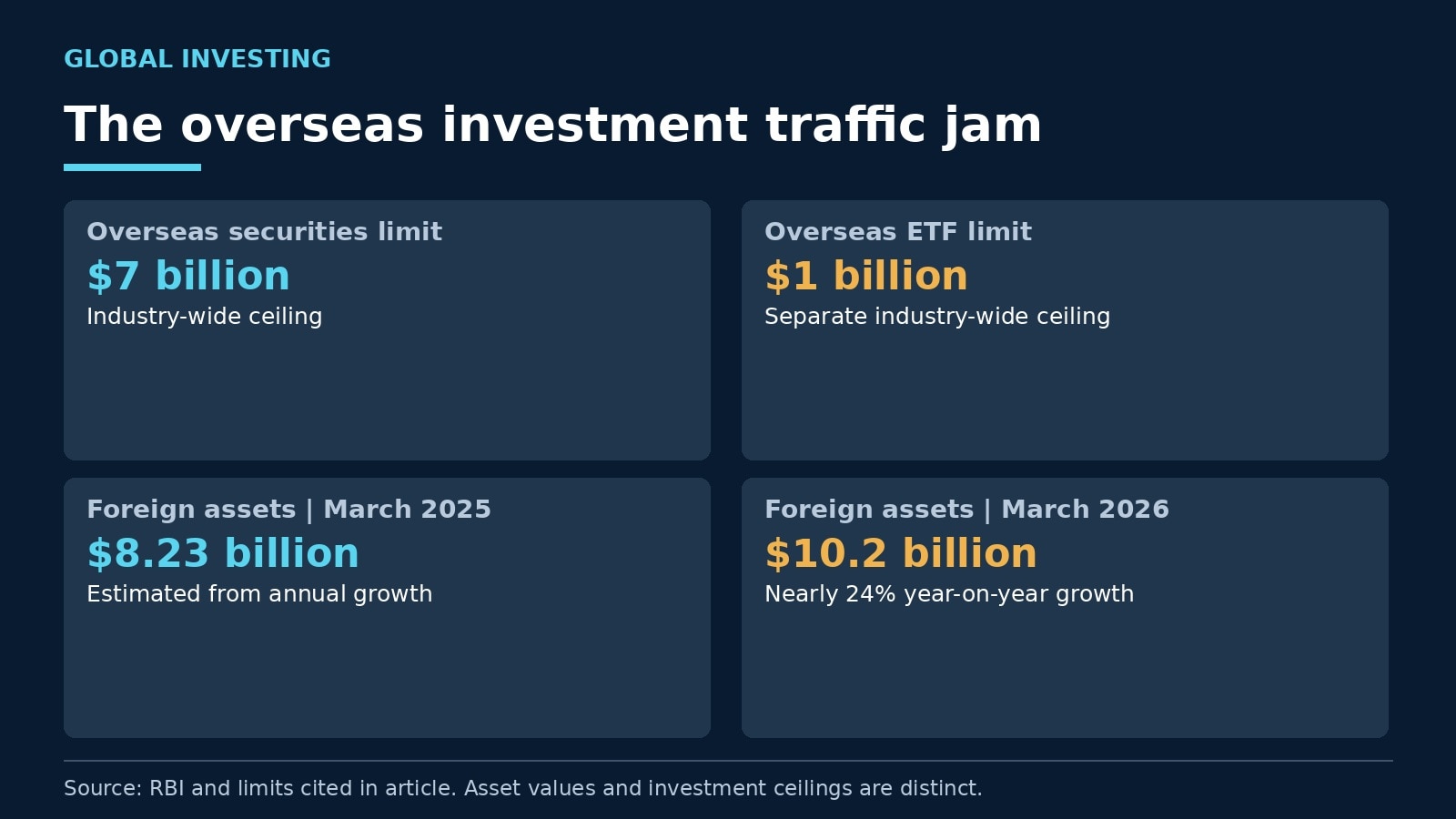
Indian mutual funds are allowed to invest abroad up to a combined industry-wide limit of $7 billion, plus a separate $1 billion for overseas ETFs. An individual fund house faces a $1 billion limit for overseas securities investments.
These industry limits have been in place for years, and the industry has faced constraints as it approached them.
The result was a pile-up. In April and May 2026, houses like Axis, Nippon India and Franklin Templeton stopped taking fresh money into certain international funds. At one point, fewer than 30 international funds were still open to new investors.
But demand didn’t disappear. Indian mutual funds’ foreign assets rose nearly 24% to $10.2 billion by the end of March 2026, driven largely by higher investments in foreign equity securities, according to the Reserve Bank of India’s annual Survey of Foreign Liabilities and Assets of Mutual Funds.
GIFT City funds are regulated by IFSCA, not SEBI, so they are not subject to the domestic mutual fund industry’s $7 billion overseas investment cap. For an AMC, that is an escape valve.
Making India easy for NRIs and foreigners
For a non-resident, investing in Indian equities the traditional way can mean navigating PAN requirements, OCI documentation, NRE/NRO accounts, PIS accounts, demat, trading and PMS accounts, plus Indian tax filing, depending on the investment route.
Phillip Capital, which runs a GIFT City fund, says onboarding an NRI the regular way takes 30 to 45 days, versus two to three days through its GIFT City fund.

So AMCs that already have NRI customers are building dollar-denominated India funds for them.
The numbers behind the surge
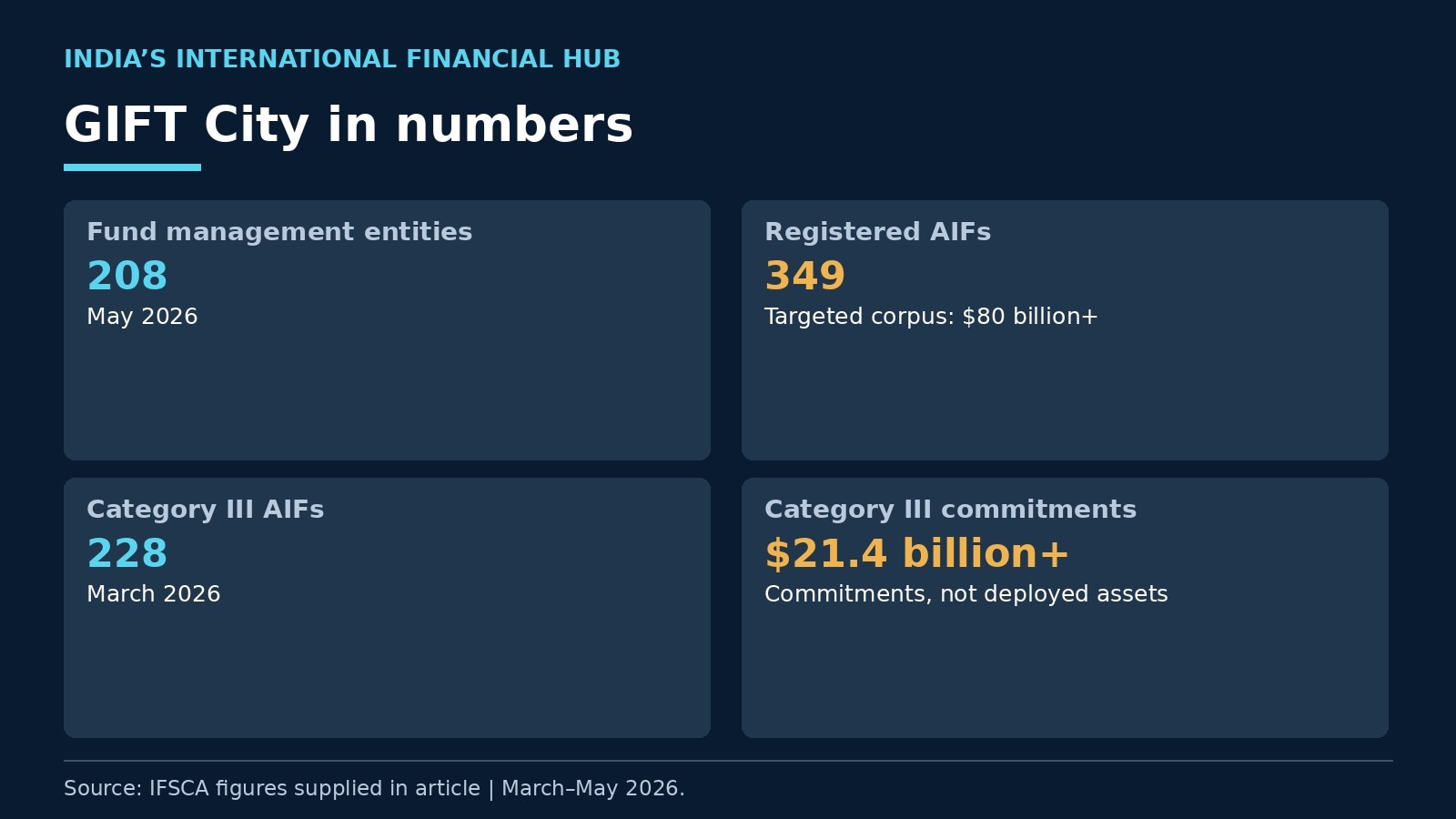
Recent AMC entrants include HDFC, ICICI Prudential, Aditya Birla Sun Life, Tata, Mirae, Edelweiss, Sundaram, JioBlackRock, PPFAS, DSP and Franklin Templeton.
The two-way street: Outbound vs inbound
“GIFT City fund” can mean two opposite things.

| Parameter | Outbound Fund | Inbound Fund |
|---|---|---|
| Money flows | India → World | World → India |
| Who it’s for | Resident Indians and Indian companies via specific routes | NRIs, OCIs, and foreign investors |
| What it buys | US, global, emerging-market, and China stocks or funds | Indian equities via mutual funds, ETFs, or stocks |
| Typical currency | USD | USD |
| Typical examples | PPFAS S&P 500 / Nasdaq 100, DSP Global Equity, HDFC International | Tata India Dynamic Equity, ABSL India Growth Fund |
Where do you fit? If you live in India and want global exposure, you are looking at outbound. If you live abroad and want Indian exposure, you are looking at inbound.
Outbound funds turn rupees into dollars for global markets. Inbound funds channel foreign currency into Indian investments. Both sit under IFSCA rules.
How is a GIFT City fund different from a regular mutual fund?
This is what most people get wrong. A GIFT City fund looks familiar, with a brand you know and a NAV, but the plumbing is different.
| Parameter | Regular Indian Mutual Fund | GIFT City Fund |
|---|---|---|
| Regulator | SEBI | IFSCA |
| Currency you invest in | Rupees | Typically US dollars |
| How money moves | UPI / net banking, in rupees | Rupee-to-dollar remittance under RBI’s LRS for residents |
| $7 billion overseas cap applies? | Yes, for relevant overseas investments | No |
| Typical minimum | ₹100–₹5,000 | $500–$5,000 for many retail funds |
| SIP available? | Almost always | Generally limited; each investment usually needs a fresh remittance |
| Time to get units | Same day to a day or two | About 2–5 days after payment |
| Redemption proceeds | Rupees, typically 1–3 days | Dollars, typically 5–6 working days and no later than 10, according to HDFC’s stated timeline |
| Tax treatment | Taxed in investors’ hands under applicable capital gains rules | Varies by structure |
| Fund size | Often thousands of crores | Many are still small |
What do you need to invest?
GIFT City has tiers, and the tier decides your minimum. Most ordinary retail investors will be looking at retail schemes rather than PMS or restricted schemes.
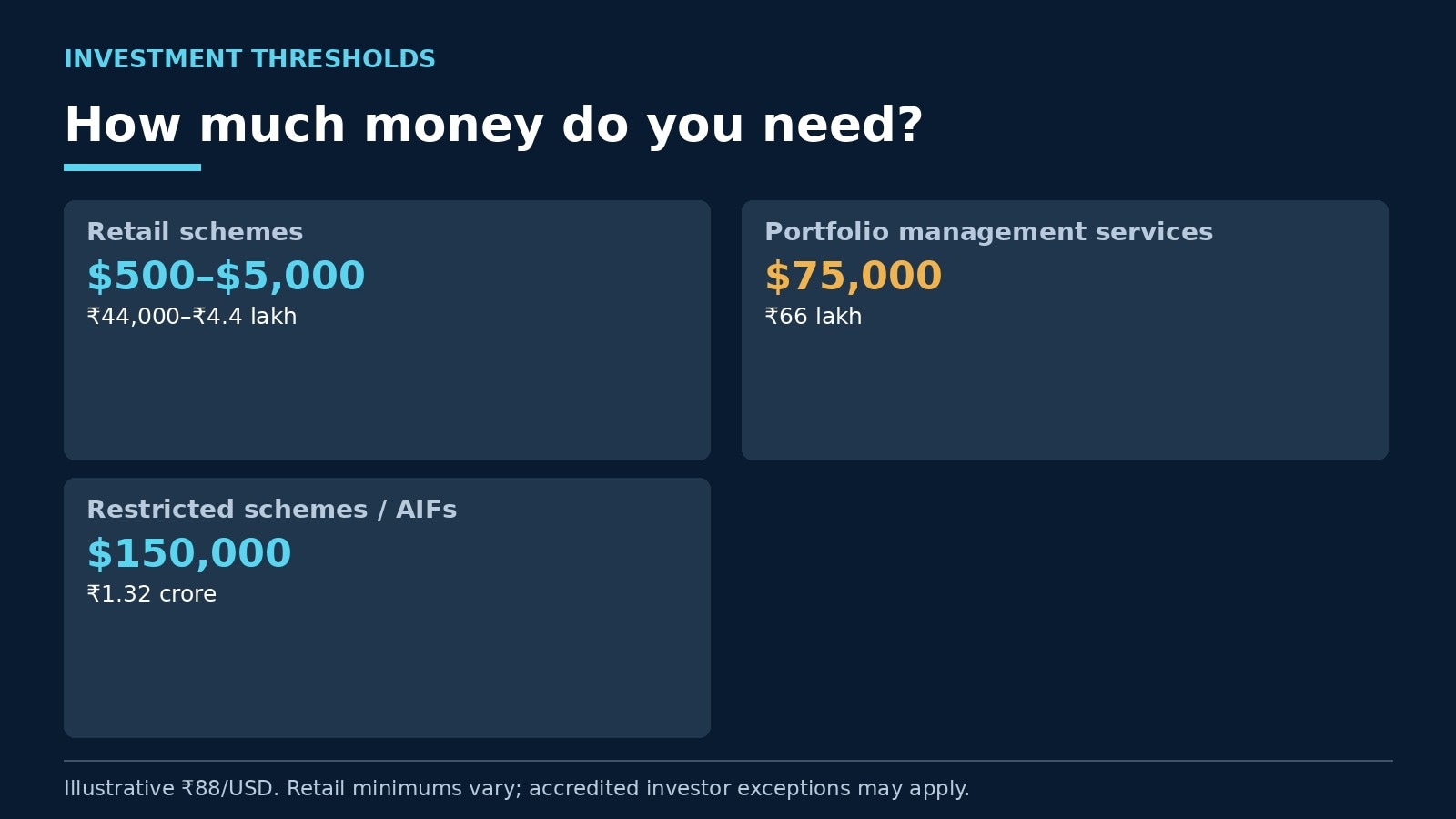
Retail scheme minimums are set by individual funds. PMS is aimed at wealthier investors who want their own managed portfolios, while restricted schemes, including Category I, II and III AIFs, are generally aimed at HNIs, family offices and institutions.
Accredited investors may qualify for exemptions from the minimum investment requirement for restricted schemes.
What can you actually buy today?
Data as of mid-to-late November 2026. Launches in the sector are moving fast.
Outbound funds (for resident Indians)
| Fund | What it does | Minimum |
|---|---|---|
| Parag Parikh IFSC S&P 500 and Nasdaq 100 (two funds) | Passive; tracks the S&P 500 or Nasdaq 100 | $500 |
| ABSL Emerging Market Equity Fund (Outbound) | Feeder into an emerging-market strategy | $500 initial; $100 top-ups |
| HDFC International Developed Markets / Emerging Markets Equity (two funds) | Passive; large and midcaps across 23 developed or 24 emerging countries | $5,000 |
| DSP Global Equity | Active; 30–50 large global companies | $5,000 |
| Edelweiss Greater China Equity | Feeder; China, Hong Kong and Taiwan | $5,000 |
| Marcellus Global Equities | Active; themes such as defence, power, AI spending and luxury | $5,000 |
| JioBlackRock Advantage World Equity | Feeder; in launch offer | $5,000 |
In the pipeline: Edelweiss US Technology Equity and Franklin US Equity IFSC Fund.
Inbound funds (for NRIs and foreign investors)
| Fund | What it does | Notes |
|---|---|---|
| Tata India Dynamic Equity Fund (GIFT IFSC) | Feeder into Indian equity MFs and ETFs; 50–100% in broad-based funds | Retail-oriented; $500 start |
| ABSL India Growth Fund (Inbound) | Fund of funds into the ABSL equity range | Retail; $500 start |
| The Wealth Company IFSC FoF | Category III AIF; USD route into 50+ AMCs and 1,600+ Indian MF schemes | Launched August 2026 for eligible non-residents |
| Edelweiss India Multimanager Equity Fund, Series I | Category III AIF; 60% flexicap, 40% midcap funds | Check minimum |
| Mirae Asset India Equity Allocation Fund | Restricted scheme | Non-retail; high minimum |
| Sundaram USD India Midcap Fund | USD route into Indian midcap equities | Check scheme details |
| Phillip India Billion Opportunities Fund | Exposure to Indian equities | Check scheme details |
Investors should check the latest offer documents for availability, eligibility, investment minimums and applicable charges.
How to invest, step by step (resident Indian, outbound fund)
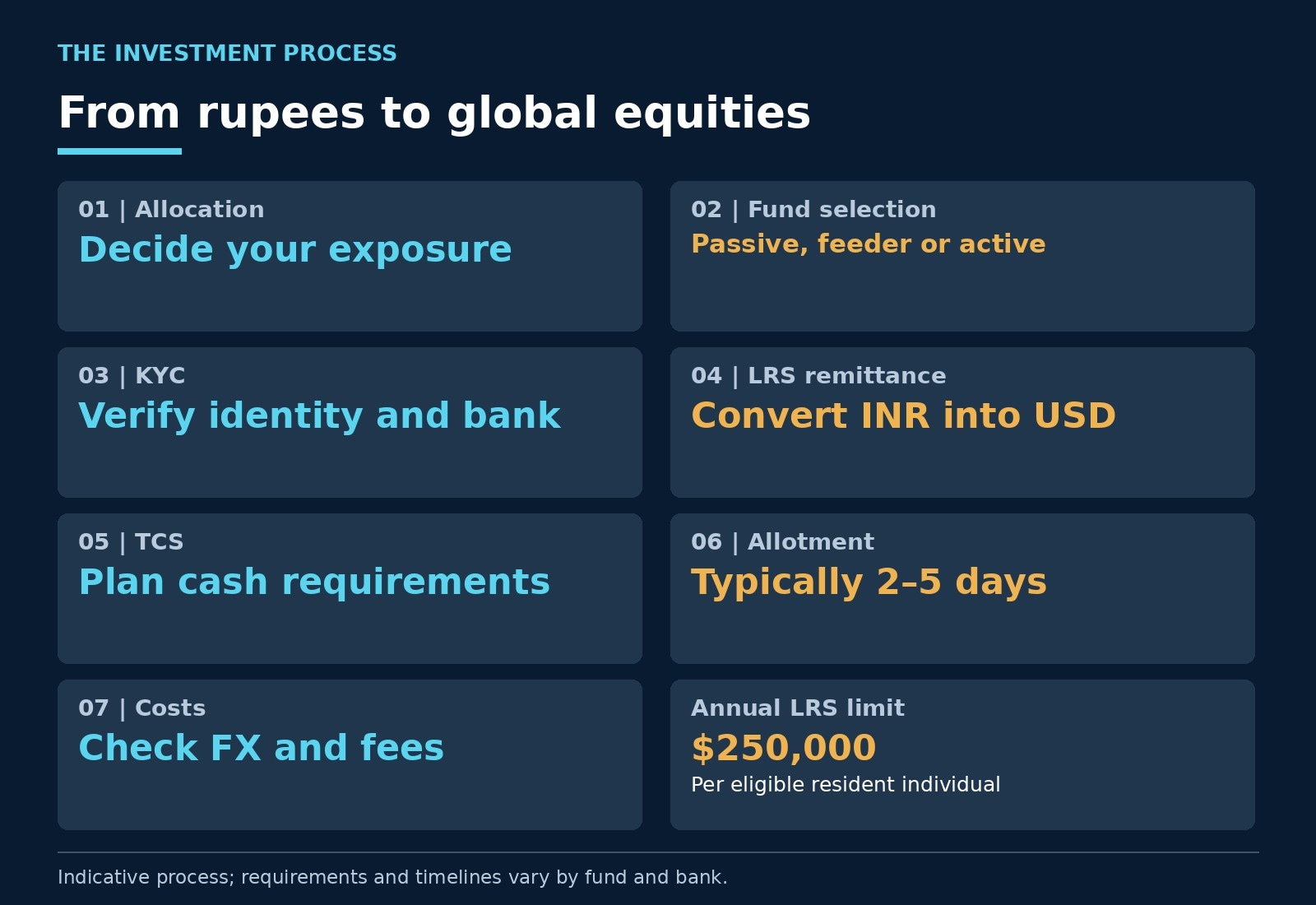
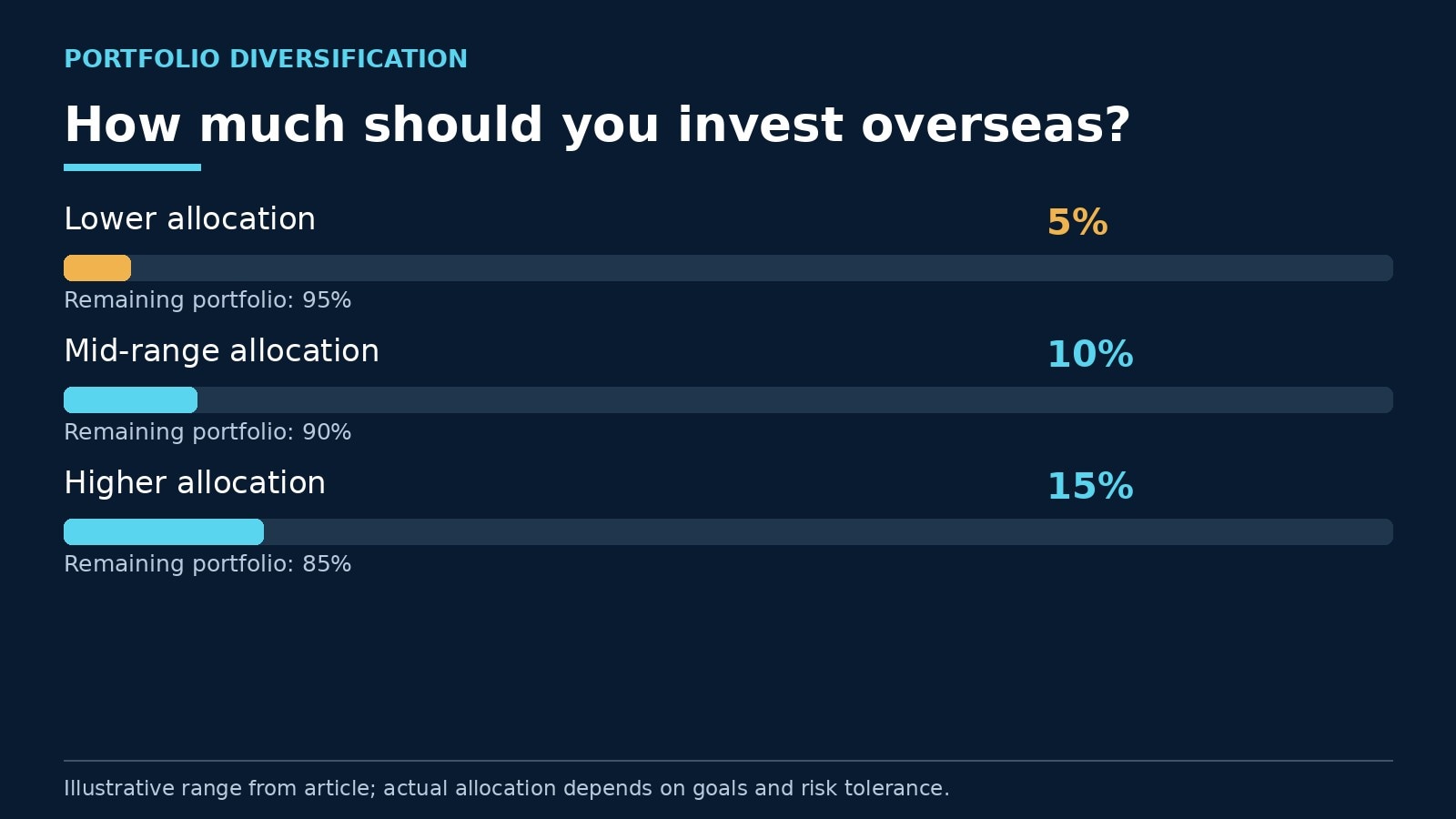
1. Decide how much, before picking a fund. Wealth managers we speak to suggest capping overseas exposure at 10–15% of the portfolio. Do not move everything offshore simply because global markets have run up.
2. Pick the type of fund. There are three broad options:
Passive fund of funds: Tracks an overseas index or ETF, generally the cheapest and simplest option.
- Feeder: Funnels money into one specific overseas fund.
- Active: A manager picks global stocks directly.
3. Open a folio (account) with the fund house. Online onboarding can take about 10 minutes: PAN, Aadhaar-based verification, bank details and e-sign. There is no common KYC across GIFT City fund houses yet, so you may need to repeat the process for each one.
4. Send the money via LRS. You remit rupees, the bank converts them to dollars and sends them to the fund. Online, you can pay through the fund house’s website via net banking and an authorised payment partner, where available. Offline, you submit Form A2 at your bank.
The Liberalised Remittance Scheme (LRS) limit is $250,000 per financial year for eligible resident individuals.
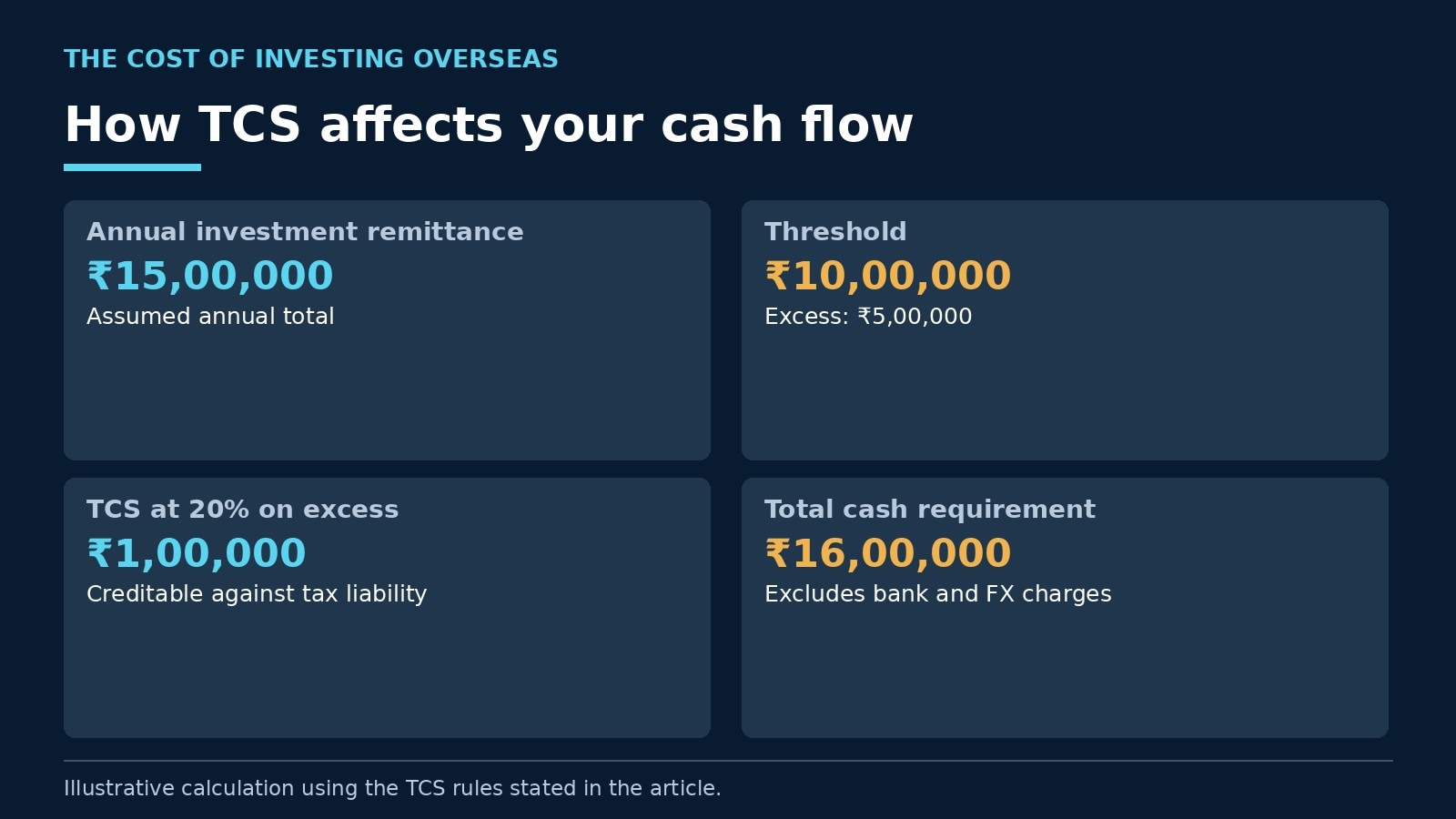
5. Watch the TCS. Total LRS remittances above ₹10 lakh in a financial year attract 20% tax collected at source (TCS) on the excess for investment purposes.
Budget 2026 cut TCS to 2% for education and medical remittances, but not for investments.
TCS is not an extra tax: you can claim it as credit against your income tax liability. It does tie up your cash in the meantime, so plan around it.
6. Wait two to five days. Fund houses generally allot units a day after the money arrives. End to end, expect about two to five days.
7. Mind the hidden costs. Banks add a markup on the rupee-dollar exchange rate, plus remittance charges. Compare before you send.
No taxes? Not really!
The biggest myth, which a Phillip Capital executive blames on WhatsApp forwards, is that GIFT City is tax-free.
It isn’t.
Taxability depends on who you are and how the fund is structured.
If you are a resident Indian (outbound funds)
Many retail outbound funds are structured so that the fund pays tax and the NAV reflects it. Such funds may publish short-term and long-term post-tax NAVs, and you are redeemed at the one that matches the applicable holding period.
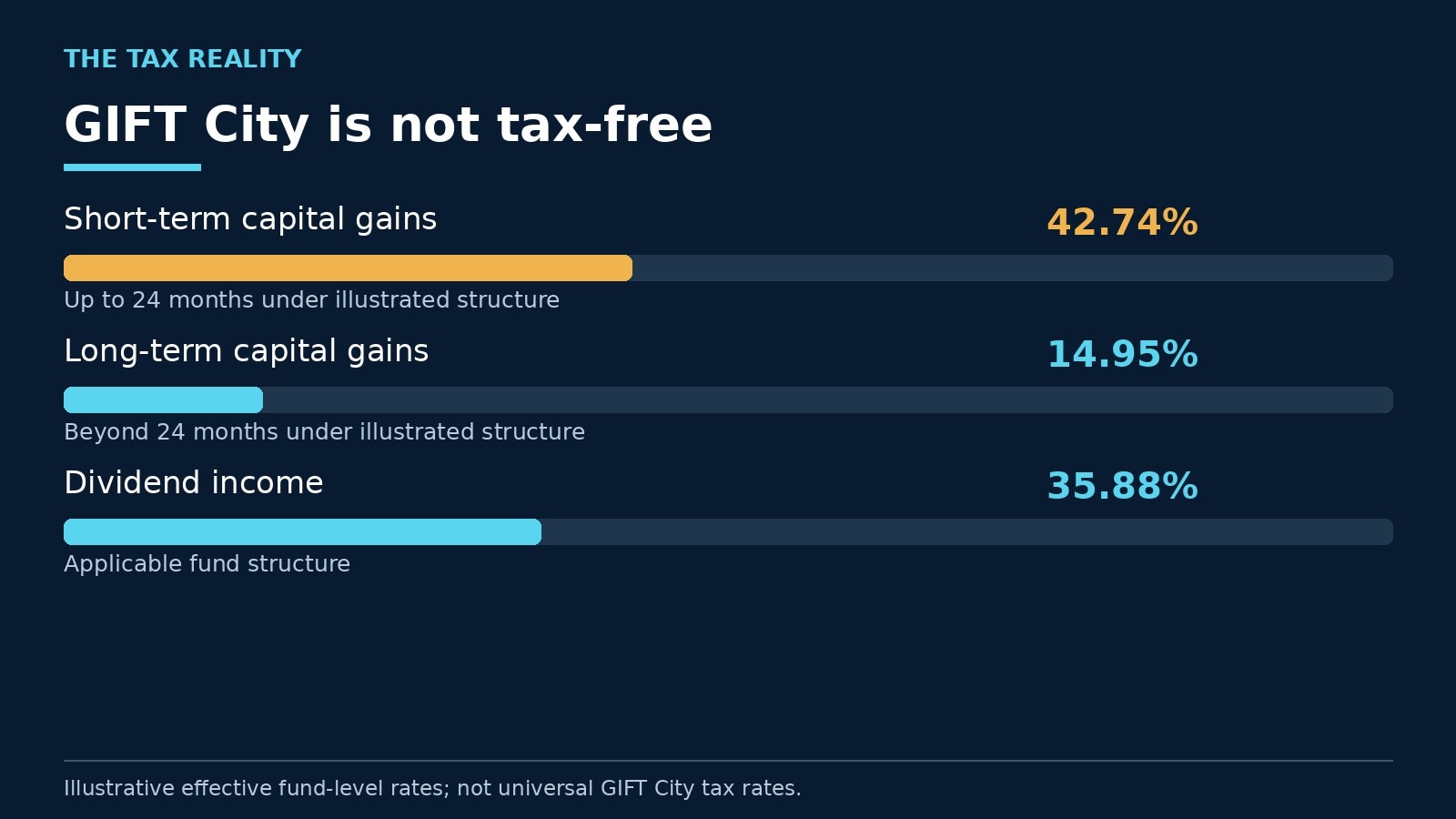
Under the structure illustrated here, tax at the fund level is roughly 42.74% for short-term gains and 14.95% for long-term gains. Dividend income is taxed at an illustrative effective rate of 35.88%.
Where the applicable exemption conditions are met, gains on redemption are not taxed again in your hands, but you may need to show the income as exempt income in your tax return.
So the holding period matters a lot. Under the illustrated structure, holdings of up to 24 months are treated as short-term and those beyond 24 months as long-term.
Understanding subscription NAV versus redemption NAV
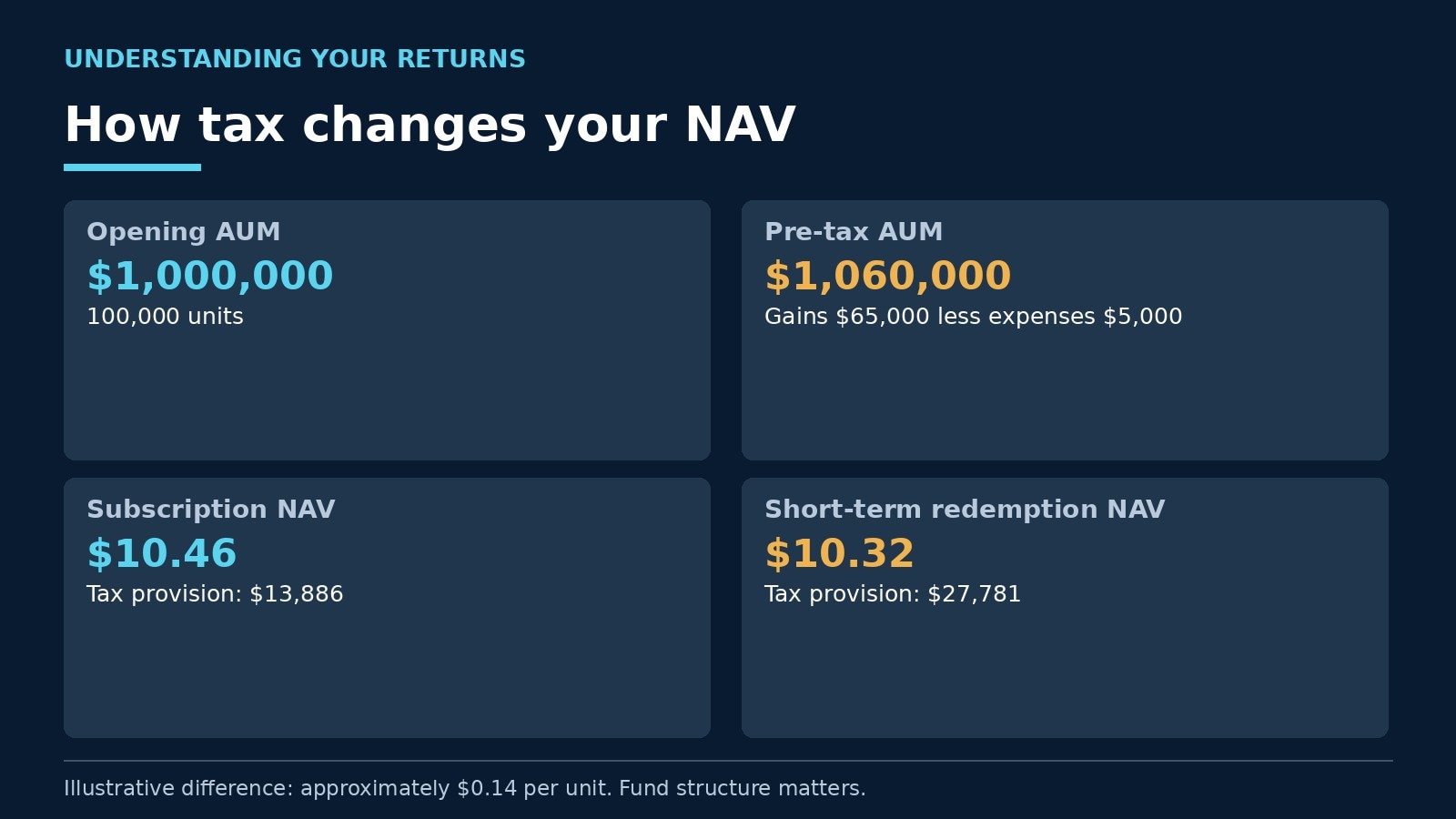
Assume an opening AUM of $1,000,000 (100,000 units, so $10 per unit), with $15,000 of realised short-term gains, $50,000 of unrealised gains and $5,000 of accrued expenses during the period.
Net income before tax brings AUM to $1,060,000, or $10.60 per unit.
| Particulars | Subscription NAV | Short-term Redemption NAV |
|---|---|---|
| Opening AUM | $1,000,000 | $1,000,000 |
| Realised short-term gains | $15,000 | $15,000 |
| Unrealised gains | $50,000 | $50,000 |
| Accrued expenses | ($5,000) | ($5,000) |
| Pre-tax AUM | $1,060,000 | $1,060,000 |
| Tax on realised gains (42.74%) | $6,411 | $6,411 |
| Tax on unrealised gains | $7,475 (14.95%) | $21,370 (42.74%) |
| Post-tax AUM | $1,046,114 | $1,032,219 |
| Number of units | 100,000 | 100,000 |
| NAV per unit | $10.46 | $10.32 |
Subscription NAV (Book NAV): Deducts tax on the realised short-term gains at 42.74% ($6,411) and tax on the unrealised gains assumed to be long-term at 14.95% ($7,475), arriving at $1,046,114, or $10.46 per unit. New investors buy in at this NAV.
Redemption NAV: Deducts tax on the same realised short-term gains at 42.74% ($6,411), but provides for tax on the unrealised gains at the full 42.74% short-term rate ($21,370), rather than the long-term assumption used in the Book NAV.
This brings the Redemption NAV to $1,032,219, or $10.32 per unit.
The gap between $10.46 and $10.32 per unit in this illustration is the incremental tax provision on unrealised gains — the difference between 42.74% and 14.95% — factored into the short-term redemption NAV.
Structures differ across funds, so read each fund’s offer document. Ask a chartered accountant how to report the investment, including any applicable foreign-asset disclosure requirements.
If you are an NRI or foreign investor (inbound funds)
The pitch is cleaner. A Category III AIF in GIFT City can qualify as a “specified fund”, and for eligible non-residents, the fund materials describe possible Indian tax exemptions on distributions and gains from units, subject to conditions.
Some funds also say you may not need a PAN or an Indian tax return if certain conditions are met.
But there are caveats.
You may still owe tax in your country of residence. If you live in the UAE, where personal investment capital gains are generally not taxed, the Indian-level tax may essentially be all you bear. In countries with higher tax rates, additional tax may be payable, and double taxation treaties or foreign tax credits may help.
US and Canada-based investors face extra regulatory and tax considerations when investing in Indian investment products. Get specialist advice.
The tax position of some GIFT City Category III AIFs is also being challenged. In October 2026, some AIFs received tax notices over surcharges on dividend and interest income, despite claimed exemptions.
Experts expect relief through the appeals process, but it shows that interpretations of the rules are still evolving.
One real saving
Eligible management fees and charges levied within GIFT City’s IFSC can benefit from GST exemptions, subject to applicable conditions.
Risks and key details to be aware of
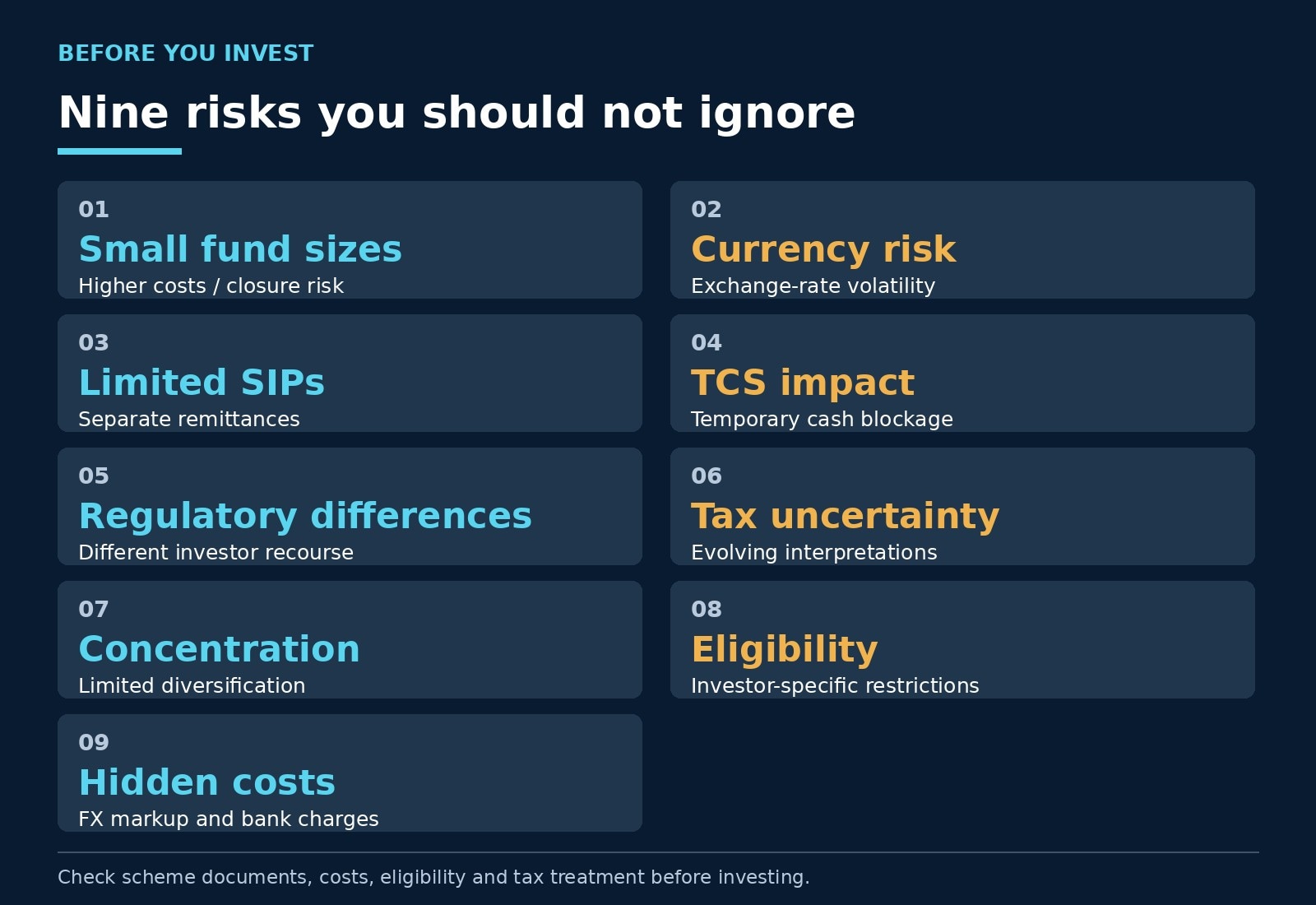
Small funds: Many of these funds are tiny. Small AUM can mean higher costs per unit and more closure risk. Check size and expense ratio before investing.
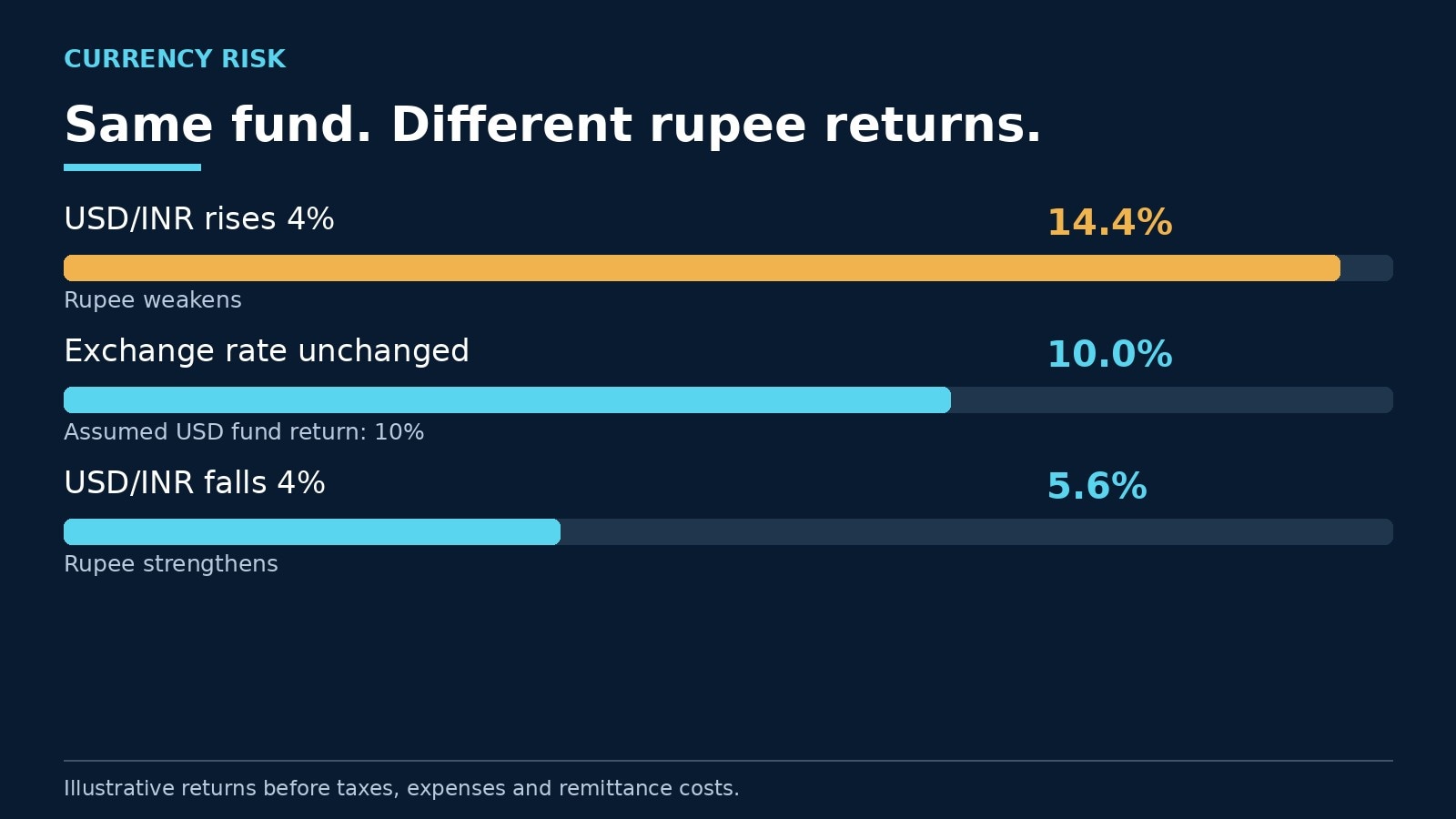
Currency cuts both ways: Holding dollars is a hedge against rupee weakness. The rupee has historically depreciated against the dollar, with estimates of around 3–4% annually over certain long-term periods. But it is not guaranteed, and if the rupee strengthens, your rupee returns shrink.
No SIP convenience: Most funds need a separate remittance each time, so rupee-cost averaging is clunky.
TCS and cash flow: The 20% TCS on eligible investment remittances above ₹10 lakh is refundable or creditable, as applicable, but it can sit with the tax department for months.
Different regulator: IFSCA is an Indian regulator, but it is not SEBI, and the investor-protection framework and recourse are not identical to those for domestic mutual funds. Read the documents.
Tax interpretation risk: The AIF notices mentioned earlier illustrate this.
Concentration: A US-only fund is not necessarily “global diversification”. Know what the fund holds.
Eligibility: Not every GIFT City fund is open to every investor. Some are NRI-only, while others are designed for resident investors.
Operational friction: Bank conversion rates, timing differences and per-fund KYC are real, if minor.
What is in it for retail investors?
If you are a resident Indian with a ₹4–5 lakh-plus surplus and no global exposure: A small allocation (5–15% of your portfolio) through a low-cost passive GIFT City fund could be a practical way to get international diversification now that many domestic international funds are closed.
If $5,000 is too much, start by exploring a $500-minimum fund.
If you are a young investor with small monthly savings: GIFT City is probably not for you yet. The minimums and limited SIP facility may not fit. Wait for lower thresholds, or look at domestic international funds that are still open.
If you are an NRI: The main benefits are onboarding speed (days rather than weeks), a dollar NAV and potentially fewer Indian compliance headaches. Check how your country of residence taxes the fund and whether the fund accepts investors from your country.
If you are a foreign or institutional investor: GIFT City funds are an increasingly mainstream India on-ramp, with Category III AIFs emerging as a dominant vehicle.
If you are an HNI: You have more options — PMS from $75,000 and restricted schemes from $150,000, with possible minimum investment exemptions if you are an accredited investor.
Quick answers!
Is my money safe?
GIFT City funds are regulated by IFSCA and typically use independent custodians and third-party administrators. But regulation is not a guarantee against market losses, and the safety net differs from that of SEBI-regulated mutual funds.
Can I do a SIP?
Generally, the facility is limited. Each purchase usually needs its own LRS remittance.
Does it count towards my LRS limit?
Yes. Investments by resident Indians under LRS count towards the $250,000 annual cap.
Is it really tax-free?
No. For residents, depending on the structure, the fund may pay tax and the NAV reflects it. For NRIs, Indian exemptions may apply, but the rules of your country of residence still matter.
Will the rules change?
Probably. Both IFSCA’s rules and tax treatment have changed several times in the past two years. Re-check before every investment.
The takeaway
Big AMCs are now building their presence in GIFT City, which gives the route credibility.
But the market is young. Funds are small, minimums are still high for many investors, SIP convenience is limited, and the tax rules need care.
Understand the plumbing before you put in money, and start small.
NOTE TO READERS
Disclaimer: This article is for informational purposes only and should not be construed as investment advice. Readers should consult certified experts before making any investment decisions.