
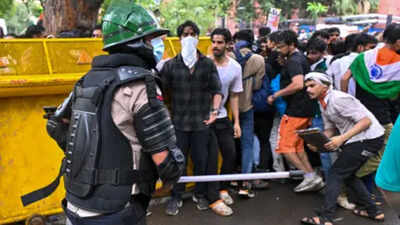
NEW DELHI: Supreme Court Thursday appointed a five-member high-powered enquiry committee (HPEC) led by former SC judge R Subhash Reddy to probe alleged police excesses on students marching to Parliament on July 20 during the CJP-led protest against NEET leak, and counter-allegations of criminal elements sneaking in to indulge in violence and vandalism.Importantly, despite pendency of petitions challenging validity of the sedition provision under Sec 152 of Bharatiya Nyaya Sanhita, SC asked HPEC to examine “establishment of strict constitutional thresholds and safeguards to prevent Section 152 (similar to Section 124A of IPC) from being invoked as an instrument to stifle political dissent and peaceful protest” and “operate as a chilling restraint upon constitutionally protected speech and assembly”.In its July 18 order made public Thursday, a bench of CJI Surya Kant and Justices Joymalya Bagchi and V Mohana gave an open tenure to HPEC, which comprises retired chief justice of Punjab and Haryana HC Ravi S Jha, retired Delhi HC judge Shalinder Kaur, former CBI director Rishi Kumar Shukla, and former Meghalaya DGP L R Bishnoi.
CJP stir police action : Panel to look at chain of command
The bench said the HPEC will inquire into 12 issues but give its first interim report at the earliest on two aspects — the first being “alleged use of excessive force and violence against protesters by police authorities and other agencies, including the deployment of pellet guns, electric batons, lathicharge and tear gas without adequate warning or proportionality, resulting in severe bodily harm and injuries, some of which are alleged to be of a grievous and lasting nature”.SC said the panel would investigate the chain of command in police to identify those responsible for issuing the directions leading to the excessive use of force against the protesters and examine the grant of interim compensation to injured protesters and policemen. Police, in its affidavit, had said 248 of its personnel and 218 protesters were injured on July 20 and had attributed the violence to criminal elements who infiltrated the ranks of student protesters.The second issue to be inquired into by the panel will be “alleged incidents of targeted violence, harassment, molestation and/or any secondary victimisation directed against female protesters, which, given the gravity and sensitivity of the allegations, warrant a focused and expeditious enquiry”.Leaving it open for the HPEC to enlist assistance of forensic, technical and domain experts in its inquiry, the bench said the committee would undertake “a continuous and periodic assessment of the 10 remaining issues and submit interim findings periodically so as to enable SC to take appropriate measures and issue such directions as may be warranted”.The other issues for the panel to inquire into are: guidelines for graded use of force by police while striking a balance between maintenance of public order and right to peaceful dissent; desirability of banning pellet guns, proper protective gear for police personnel engaged in crowd control; necessity of wearing uniforms and nameplates by police during crowd control for individual accountability; and whether use of surveillance tools violated protesters’ rights to privacy and free assembly.SC flagged two more issues for the HPEC: should blanket prohibitory orders (under Section 163 of BNSS/Section 144 of CrPC) be routinely issued or only for countering “real and imminent threat to public order”; and determination of the constitutional thresholds and safeguards to prevent invocation of Section 152 of BNS.
Share your thoughts in the comments
Be respectful · TOI community guidelines
The bench also asked the panel to examine alleged use of force and violence by protesters against police and security personnel, leading to many injuries and the damage caused to public and private property.Though it tasked the HPEC with examining certain broader constitutional questions, the bench clarified that these shall be dealt with by SC after hearing the parties. “These are matters that call for a measure of judicial nuance and circumspection, and merit determination by this court only upon a careful consideration of the submissions,” it said.SC asked police, paramilitary and probe agencies to submit to the panel all CCTV and drone footage, body-worn camera recordings, videography, wireless communication records and PCR call logs and cooperate with the inquiry. Pendency of inquiry by the HPEC will not bar police and security forces from “taking administrative or disciplinary action against such officers as may be found to be in contravention of the rules”.