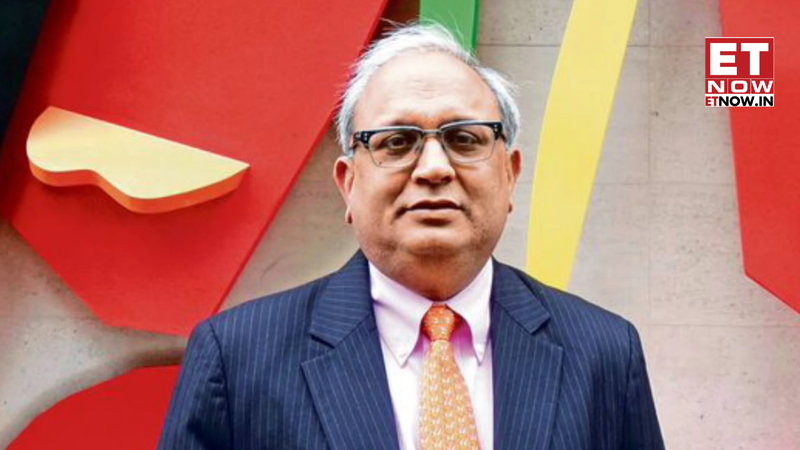
Helios Capital founder and fund manager Samir Arora shared his views on India’s financial sector, IPO market, new-age technology stocks and portfolio strategy in an interaction with ET NOW. Arora said he currently prefers NBFCs over banks, expressed frustration with one of his large banking holdings, and explained why Helios takes a selective approach to IPOs rather than chasing anchor allocations.
He also discussed the opportunities and risks in AI-linked stocks, highlighted recent performances of Paytm, Eternal and Aether, and explained how he manages portfolio rotation without making large-scale changes every quarter.
Arora said Helios currently sees more opportunities in NBFCs than in banks, even though it continues to hold banking stocks.
“So as of now we like NBFCs more than our banks we own the banks and we are very unhappy with our big holding which you know which one it is because we have had too much patience but anyway,” he said.
When asked whether he was referring to HDFC Bank as the holding that had tested his patience, Arora said he was.
“I am running out of patience in the sense that you know it’s a bit too much to every day see that it is falling or not going up and good market bad market it is there,” he said.
Arora said he would prefer to see the stock perform on its own before considering further investment.
“Broadly we are saying at least for me forget about the Indian mutual fund because they have other benchmarks and other issues I will not buy till it does well on its own as a stock first for some time,” he said.
Why Helios is selective about IPOs
Arora also explained why Helios does not participate in most IPOs hitting the market.
He said that while the fund house is selective, it tries to secure anchor allocations in the issues it genuinely likes. According to Arora, Helios may participate in only a small fraction of the IPOs that come to the market.
“If there were I don’t know maybe 50 IPOs last year we would have done as Helios India maybe five six IPOs. So that way we are particular but the ones we like we want to hustle to get a anchor allocation,” he said.
However, he said this selective approach can make it difficult for Helios to receive anchor allocations.
“For us because we refuse to buy 70 80 or 90% of the IPOs and are only interested in 10%, we don’t even get those 10% easily,” Arora said.
He argued that some large funds receive greater access because they participate in a large number of IPOs, but Helios does not want to change its investment strategy simply to maintain relationships with investment banks.
“We are not going to buy an extra IPO just to win favors with the investment bank,” he said.
‘It is not a flaw that is reality’
Asked whether this represents a flaw in the current IPO allocation system, Arora said he sees it more as a reflection of how the market operates.
“It is not a flaw that is reality,” he said.
Arora described the system as “effectively a institutional bribing system”, while clarifying that the benefit goes to funds rather than individuals.
He also argued that investors should look at what happens to stocks after their IPO allocation rather than simply tracking who receives anchor shares.
“If you if you want to do research just write down last 30 IPOs see which funds bought each and every of those or 85% of those and see one month later whether it came in their portfolio mostly those stocks have disappeared after the first buying,” he said.
How to play the AI and new-age tech theme
On artificial intelligence and other new-age technology themes, Arora said Helios has some exposure but remains cautious because valuations are high and the long-term business opportunity is still developing.
He cited companies such as Schneider and Hitachi as examples of the kind of businesses investors could consider, while saying such investments would remain relatively small positions.
“Very few you know you buy all these which we also have by the way because we do like growth all these Schneider we don’t have but I’m saying things like that or Hitachi or Genova or you can buy some black box,” he said.
Arora said the uncertainty around India’s future data-centre requirements and how AI infrastructure will evolve makes it difficult to take very large positions in the theme.
“Growth is very high valuation is also quite high,” he said, adding that it is still unclear how the market will evolve as AI moves from training to inference.
He said Helios’ overall exposure to such stocks could remain around 3-4%, spread across a few companies.
Arora said Helios has been pleased with the recent performance of new-age companies, particularly Paytm, Eternal and Aether.
“We like new age and we are delighted with the performance of PTM and Eternal and Aether all up in the 15 20% range,” he said.
However, he stressed that the fund does not need to make dramatic portfolio changes every quarter.
“You don’t need to buy completely new things every quarter. You just need an ongoing reinforcement and once in a while also change a stock here or there,” Arora said.
His portfolio strategy: Change five stocks, not 25
Arora explained that his approach is to maintain a core portfolio while making smaller changes depending on market conditions.
“So my big picture formula is that if you have 50 stocks and every you are willing to change five stocks you can be ready for every phase of the market,” he said.
According to Arora, investors do not necessarily need to overhaul their entire portfolio whenever market conditions change. Instead, most of the portfolio can remain focused on long-term convictions, while a smaller portion can be adjusted based on the prevailing environment.
“We said out of 50 stocks 40 well let’s say I’m just giving broad say 40, 45 are what we like and five are we like because today the environment is like ABC that is the only difference,” he said.
He added that these five or six stocks can effectively serve as the more tactical portion of the portfolio.
“We are willing to be short-term trading whatever you want to call it it’s only these five six stocks you change and you can be ready for any environment whatever those five six are in that period,” Arora said.