The RBI has asked Tata Sons to comply with the regulatory framework applicable to Upper Layer NBFCs (non-banking financial companies), potentially bringing the holding company back towards a stock-market listing.
Tata Sons had applied to the RBI in March 2024 to surrender its CIC registration. The company had argued that its changed financial position, including significant debt repayment, supported its request for deregistration. However, with the application now rejected, the key question is whether Tata Sons will have to list and, if so, what valuation it could command.
The Tata Sons board is scheduled to meet on September 17, making the meeting an important milestone for investors tracking the development.
Tata Sons: Why is listing back in focus?
The RBI classified Tata Sons as an NBFC-Upper Layer in September 2022. Under the regulatory framework, entities placed in this category are required to list within a specified period.
Tata Sons had originally faced a September 2025 deadline. However, the company remained unlisted while the RBI examined its deregistration application. The latest RBI decision effectively removes the deregistration route and puts compliance with the Upper Layer NBFC framework back at the centre of the issue.
The development is significant because Tata Sons is not merely a holding company. It sits at the centre of one of India’s largest business groups, owns stakes in several listed Tata companies, and has exposure to a number of large unlisted businesses.
Who owns Tata Sons?
Tata Sons has a distinctive shareholder structure, with charitable Tata Trusts holding the majority stake. Tata Trusts hold around 66%, while the Shapoorji Pallonji Group owns 18.37%. Tata Group companies collectively hold around 13%.Among the listed Tata companies that hold shares in Tata Sons are Tata Motors Passenger Vehicles, Tata Steel, Tata Chemicals, Tata Power, Indian Hotels, Tata Consumer Products and Tata Investment Corporation. This cross-holding structure could become an important focus if Tata Sons eventually lists on the exchanges.
Tata Sons’ stakes: How valuable are they relative to the group companies?
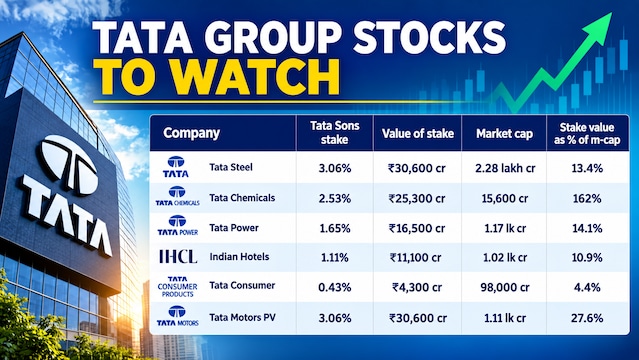
One way to assess the potential value is to compare the value of Tata Sons’ stake in each listed company with that company’s market capitalisation. For illustration, assuming a ₹10 lakh crore valuation for Tata Sons, Tata Sons’ holdings in the listed group companies would be worth:
Tata Chemicals is the clear outlier. At a ₹10 lakh crore Tata Sons valuation, the value of Tata Sons’ 2.53% stake in Tata Chemicals works out to ₹25,300 crore — substantially higher than Tata Chemicals‘ own market capitalisation of around ₹17,631 crore. This does not mean Tata Chemicals itself is undervalued by that amount. Rather, it highlights the substantial value of the Tata Sons cross-holding relative to the company’s market value.
What are investors really buying if Tata Sons lists?
A Tata Sons listing would effectively offer investors exposure to a broad portfolio of Tata businesses. Its listed portfolio includes significant interests in companies such as:
| Company | Tata Sons Stake |
| TCS | 71.74% |
| Tata Power | 45.2% |
| Tata Motors | 40.1% |
| Tata Chemicals | 31.9% |
| Trent | 32.45% |
| Indian Hotels | 35.7% |
| Tata Consumer Products | 28.7% |
| Tata Steel | 31.76% |
| Voltas | 26.64% |
| Titan | 20.84% |
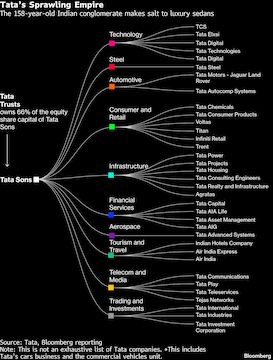
Beyond listed companies, Tata Sons also has exposure to large unlisted businesses, including Air India, Tata Electronics, Tata Digital and Tata Advanced Systems. This gives Tata Sons exposure across technology, automobiles, consumer businesses, financial services, steel, power, hospitality, aviation, electronics and defence.
What happens next?
The immediate focus will now shift to the Tata Sons board meeting on September 17 and the steps the company takes to comply with the RBI’s Upper Layer NBFC framework. For shareholders of Tata group companies, the bigger question is whether the market begins to assign a different value to the cross-holdings and the underlying Tata Sons portfolio.