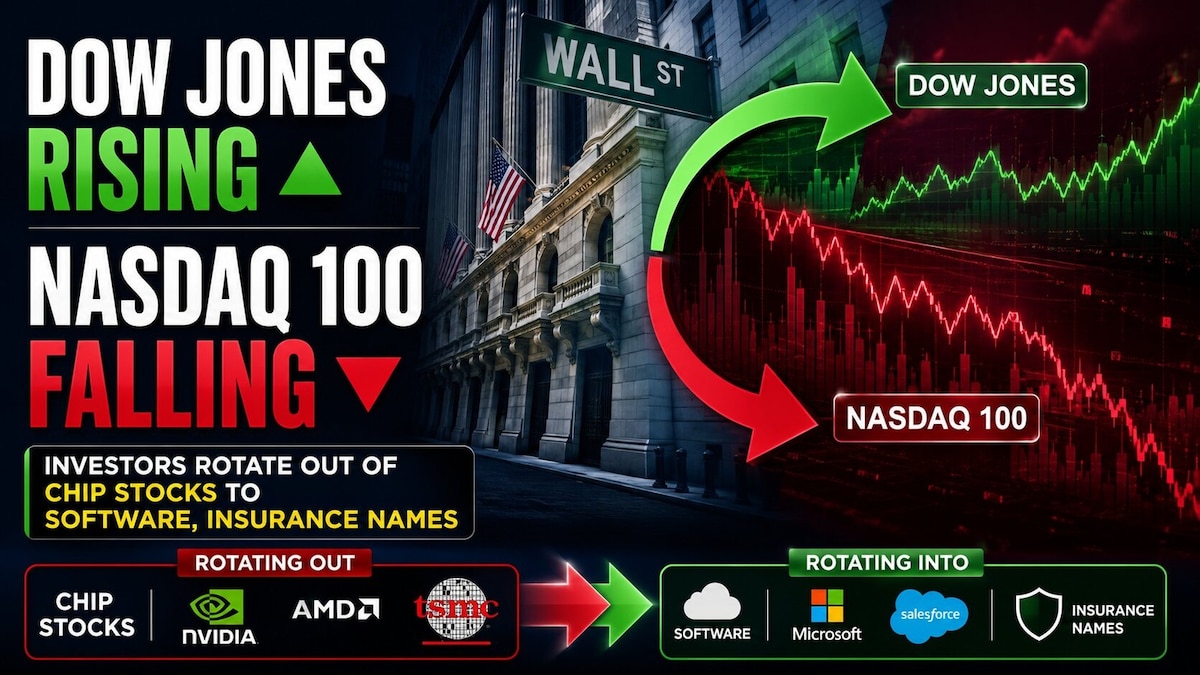
The Dow Jones ended with gains of nearly 550 points, comfortably outperforming its peers S&P 500 and the Nasdaq. While the S&P 500 closed above the flat line, while the Nasdaq Composite fell 0.2%. The Nasdaq 100, which houses most of these semiconductor / chip stocks, fell 1%, not before recovering 300 points from the lows.
Which Stocks Contributed To Dow Jones Gaining 550 Points On Tuesday?
The Dow Jones was led higher predominantly by three stocks on Tuesday, Sherwin-Williams, Coca-Cola, and Boeing, all of whom reacted to their respective quarterly results.
Sherwin-Williams reported better-than-expected results on Tuesday, following which the stock rose over 8%. Coca-Cola not only delivered an earnings beat, but also raised its full-year guidance. Boeing reported better-than-expected cash flow numbers in the second quarter, sending the aircraft manufacturer stock higher by 5%. Together, these three stocks comprise of nearly 8% of the Dow Jones index.
This rotation out of chip stocks was also evident as investors chose to buy the beaten down software stocks, as shares of Accenture and Cognizant gained 7% each, while those of Salesforce and Adobe were also up 4.5% each. The US-listed shares of Indian IT services giant Infosys, were also up 5.5% overnight.
What Dragged The Nasdaq 100 Lower on Tuesday?
Semiconductor stocks continued to sell-off on Tuesday. Nvidia managed a recovery from the day’s low to end just above the flat line, but the same cannot be said for its peers.
Shares of AMD fell another 8% on Tuesday, followed by Micron, whose shares fell 9%. The SK Hynix ADR further extended its losses below its issue price with another 9% fall. Sandisk shares fell 14%, while Western Digital and Seagate fell 7% and 8.5% respectively.
The Philadelphia Semiconductor Index is now down 25% from its peak, extending its losses in “bear market” territory. The index has now trimmed its 2026 gains down to 56%, while at its peak, it had more than doubled for the year.
Concerns over rising competition from China and Nvidia’s AI infrastructure deals have contributed to the recent rout in these chip companies.
The Most Important Triggers Of Wednesday
Two most important triggers will determine Wall Street’s trajectory on Wednesday. First is the interest rate decision by the US Federal Reserve, which will be announced while markets are open.
While a majority still expects the Fed to keep rates unchanged, there is still a 30% probability of a surprise 25 basis points rate hike, according to the CME FedWatch tool. That figure stood at 36% on Monday.
The other major trigger for the day is going to be results from big tech companies that will be announced after market closing hours. Microsoft, Meta, Qualcomm, ARM holdings will all be reporting their results overnight.
These big tech results also assume greater significance as they come a week after Alphabet raised its capex guidance for the year and witnessed the stock see its biggest single-day drop in over a year as well.