
In a September 21 report, Kotak Institutional Equities said the divergence is striking, arguing that the valuation premium commanded by Oil India over ONGC appears difficult to justify.
Why Oil India pulled ahead Of ONGC
Kotak attributed Oil India’s sharp outperformance over the past three months partly to the broader preference for mid-cap stocks over large-caps. The brokerage noted that mid-cap funds continued to attract strong inflows, while large-cap funds saw comparatively low mobilisation during the period.
Data cited by Kotak showed dedicated mid-cap and small-cap mutual funds accounting for 32% and 42%, respectively, of equity-oriented fund flows in the eight months through August and during June-August 2026. The weighted-average net asset value of mid-cap funds also crossed its September 2024 peak in May 2026.
ONGC has lagged Oil India by 15 percentage points
Kotak noted that ONGC has underperformed Oil India by 15 percentage points since the end of February 2026 and by 14 percentage points since the end of June in terms of share price returns.
Oil India’s stock was down just 1% from February 28, while ONGC was down 16% over the same period, according to the brokerage. Over the past three months, Oil India shares have gained 14%, in comparison to ONGC’s 4% decline.
The brokerage said the divergence is notable because both companies operate under a broadly similar fiscal regime, sell crude at similar import-parity-linked gross realisations and gas at administered / NWG-linked prices, and have similarly benefited from the rise in global crude and gas prices during the West Asia conflict.
Oil India has near-term volume advantage
Kotak expects Oil India to deliver stronger crude oil volume growth than ONGC in FY27. Its estimates show Oil India’s total sales volumes rising from 5.7 million tonnes of oil equivalent (mn toe) in FY26 to 6.5 mn toe in FY27, implying a growth of 13.8%.
For ONGC, total sales volumes are estimated to increase from 41 mn toe to 42 mn toe over the same period, a 2.4% increase.
This translates into a better near-term earnings outlook for Oil India, according to Kotak. However, the brokerage said the earnings growth expected for both companies is largely driven by higher oil and gas prices.
Why Kotak sees a stronger long-term case for ONGC
While Oil India has the near-term volume advantage, Kotak said ONGC has a stronger long-term production and earnings outlook, citing its higher reserves-to-production ratios for both oil and gas.
At the end of FY26, ONGC’s oil reserves-to-production ratio stood at 13.6 times, compared with 8.3 times for Oil India. For natural gas, the corresponding ratios were 13.3 times and 11.1 times, respectively.
Kotak also pointed to ONGC’s higher net realisations for both oil and gas, stronger return ratios and better historical cash conversion. Its estimates show ONGC’s standalone return on average capital employed (RoACE) at 11.2% in FY26 versus 6.1% for Oil India, while free cash flow to profit after tax stood at 105% for ONGC compared with 78% for Oil India.
Valuation gap widens
The biggest difference, according to Kotak, is valuation. The brokerage said Oil India’s domestic operations were trading at 7.7 times one-year forward price-to-earnings (P/E), compared with 3.4 times for ONGC’s standalone operations, excluding investments and subsidiaries.
On an enterprise value-to-EBITDA (Earnings Before Interest, Tax and Amortisation) basis, the respective multiples were 6 times and 2.7 times.
Kotak said the premium implies that the market is assigning Oil India more durable earnings and cash flows, while potentially pricing in weaker medium-term earnings and limited terminal value for ONGC’s reserves. The brokerage disagreed with both interpretations.
Street expectations and stock movement
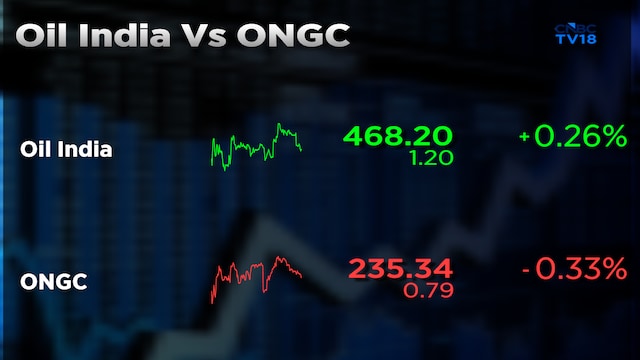
According to Bloomberg consensus data, 16 of the 23 analysts covering Oil India have a “Buy” rating on the stock, six say “Hold” and one has a “Sell” recommendation. The 12-month consensus target price on the stock is ₹546.09, implying about 16% return potential from ₹469.90.
For ONGC, the consensus comprises 22 “Buy”, five “Hold” ratings and four “Sell” ratings. The 12-month consensus target price is ₹293.79, implying nearly 25% return potential from ₹235.70.
Oil India stock has advanced about 10% so far in 2026 and nearly 16% over the last 12 months, while ONGC has declined nearly 1% year-to-date and about 0.4% in the trailing 12-month period.
Read more: Block Deals Galore: Equity worth ₹2,700 crore changes hands in these seven stocks