
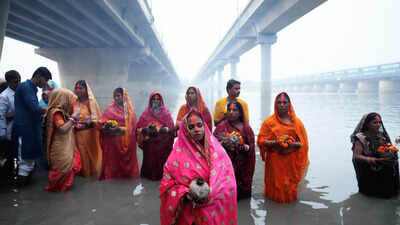
NEW DELHI: Purity, hygiene and cleanliness are paramount for devotees during Chhath Puja. With God as their witness – quite literally in this case – devotees go to great lengths to observe strict hygiene while following elaborate rituals centred around the worship of the Sun deity over four days.In Delhi, however, devotees will step into the sullied waters of the Yamuna, believing that their faith will protect them.As Delhi is already gasping for breath after Diwali, the debate has now pivoted to the pollution of the river which Delhi, for most of the year, views from the bridges built over it.As thousands of people come down to the Yamuna’s banks, the river will undergo its annual public audit by devotees standing waist-deep in its waters.
Significance of Chhath
Chhath Puja, rooted in devotion to the Sun God and Chhathi Maiya, is primarily observed by people from Bihar, eastern UP and Jharkhand.Observed over four days, the festival begins with Nahay-Khay, when devotees prepare simple, traditional food while observing strict personal hygiene and purity.This is followed by Kharna, when jaggery-based kheer and wheat rotis are prepared as prasad.After Kharna, devotees undertake a rigorous 36-hour nirjala fast, abstaining from both food and water. The rituals culminate in offerings of arghya to the setting Sun, followed by prayers to the rising Sun on the final day.
Chhath and politics go hand in hand in Delhi
Every year, as Chhath Puja approaches, the Yamuna becomes more than a river for Delhi.This year, BJP MP Manoj Tiwari took a dip in the Yamuna at Sonia Vihar, praising the cleanup under chief minister Rekha Gupta.“How can we not appreciate the work that has been done here?” he said. “There might be crocodiles in the water here, but crocodiles come in clean water.”AAP MLA Kuldeep Kumar answered by floating an effigy of Tiwari at Kalindi Kunj and challenging him to bathe there, claiming that stretch was far more polluted.On Nahay Khay, the first day of the festival, a video purportedly showing dead fish near Sonia Vihar surfaced on social media.Delhi ministers accused AAP of staging it, alleging that party workers bought fish from the market and dumped them in the river.Delhi AAP chief Saurabh Bharadwaj denied this and demanded an inquiry on Friday, saying water samples had not yet been collected to establish the cause.The river has been a political flashpoint around Chhath before. Last year, AAP alleged that a temporary artificial pool at Vasudev Ghat was built to project a clean Yamuna ahead of Prime Minister Narendra Modi’s planned Chhath visit, which did not take place.
Why Chhath has become a political event
Chhath’s growing political importance has a lot to do with Delhi’s changing demography. According to reports, continued migration from Bihar, Jharkhand and eastern UP has increased the share of the Purvanchali community to about 30 percent of Delhi’s population.The festival offers political parties an opportunity to reach a sizeable constituency through a celebration deeply woven into its cultural identity.According to reports, the Delhi government is setting up 1,482 Chhath ghats across 996 locations. The growing prominence of a festival once largely observed within community networks reflects how it has become an important fixture on the capital’s political calendar.
Why the Yamuna turns frothy around Chhath
The Yamuna’s pollution becomes particularly visible around Chhath Puja, when devotees gather in large numbers along its banks to offer prayers.While talking to the Times of India, environmentalist Saumya Dutta said that the timing of Chhath coincides with a period when the river’s flow has receded considerably after the monsoon, leaving less water to dilute the pollutants entering it.
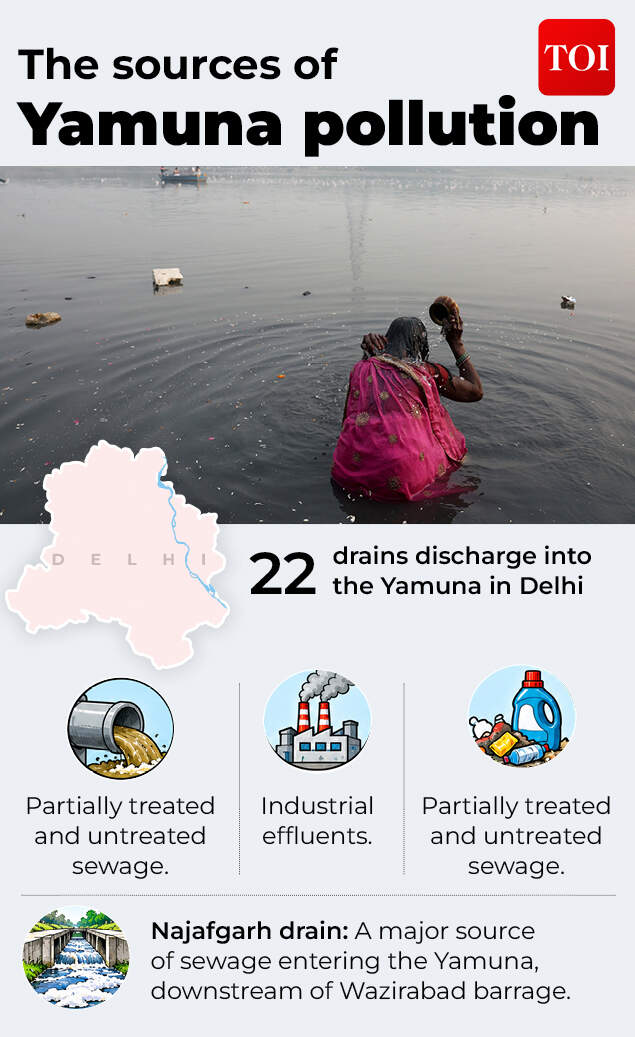
“During the days of Chhath Puja, tens of thousands of Delhi residents from Bihar and eastern UP, along with others, add huge amounts of pollutants, particularly detergents containing surfactants, which are common ingredients in soaps and detergents, as well as some industrial waste,” Dutta said.“Long after the peak monsoon flow, this is the period when the Yamuna’s flow becomes very low. This low water flow, combined with high amounts of surfactants, causes large amounts of foam when the water is agitated. This becomes particularly visible during the huge influx of people and pollutants into this short 2% stretch of the Yamuna,” he said.According to Dutta, the 22-km stretch through the capital accounts for roughly 2% of the Yamuna’s total length but contributes 70-80% of its overall pollution load.
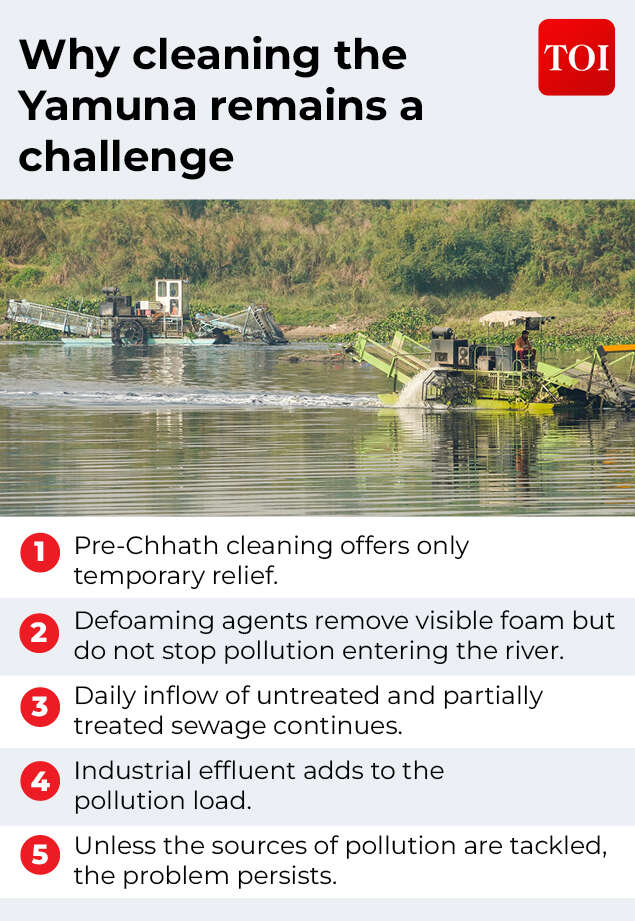
“Defaming agents and pre-Chhath cleaning do help for a very short period, but as the incoming pollution does not go down, this benefit is very short-term and vanishes quickly,” Dutta told TOI.“The major reason for the abject failure of Yamuna cleaning plans, as well as schemes like Namami Gange, is that the huge daily inflow of partially treated or even untreated sewage and industrial effluent into the river is not being tackled,” he added.
The health risks for the devotees
In one of the most polluted major rivers of India, devotees will stand waist-deep, waiting for the Sun to set and rise the following day.But is it safe for a person to come in contact with such polluted river?According to Dr Srijan Garg immersion during Chhath can expose people to harmful bacteria, viruses and parasites through the skin, eyes, nose and ears, and sometimes through accidental ingestion.“Devotees are exposed through the skin, eyes, nose, ear and sometimes by ingestion. However, the major exposure is through the skin and can cause various infections such as folliculitis, dermatitis, fungal infections,” Dr. Garg told TOI.
The water is full of untreated sewage water. so swallowing that water will affect the health of the individual. Some acute infections typhoid, hepatitis A or E, giardiasis, cholera. These usually present with diarrhoea, vomiting and pain abdomen,” he added.Meanwhile, Dr. Ishan Singh said that people with cuts or open wounds are particularly vulnerable to infections.“Industrial discharge may introduce heavy metals such as lead, mercury, arsenic and cadmium into river water. Depending on concentration and duration of exposure, these can affect the kidneys, liver and nervous system. Some chemicals may also irritate the skin and eyes,” Dr. Singh told TOI.
Share your thoughts in the comments
Be respectful · TOI community guidelines
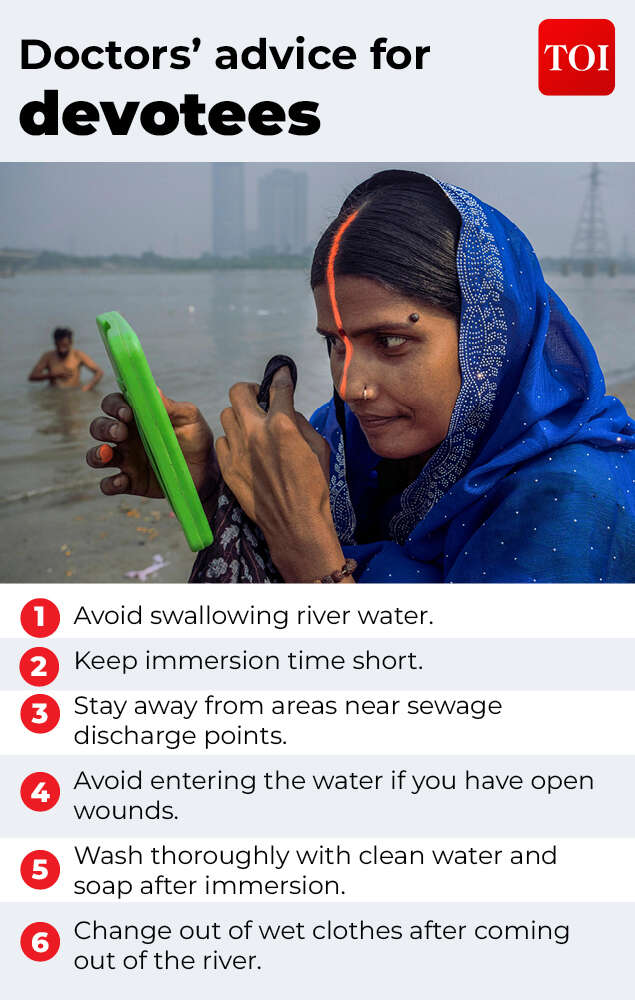
“However, their actual presence and concentration at individual ghats must be confirmed through laboratory testing. A single brief exposure should not automatically be considered a cause of heavy-metal poisoning,” he added.He also said that children, pregnant women, elderly people, diabetic patients and people with weakened immunity need particular attention.Dr. Singh also advised devotees to avoid swallowing river water, keep immersion time short and stay away from areas close to sewage discharge points. Those with open wounds should preferably avoid entering the water. After immersion, devotees should wash thoroughly with clean water and soap and change out of wet clothes.