Another World Cup knockout match, another refereeing controversy.
England survived a major scare to beat Norway 2-1 after extra time in their quarterfinal on Saturday, but much of the post-match discussion centred on Jude Bellingham’s first-half equaliser. Norway believed the goal should never have stood, prompting FIFA to issue a clarification explaining why the officials were correct to allow play to continue.
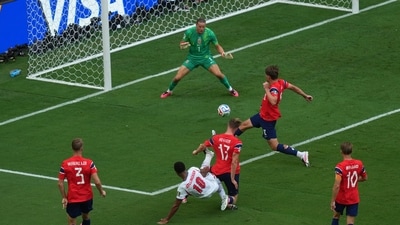
The controversy began just before halftime. As Norway goalkeeper Orjan Nyland launched a goal kick upfield, several Norwegian players believed the ball had struck one of the cables supporting the Skycam suspended above the pitch. England retained possession, and a few passes later, Bellingham fired home the equaliser.
Nyland, head coach Stale Solbakken and several Norway players immediately protested, repeatedly pointing towards the overhead cables while appealing to referee Szymon Marciniak. Solbakken continued his protests on the touchline as England celebrated and again during the halftime interval.
ALSO READ: Jude Bellingham fires ENG to semifinals with 2-1 win
Under the Laws of the Game, if the ball makes contact with an outside object such as an overhead cable, play must be stopped and restarted with a dropped ball. But play continued, and it was only after the halftime whistle that clips of the incident went viral on social media, fuelling fresh debate over officiating at this World Cup.
FIFA later released a statement dismissing the claims, saying there was “no evidence” that the ball had touched the wire.
“Before England’s goal in minute 45+2 against Norway, the sensor in the Connected Ball showed no peak in the ‘heartbeat of the ball’ while it was in the air, and therefore no evidence that the ball touched the overhead wire and changed the movement of the ball,” FIFA said.
For the 2026 World Cup, the official match ball is fitted with a tiny motion sensor that sends data 500 times every second to assist the VAR system. Known as Connected Ball Technology (CBT), it helps officials determine the exact moment a player touches the ball. While primarily designed to improve offside decisions, it can also detect whether the ball has made contact with a player or another object.
The drama did not end there.
Norway thought they had regained the lead in the second half, only for another VAR review to rule out the goal after Erling Haaland was adjudged to have committed a foul in the build-up.
With the contest heading towards penalties, Bellingham produced the decisive moment in the 93rd minute of extra time, capitalising on a costly mistake from Nyland to score his sixth goal of the tournament and send England into the semifinals.
England will now face either Argentina or Switzerland for a place in their first World Cup final since 1966.
The defeat also ended Haaland’s remarkable streak of scoring in 14 consecutive competitive internationals for Norway. Exhausted after another tireless display, the striker was substituted during the second period of extra time.
England’s comeback also underlined their growing resilience. Having failed to win a World Cup knockout match after conceding first since the 1966 final before this tournament, they have now achieved the feat twice in their last three matches.