
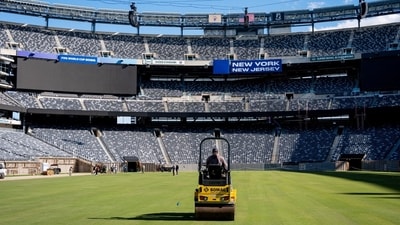
EAST RUTHERFORD, N.J.—A highhanded international organization with a reputation for skulduggery and cozy relationships with autocrats may have finally met its match: the state of New Jersey.
FIFA, soccer’s global governing body, will stage eight World Cup matches—including the final—at the Garden State’s MetLife Stadium. But just as the extravaganza is set to kick off, many New Jerseyans are viewing their hosting duties less as an honor and more as a costly burden they could do without.
The tension came to a boil when NJ Transit announced last month it would charge fans $150 for a round-trip ticket from Manhattan to the Meadowlands, a ride that typically costs around $13.
Such charges would have “a chilling effect,” FIFA’s chief operating officer, Heimo Schirgi, warned—which struck some New Jersey officials as rich, coming from a body that touts the inclusive nature of the games while charging nearly $33,000 for top tickets.
NJ Transit has since reduced the train fare to $98, thanks to contributions from corporate sponsors. Still, New Jersey’s new Democratic governor, Mikie Sherrill, shows no sign of bending further to an organization that expects to generate at least $14 billion from the quadrennial soccer-fest.
“My number one concern is to make sure that this isn’t put on the back of New Jerseyans,” Sherrill said of an estimated $62 million in World Cup-related transit costs at a time when she is trying to pass her first budget. “We still strongly feel like they need to throw in more for some of these expenses.”
Others are less diplomatic. In a recent budget hearing, Declan O’Scanlon, a Republican state senator and fiscal hawk, gave voice to a nativist suspicion about the world’s game. O’Scanlon dismissed predictions of a World Cup bonanza “because soccer sucks,” he said.
The clash between FIFA and New Jersey features the familiar rage of this populist era—namely, a public beaten down by rising costs snarling at global elites. It is fodder for the debate about the economic merits of hosting big sporting events. Underlying all that is the fragile ego of a state whose outward brassiness is often a cover for an inferiority complex stoked by its glittering neighbor.
“We face this identity crisis every time we’re paired up with New York,” said Ashley Koning, the director of Rutgers University’s Eagleton Center for Public Interest Polling.
A recent poll Eagleton conducted with research group SSRS found only 2% of respondents were planning to attend a World Cup match, while 49% claimed no interest in the tournament. Another 15% worried it would disrupt their daily lives.
The mood seemed different years ago when FIFA chose the region to be one of the 16 tournament hosts across the U.S., Canada and Mexico. Elected officials touted it as a shot in the arm for an economy still emerging from the pandemic.It was the culmination of a yearslong charm offensive led by Phil Murphy, then New Jersey’s governor, who developed a passion for soccer during his time as U.S. Ambassador to Germany.
Contrary to Sen. O’Scanlon’s remarks, the state has rich soccer heritage. Kearny, a working class town in Hudson County has been dubbed “Soccer Town U.S.A.” for the many national team members it has produced—a talent pipeline first fed by Scottish immigrants, now often by families from Ecuador and Peru.
But the World Cup came to seem more like a chore by the time Murphy’s successor, Sherrill, took office in January after campaigning with a laser focus on affordability.
New Jersey has already scrapped a $5 million fan festival at Liberty State Park, which had been billed as a central gathering place for tens of thousands during watch parties throughout the tournament.
The biggest issue has been transportation. FIFA declared the Meadowlands’ vast parking lot off limits, setting it aside for security needs, fan events and VIP facilities. That meant relying on NJ Transit, the chronically underfunded public-transportation system, to shuttle huge numbers of fans to and from the matches.
That requires extra staffing, overtime and putting into service a little-used rail spur between Secaucus and the stadium. Adding to commuters’ ire, Manhattan’s Penn Station will be shut down for regular New Jersey-bound rail service for four hours before each match.
New Jerseyans weren’t having it—especially since many are convinced the World Cup windfall will largely flow to New York City, where visiting fans will fill hotels and restaurants, and not their own state.
“There’s not a whole lot of support in New Jersey for subsidizing Norwegians staying in New York,” said David Wildstein, the former Port Authority official known for his role in the Chris Christie-era “Bridgegate” scandal. “They’re not staying at the Secaucus Hilton or eating at Rutt’s Hut.” (Note to hot dog-loving Norwegians: Rutt’s is just off Route 3 in Clifton.)
Publicly, at least, FIFA and its local partners have struck an optimistic tone, betting that the controversy will fade as soon as the players take the field.
“With less than four weeks to go, we are excited to see the final touches being placed by each of our host city partners across Canada, Mexico and the U.S.” Schirgi said.
Alex Lasry, chief executive of its New York New Jersey Host Committee, thanked Sherrill and other local partners “for their efforts to help make the entire World Cup experience more affordable and accessible for everyone.”
In past World Cups, the Swiss-based FIFA has had the luxury of dealing with a single national authority—such as the Kremlin or the royal family of Qatar. Coming to America has forced it to navigate a raft of state and local governments, each with their own peculiarities.
It seems it was either unaware—or unbothered—that renaming MetLife for the World Cup as “New York New Jersey Stadium” might offend sensibilities west of the Hudson River. The change was necessitated because FIFA doesn’t want stadium sponsors overshadowing its own sponsors.
“I have not seen a map,” Wildstein said, “that shows East Rutherford in New York.”