
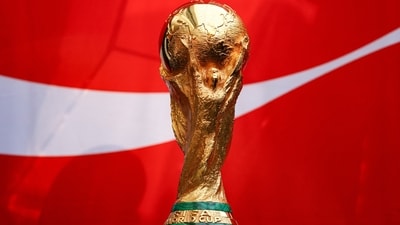
The 2026 edition of the FIFA World Cup, hosted by the United States, Mexico and Canada, will be the first to feature 48 teams. For a quarter of a century, from 1998 to 2022, fans knew the tournament’s shape by heart: eight groups of four, two qualifiers from each, straight into the Round of 16. That map has now been redrawn.
The new tournament opens with 12 groups of four. Every team still plays three group matches, so the opening fortnight will feel familiar. What changes is everything that follows. The group stage no longer halves the field. It trims 48 teams down to 32, and that single number is the key to understanding the entire format.
How teams qualify from the group stage
The 48 teams are split into 12 groups, labelled A through L, with 4 teams in each group. Once all three rounds of group matches are complete, 32 teams move on.
The arithmetic works like this. The top two teams in each group qualify automatically, totalling 24 places. The eight best third-placed teams across all 12 groups take the remaining spots. The four weakest third-placed teams go home, along with every fourth-placed team.
Twelve group winners, twelve runners-up, eight best third-placed sides. That makes 32.
This is the format’s most consequential change. In the old system, third place was a polite way of saying eliminated. In 2026, third place keeps a team alive, but only if its record stands up against the other third-placed sides. Two teams can finish third with identical positions and meet opposite fates. The difference might be a single goal, a late equaliser, one heavy defeat, or even disciplinary record if the margins shrink far enough.
Why the third-place race changes everything
The third-place table will become a tournament within the tournament.
In the 32-team era, a side only had to watch its own group. First or second meant progress. Third or fourth meant the airport. In 2026, teams must monitor their own group with one eye and the rest of the draw with the other.
The rough survival ladder looks like this. A third-placed team with four points will usually be safe. Three points put a team at the mercy of goal difference. Two points mean serious trouble. And the details matter at every rung: a heavy defeat can wound a team that still has enough points, while a late consolation goal in a lost cause can quietly become the goal that keeps a campaign breathing.
That logic will reshape how matches are played. A team trailing 3-0 has every reason to chase a goal, because 3-1 might matter in the third-place comparison. A team already winning has every reason to chase another. Games that look settled will carry hidden stakes.
The final round of group fixtures could be gloriously chaotic. Results in one group will ripple into others. A stoppage-time goal in Group J could eliminate a third-placed team sitting anxiously in Group D. The group stage becomes a live puzzle, solved across 12 boards at once.
What happens after the cut
Once the 32 qualifiers are confirmed, the knockout phase begins, and it has grown too.
The road to the trophy now runs through the Round of 32, then the Round of 16, the quarter-finals, the semi-finals and the final, with a third-place match alongside. That extra knockout round is the second major shift. The old format jumped straight from the groups to the last 16. The new one adds a full elimination round before it.
The champion will therefore survive a longer gauntlet than any winner before. Squad depth, rotation, recovery and injury management become decisive. No team can plan to peak after three group games. The tournament now demands a side that can sustain itself through more matches and greater pressure.
Also Read: Football’s age curve is broken, and World Cup 2026 may be the cleanest proof yet
Why FIFA kept four-team groups
FIFA had considered a radically different structure: 16 groups of three. It eventually retained four-team groups, and the reasoning matters.
Four-team groups preserve the World Cup’s traditional rhythm. Every team gets three matches. The final group games can kick off simultaneously, which helps prevent teams from engineering convenient results. Nobody sits idle while two rivals decide their fate.
The price of that decision is the third-place qualification route. Sending 32 teams into the knockouts, rather than 16, is what allows the tournament to absorb the jump from 32 entrants to 48 while keeping the group stage recognisable.
A different kind of pressure
With two-thirds of the field advancing, the 2026 group stage will be less ruthless than its predecessor. It will not be softer. It will simply punish different things.
Under the old system, a poor opening match could all but end a campaign. Under the new one, a team can survive a bad start, but it must then guard its points, its goal difference and its discipline, because every small detail feeds the qualification picture.
The format also opens a genuine door for smaller nations. A third-place finish with a respectable record can now lead to the Round of 32, keeping more teams competitive deeper into the group stage rather than fading after two defeats.
The trade-off is uncertainty. Teams may not know whether third place is enough until other groups conclude. Fans will track standings across the tournament. Coaches will face a recurring dilemma: attack to improve goal difference, or protect what is already banked.
The 2026 World Cup is not merely a bigger version of the old tournament. Its first great drama will be the sorting itself, the compression of 48 teams into 32. The question at the heart of the group stage is no longer just who wins the group. It is who survives the cut.
And in a tournament this vast, survival may hinge on the smallest of things. One goal. One card. One collapse. One late rescue act. That is how a 48-team World Cup begins narrowing itself into a 32-team race.