New Delhi: The first round of matches at the 2026 FIFA World Cup is over, and the football, to say the least, has been exciting. Some of the biggest stars in the game have put on a show but many others need to buck up.
Here’s a look at three things we’ve learnt from a week of action spread across the USA, Mexico and Canada:
Ronaldo’s descent into mediocrity
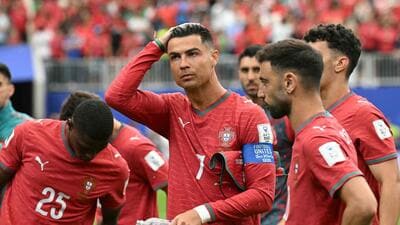
Cristiano Ronaldo became just the second player to appear at six different World Cups and he became the oldest outfield player to start a match in the tournament’s history. But not long after play started, it became clear (not for the first time) that the years had not been kind to him.
The steps were slow, the thinking muddled and those who grew up the pacy winger could be forgiven for telling others that they are not sure who this imposter is. We have seen a few other old-timers (Messi, Modric, Vozinha, etc) taking the field in this World Cup and no one has looked as out of it as Ronaldo.
Messi and Co may not be as quick or as strong as they once were. But the touch hasn’t deserted them, neither has the vision and what is missing can be made up for with experience. But watching Ronaldo makes one wonder why he doing this to himself and his fans.
It has been like this for a while. But such is Ronaldo’s record over the years that one can’t help but hope for another flash of brilliance. The attempt to reinvent himself into a centre-forward has been a disaster of sorts and one has to wonder whether it might drag Portugal down in the tournament.
Speaking on Fox TV, former France forward Thierry Henry tried to analyse the problem. “One thing that is important: the team needs to score, not you need to score,” said Henry.
Breaking down one of Ronaldo’s two-and-a-half attempts at goal, Henry said: “Portugal are on the ball, (Francisco) Conceicao receives it. Ronaldo (right in front of goal) has been in that situation multiple times, if he had made a run into the six-yard box, he would have opened it up for Bruno but because he wants to score, he goes into the path of Bruno. If he had gone into the six-yard box, you (the defender) would have had to follow him and then it would have been a tap-in for Bruno. You saw Bruno’s reaction… like saying, ‘let it roll.’ And that is the point: the team needs to score.”
To be fair, he has been scoring goals at the club level. His 28 goals in 30 appearances helped Al-Nassr claim the Saudi Pro League title. But top-level football is something different. Ronaldo has now gone 10 consecutive major tournament games ((FIFA World Cup/EURO) without scoring for Portugal. That’s 33 shots, 11 on target, 0 goals.
Will the big teams come out to play?
Brazil, Spain and Portugal. Three teams that were expected to light up the World Cup but failed to settle in their opening games.
On way to winning EURO 2024, Spain outscored opponents 15-4 while scoring at least twice in all four knockout games. But without Lamine Yamal and Nico Williams for most of the game, they looked lost against Cape Verde.
Take France out of the picture and it is Portugal that have the most mouthwatering line-up in the tournament. Bruno Fernandes, the Football Writers’ Association player of the year in England, has Bernardo Silva, Rafael Leao, Pedro Neto, João Félix and Vitinha for company. And the legendary Ronaldo adds presence (if not goals) in the box.
Brazil have looked disjointed but they have Carlo Ancelotti, one of the most celebrated club managers in the game, and a legacy that inspires joy. The talent isn’t lacking with Vinícius Júnior, Raphinha and Neymar Jr (if he plays) up front and many other big names to follow them.
But all these teams need to come out at play with freedom. Reputations count for little in a tournament where everyone wants to earn one for themselves. The bigger the team, the greater the reward to take them down. That’s their motivation. But Brazil, Portugal and Spain will all need to find their own.
The gap has closed
Once upon a time there was a clear gap between the elite teams and the rest. The players of the elite teams would play in the best leagues and for the best teams. The experience of playing with the best created a coterie which allowed them to dominate world football.
Now, that is starting to change. Many players from lesser-ranked countries are starting to make it to the top leagues, and they carry that experience back home. A new understanding of the game is slowly starting to take root in countries such as Australia, New Zealand, Cape Verde, Jordan, Congo DR, Japan and Korea.
Morocco, once regarded as a weaker side, are ranked sixth in the world and they only seem to be getting stronger every year. They reached the 2022 World Cup semi-finals, beat Argentina to win the U-20 World Cup in 2025, pushed Brazil hard in the opener in 2026 and are co-hosting the 2030 event.
This is a model (a blend of tactical discipline, technical quality and fearless ambition backed by the state) that the others would want to follow. The big teams might rediscover their poise in the next round but the first set of matches have shown that the gap has closed.