

NEW DELHI: Everyone knows a last-minute flight costs more. Almost nobody knows by how much, or on which routes it matters enough to change what you do.An analysis of fares by the TOI-DPA Airline Price Index, flights across 54 routes connecting Delhi, Mumbai, Bengaluru, Chennai, Kolkata, Hyderabad, Ahmedabad and Pune puts a number on it. Booking a month ahead instead of the day before saves about a fifth of the fare on the average route. And there is not one route in the set where leaving it late works out cheaper.Flying to Kolkata for Durga Puja? Be ready to pay 71% more on Oct 16
What does the curve look like?
The tracker sets the day-before fare on each route at 100 and measures every other booking point against it. A reading of 80 means a ticket bought at that point costs 80% of what the same seat costs the day before departure.
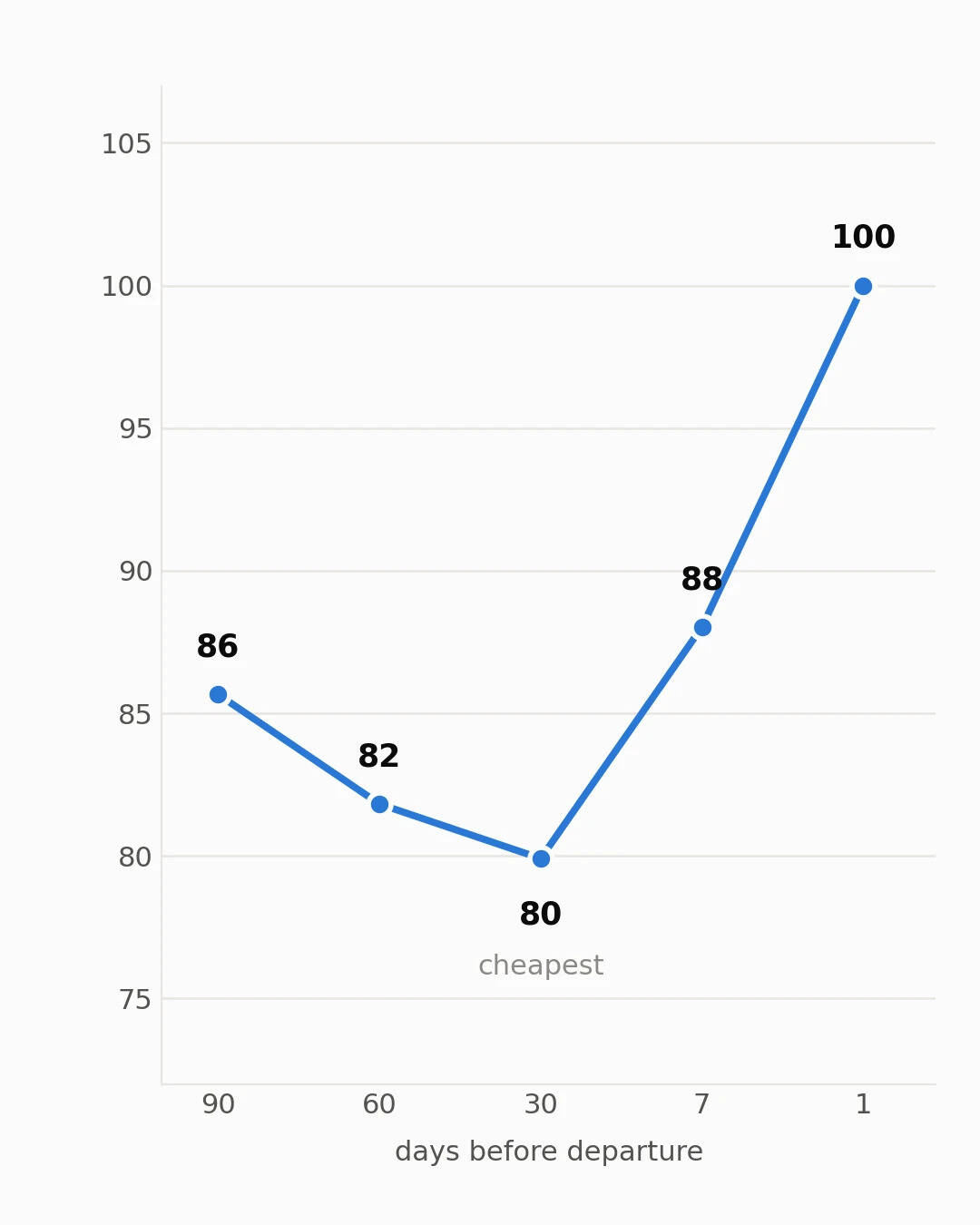
Days before departure vs price index
Across the whole network the reading at 30 days out is 80. At a week out it is 88. So the last three weeks before departure account for most of the damage, and the final week alone adds about 12 points.Read the other way, a passenger booking the day before pays roughly 25% more than one who booked the same journey a month earlier.
Is there any route where waiting works?
No. Not one of the 54.
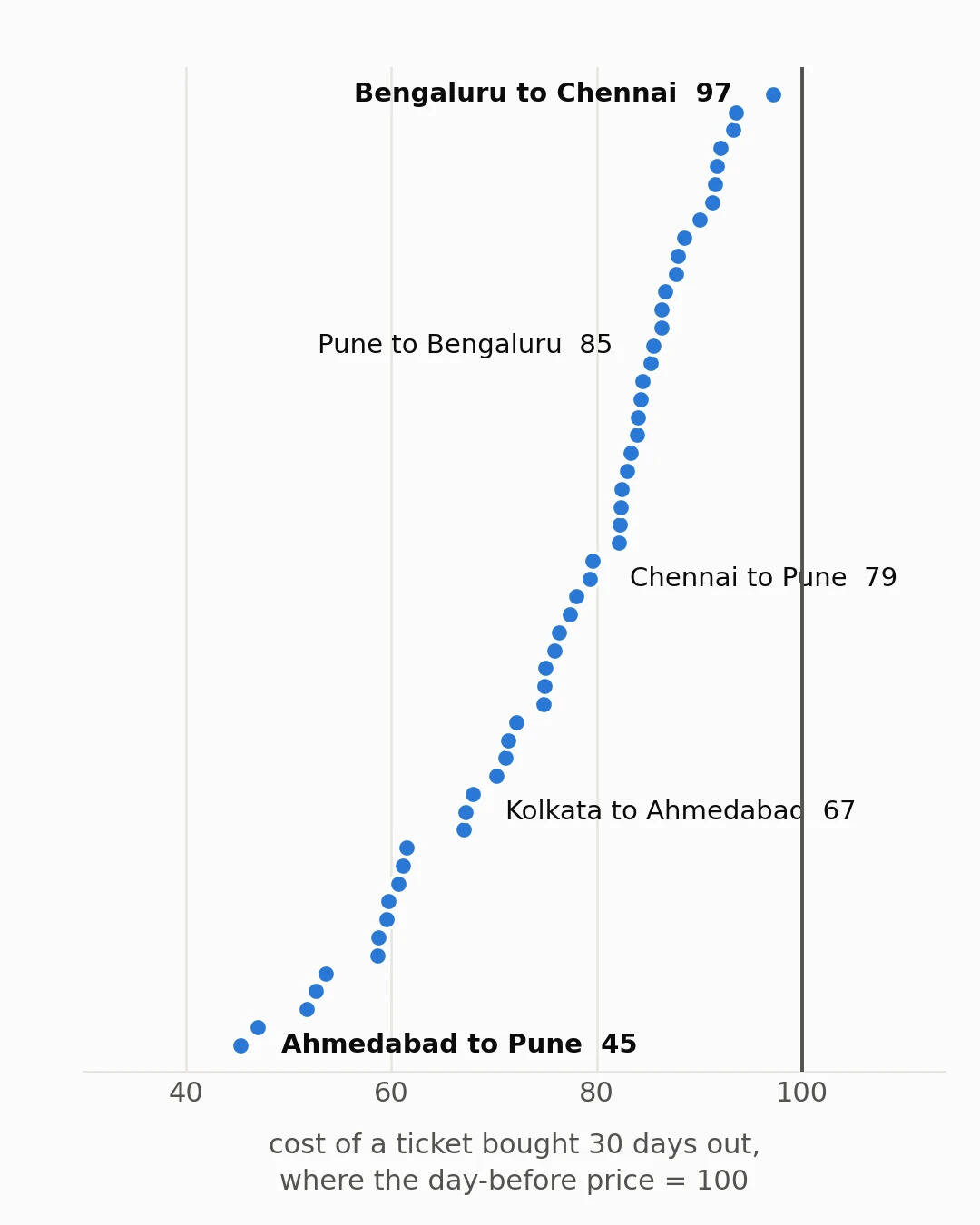
What all the different routes cost 30 days in advance as opposed to on the day before the flight
At 30 days out, every single route sits below 100, meaning every single route is cheaper booked a month ahead than booked the day before. The same holds at a week out and at two months out. The figures were checked on two consecutive captures and did not change.The closest any route comes to breaking even is Bengaluru to Chennai at 97, where booking a month ahead saves under 3%. The furthest is Ahmedabad to Pune at 45, where the day-before fare is more than double.
Where does waiting hurt most?
Ahmedabad to Pune is the worst in the country, at 121% extra for booking the day before. Kolkata to Chennai follows at 113%, then Kolkata to Bengaluru at 93% and Kolkata to Hyderabad at 90%.
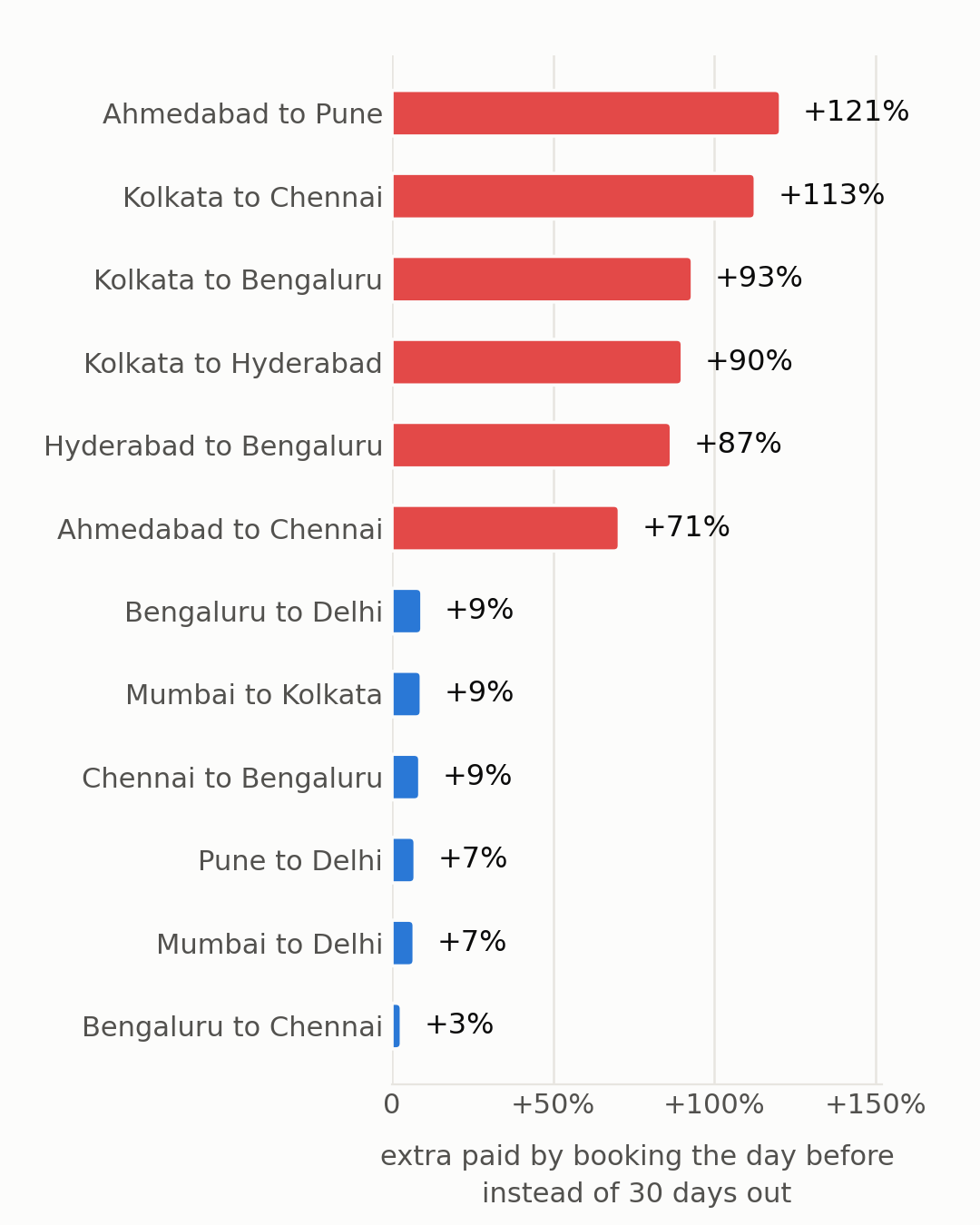
Percentage of increase in airline price one day before as opposed to booking 30 days in advance
| Route | 30-day index | Extra |
| Ahmedabad to Pune | 45 | 1.21 |
| Bengaluru to Hyderabad | 59 | 0.7 |
| Kolkata to Ahmedabad | 67 | 0.49 |
| Delhi to Hyderabad | 75 | 0.33 |
| Chennai to Pune | 79 | 0.26 |
| Bengaluru to Kolkata | 83 | 0.2 |
| Pune to Bengaluru | 85 | 0.17 |
| Delhi to Mumbai | 90 | 0.11 |
| Chennai to Bengaluru | 92 | 0.09 |
| Bengaluru to Chennai | 97 | 0.03 |
At the other end the numbers collapse. Bengaluru to Chennai charges 3%, Mumbai to Delhi and Pune to Delhi around 7%, Chennai to Bengaluru and Bengaluru to Delhi about 9%.The gap between the two ends is the useful part. On a Kolkata route, planning ahead is worth more than the ticket itself. On Bengaluru to Chennai, planning ahead buys you a seat and almost nothing else.
Why is Bengaluru to Chennai so flat?
It is the shortest hop in the set at about 270 km, and it is well served, with roughly ten flights a day in each direction.Short, dense, heavily served routes tend to run something close to a fixed price ladder. There are enough seats that airlines are not squeezing the last few, and the flight is cheap enough to operate that the gap between a cheap seat and an expensive one is narrow in absolute terms. The result is a fare that barely moves as the date closes in.That is a convenience, not a bargain. The route is still expensive per kilometre. It just does not get more expensive if you turn up late.
So when should you book?
About a month out, and there is a reason not to go much earlier.Thirty days is where the curve bottoms. At 60 days the reading rises to 82, and at 90 days to 86. Booking three months ahead costs slightly more than booking one month ahead on most routes. On six routes, including Mumbai to Delhi and Ahmedabad to Mumbai, the 90-day fare is actually a little higher than the day-before fare.Route by route, 34 of the 54 are cheapest at 30 days, 14 at 60 days and only six at 90.If you can plan one thing, plan to be booked about four weeks out. Earlier than that buys you certainty rather than savings. Later than that is where the money goes.
Is there an exception right now?
Yes, and it is a large one. Flights into Kolkata are currently running backwards.
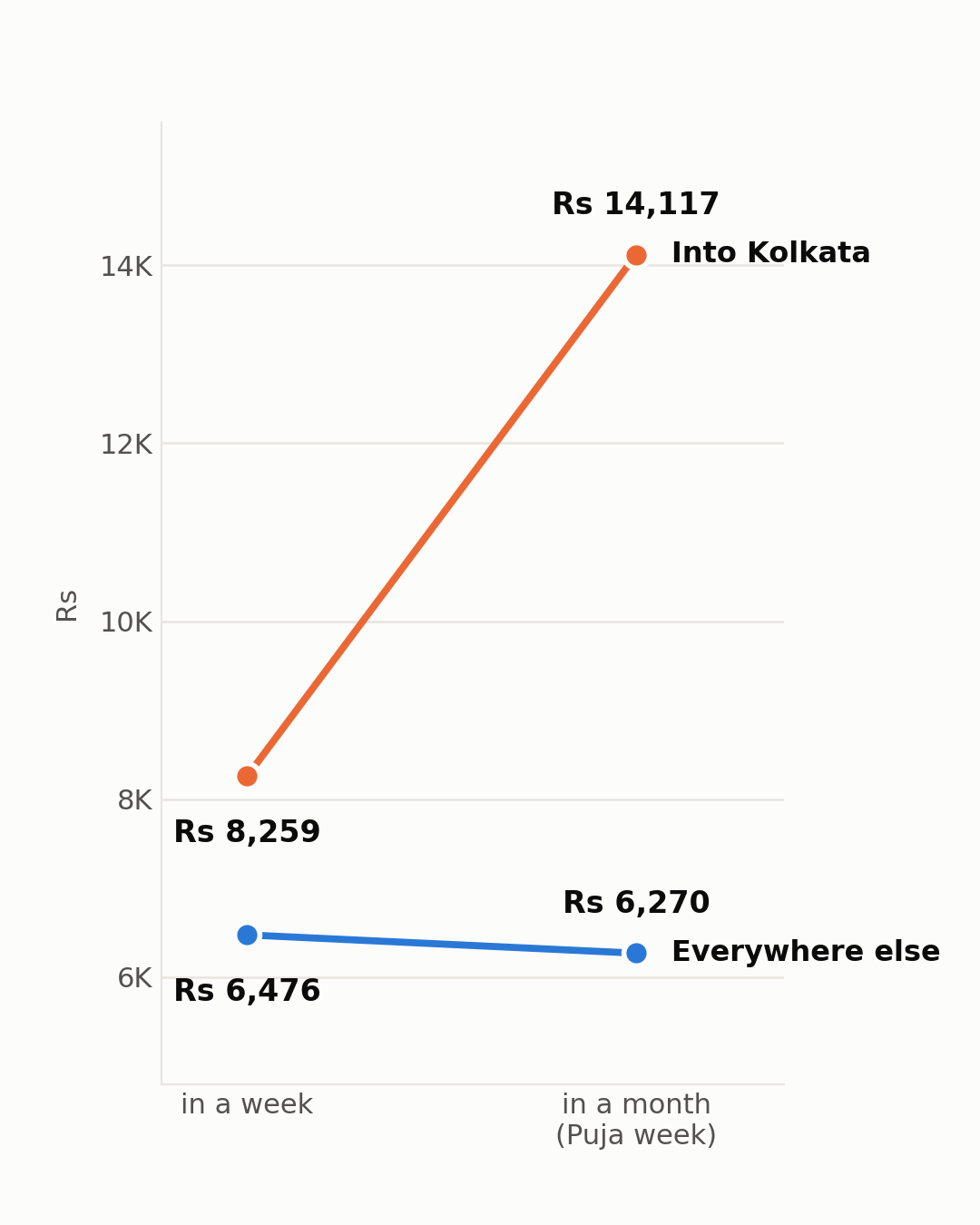
The exception to this rule right now is Kolkata
The median fare into Kolkata for a departure a week away is Rs 8,259. For a departure a month away it is Rs 14,117, which is 71% higher. All seven routes into the city show it. Everywhere else the median goes the normal way, Rs 6,476 for next week against Rs 6,270 for next month.The reason is the calendar. A month from the capture date is Durga Puja week, when Kolkata fills up. So on those routes, for that week only, booking further ahead does not help because the date itself is the expensive thing.This is the exception that proves the rule rather than breaking it. Waiting still does not pay. It is the destination date that is dear, not the lateness of the booking.
What this means in rupees
On the morning of 16 September, across the 40 routes that touch neither end of Kolkata, the median advertised fare was Rs 6,957 for a seat the next day and Rs 6,270 for a seat a month out.That is a smaller gap than the percentage figures above imply, because the two are measured differently. The percentages come from the tracker’s own fare-time index, which is built over a longer window; the rupee figures are a single morning’s quotes. Treat the percentages as the shape of the market and the rupees as an illustration of one day.
About this data
The figures come from fares and schedules listed on the TOI-DPA Airline Price Index for 54 routes between Delhi, Mumbai, Bengaluru, Chennai, Kolkata, Hyderabad, Ahmedabad and Pune, captured daily. The percentage comparisons use the tracker’s fare-time index, which fixes the day-before fare at 100 for each route and expresses the other booking points against it. Rupee figures come from the captures of 16 and 17 September 2026.
Limits
These are advertised medians, not fares any passenger finally paid, and a quote visible one morning can move.This is not the same as following one flight. The comparison is between what different departure dates cost when quoted on the same morning, not what one specific flight cost as its date approached. Those two things usually point the same way, and here they do, but they are not the same measurement.Flight counts move a lot between captures, so the description of how busy a route is should be read as approximate rather than exact.The TOI-DPA Airline Price Index aggregates fares from airlines and booking sites, so a figure here may differ from what an airline shows on its own website. The data records which airlines fly a route but not which airline charged a given fare, so nothing here identifies who sets these prices.TOI-DPA Airline Price Index is a joint initiative of The Times of India and Decimal Point Analytics.Source: Decimal Point Analytics Airline Price Index