
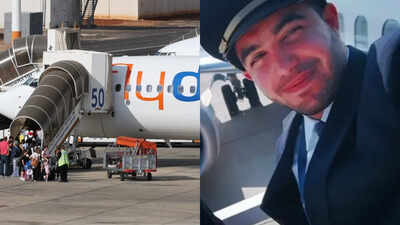
The Omani co-pilot who attacked the captain of a flydubai flight bound for Tel Aviv may have tried to crash the aircraft in the Saudi desert after realising that passengers were about to thwart his attempt to seize control of the plane, according to an investigation by Italian newspaper Corriere della Sera cited by Ynet News.The report said the co-pilot, identified as Hamam al-Hammami, after repeatedly striking Indian captain Smit Machchhar with a crash axe, took control of the Boeing 737 after the injured captain activated the switch that allowed the cockpit door to be opened.Once he realised his plan to crash the aircraft would fail, he allegedly tried to bring it down in the Saudi desert.According to the investigation, the attacker disconnected the autopilot and pushed the aircraft’s controls sharply forward, sending the plane into a steep descent. The aircraft lost around 16,000 feet in less than a minute.
Report raises possibility engines were shut down
The Corriere della Sera investigation also raised a possibility not previously reported, that the co-pilot may have cut the fuel supply to the aircraft’s engines.Two Boeing 737 captains who examined videos recorded inside the aircraft reached this possibility after noticing that the emergency lights in the passenger cabin suddenly came on during the flight, Ynet News reported.The emergency lighting is designed to assist passengers during an evacuation or when an aircraft is on the ground. According to the report, such lights would not normally be activated at cruising altitude.The two captains told Corriere della Sera that emergency lights can switch on when a Boeing 737 loses its main electrical power supply and moves to battery power. That can happen if the aircraft’s generators or engines are shut down.Investigators will therefore need to establish whether the co-pilot moved the switches controlling fuel flow to the engines from the “Run” position to “Cutoff”, according to the report.Corriere della Sera said its investigation was based on passenger testimony, reports submitted to security authorities by the flight crew, accounts from people familiar with the incident, airport employees, air traffic controllers and data from several platforms.Videos recorded during the flight were analysed by Boeing 737 captains who spoke to the newspaper.
Emergency codes changed during crisis
The report also disclosed details about the emergency codes transmitted from the aircraft after additional pilots were called into the cockpit.One of the pilots transmitted squawk code 7700, which indicates a general emergency on a commercial aircraft without specifying its nature. Air traffic controllers initially did not understand what was happening.Seven minutes later, the aircraft’s code was changed to 7500, the code indicating a suspected hijacking.By that point, the aircraft was approaching Jordanian airspace, and air traffic controllers instructed it to turn back. Seven minutes later, controllers directed the aircraft to continue to Tabuk in Saudi Arabia for an emergency landing.The flight, FZ1073, was travelling from Dubai to Tel Aviv when the co-pilot attacked the captain with an emergency crash axe and attempted to take control of the aircraft.UAE authorities described the incident as a “terrorist attack”.The aircraft plunged around 16,000 feet in about 30 seconds before being levelled out after passengers overpowered the co-pilot.Aviation instructor Alberto Paduanelli, who recreated the descent in a flight simulator for Reuters, said the experience would have felt like a “vertical roller coaster” for those on board.
Security questions emerge after attack
The incident has also prompted questions about how the Omani co-pilot was able to board the flight and operate it despite concerns about his background.UAE authorities had shared a list of passengers and crew, including their nationalities, with Israel before the flight. Israeli officials said no passenger or crew member had triggered a security warning.Israeli Prime Minister Benjamin Netanyahu subsequently instructed the head of the National Security Council to appoint an examiner to review “all security aspects regarding foreign civil aviation to Israel”.Authorities had already said the Omani co-pilot had been barred from flying by his own country because of concerns over his extremist views.The Shin Bet said Israel’s transportation ministry was responsible for vetting passenger lists from foreign flights. Transportation minister Miri Regev said on X that security agencies were responsible for flight security and that her ministry had not received a passenger list or any warnings.Sharing passenger lists is standard aviation procedure. Dvir Rubenstien, head of aviation security at Israel’s transportation ministry, told Army Radio that the ministry relies on security checks conducted locally and does not have the tools or ability to check every passenger on every flight.
Investigation into co-pilot’s background
The co-pilot’s background is also being examined.Royal Air Maroc told Reuters that he underwent three months of training with the airline in 2025, but his subsequent application to work there was rejected.Buckinghamshire New University in Britain said he had completed a distance-learning course in aviation management, but not pilot training.An Australian Federal Police spokesperson said authorities were investigating the co-pilot’s “links to Australia”. A source briefed on the investigation told Reuters that he had studied at a university in Melbourne.Flydubai has said the circumstances surrounding the incident remain under investigation and that it could not comment further.