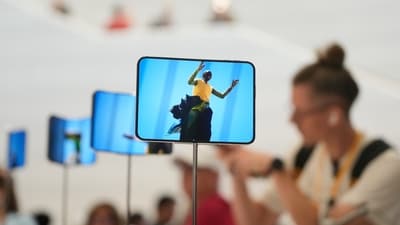
Cupertino, US: Apple unveiled its first folding iPhone on Wednesday, the iPhone Duo, priced at $2,000, the most visible change to the design of its best-selling product since the company dropped the physical home button with the iPhone X in 2017. The launch, at its Cupertino headquarters in California, was the first led by chief executive officer John Ternus, who took over from Tim Cook on September 1.
Apple also launched the iPhone 18 Pro and iPhone 18 Pro Max, priced at $1,199 and $1,299 and starting at ₹1,64,900 in India, along with the Apple Watch Series 12, a fourth-generation Watch Ultra, and the AirPods 5. Both Pro models are $100 more than last year’s.
The company is releasing iOS 27 in the coming days with a new Apple Intelligence suite built on a partnership with Google. In its 50th year, Apple is entering what it has described as its most prolific run of device launches.
The standard iPhone 18 models were absent and are now expected early next year.
At $2,000, the Duo is the most expensive iPhone Apple has sold. Samsung’s Galaxy Z Fold8, which uses similar passport-style dimensions, starts at $1,900, or ₹1,74,999 in India. Xiaomi’s 18 Fold is the other phone in the category.
Ternus introduced the foldable as he weaved in the words “there is one more thing”, the phrase Steve Jobs used to close Apple launches for years and one the company has largely left alone since. Saving it for the Duo placed the product as evidence Apple can still invent rather than refine. Opened out, Ternus said, the Duo is the thinnest iPhone the company has made.
Cook, who moved to the role of executive chairman, watched from the audience. He introduced his successor in the pre-recorded video that opened the event, describing the camera convention of holding a shot on the main character as the shot held on him, before turning it towards Ternus: “that’s your guy”.
The Duo has a 5.5-inch OLED cover display and a 7.8-inch flexible OLED main display running at 120Hz, with TouchID fingerprint recognition. It carries dual 48-megapixel wide and ultra-wide rear cameras and a 24-megapixel FaceTime camera, and storage starts at 256GB. Its shorter, wider shape, closer to a passport than to the book-style phones Samsung and others have sold, lets it run apps side by side in the way an iPad does, and it works with the Apple Pencil.
Also Read: iPhone Duo full specs: Price, display size, colors, cameras, battery, weight, and more
Apple framed the new phones around what it called personal intelligence, its term for the assistant work it has been promising for two years. The company introduced its latest foundation model, including a version built to run on the device itself, and a new Siri that can draw personal context from across a user’s apps, including mail and messages. Apple demonstrated a version of that capability in 2024 and then delayed it. The suite ships with iOS 27, built in partnership with Google.
The Pro models keep the shape of last year’s phones and switch from orange to burgundy, which Ternus described as a sophisticated colour. Both the Pro and the Pro Max get a 48-megapixel Fusion main camera with a variable aperture, giving finer control over depth of field and better pictures in low light, a change that pre-event reporting had expected only on the larger model. The camera software fingerprints images as they are captured to support claims about their authenticity.
Both phones run the A20 Pro, built on a 2-nanometre process, which Apple said has the widest memory bandwidth of any iPhone chip and uses new packaging with better heat handling. Together with a redesigned vapour chamber, Apple said the efficiency gains give the 18 Pro the same battery life as last year’s Pro Max, and the 18 Pro Max 30 hours of use by the company’s own testing measure, which has no industry equivalent. Apple said the Pro Max charges to half its capacity in 15 minutes.
The Apple Watch Series 12 and Ultra 4 carry a new health sensing system that reads heart rate every five seconds through the day and samples heart rate variability, the variation in the gaps between beats, every five minutes. Apple said the denser data improves what the watch can say about stress and recovery. A new Readiness app draws on those readings and on sleep data to tell the wearer whether to push, hold back or rest.
The watch also gained what Apple calls audio intelligence, processed on the wrist. It recognises sounds including sirens, alarms and doorbells, which the company pitched as an accessibility feature for people with hearing loss, and a live rewind function lets the wearer go back 15 seconds through what it has just heard. A related feature, Siri Recap, listens ambiently and takes high-level notes from conversations. Apple said it does not identify speakers and that the notes stay on the device.
The AirPods 5 brings live translation to the line, the first time the feature has reached Apple’s earbuds.
Samsung Electronics and Huawei Technologies have sold folding phones since 2019 without moving them beyond a small group of enthusiasts, held back by shorter battery life, weaker cameras and the crease visible along the fold. Research firm IDC expects Apple to sell every folding handset it can produce and to take about 40% of the segment by the end of next year.
Also Read: Apple iPhone 18 Pro vs iPhone 17 Pro: what’s new, price, camera, specs and battery compared
Arriving late gives Apple the benefit of work rivals have already done on hinges that survive years of opening and closing, and on reducing how much of the crease shows. Resistance to dust and water is the harder problem. Google’s Pixel 10 Pro Fold carries an IP68 rating, meaning it is dust-tight and can be submerged in a metre of water, a standard Samsung’s folding models have not matched.
The iPhone remains the core of Apple’s business, bringing in $209.6 billion in the last full financial year, a little more than half of total sales. Apple raised prices on Macs, iPads and home devices in June, citing a shortage of memory chips, while leaving iPhone prices untouched at the time.