
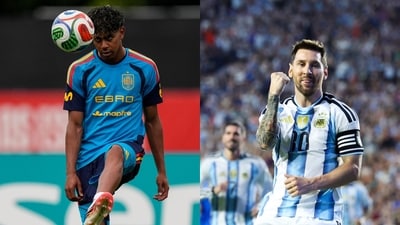
The FIFA World Cup has always been a tournament of footballing eras. The 2026 edition may be the first to stage two of them at once.
This is already the biggest World Cup ever conceived: 48 teams, 104 matches and 1,248 players spread across Canada, Mexico and the United States. Expansion will stretch the tournament’s geography, calendar, and competitive depth. It is also stretching its age table.
At one end, eight players aged 40 or above have been selected, more than every previous World Cup combined. Cristiano Ronaldo, 41, arrives for a sixth World Cup. Lionel Messi, weeks short of 39, returns for a sixth of his own. Guillermo Ochoa completes that six-tournament club. Luka Modric, Manuel Neuer and Craig Gordon lend 2026 the air of a museum of footballing memory that refuses to close its doors.
At the other end sit the teenage class: Mexico’s Gilberto Mora, Spain’s Lamine Yamal, Brazil’s Endrick, Ecuador’s Kendry Paez, the faces of football’s accelerated future. Mora will be 17 when the tournament kicks off. Endrick will still be 19. Yamal, already a senior star rather than a distant promise, will not yet have left his teens.
The easy reading is old against the young. The truer reading is squad economics.
World Cup 2026 is squeezing football’s middle age
Football’s age curve was once a simple drawing. Teenagers were prospects. Players between 25 and 29 were the core. Veterans were exceptions, tolerated mostly in goal. World Cup 2026 bends that curve out of shape.
The expanded format rewrites what a squad is worth. A 48-team, 104-match tournament does not reward only the best starting eleven. It rewards depth, role clarity and problem-solving. Teams need answers for every game state: someone to calm a frantic knockout spell, someone to run at tired full-backs, someone to take the penalty, someone to guard a lead, someone to break a rhythm.
This is where the age split turns tactical. The old are not surviving because they can still do everything. They are surviving because they can still do something rare. The young are not arriving because they are complete. They are arriving because they offer something violent, fresh and impossible to fully prepare for.
The player caught in the squeeze is the ordinary peak-age footballer: physically dependable, tactically sound, yet elite at no single tournament function.
Why the old are still useful
Ronaldo in 2026 is not Ronaldo in 2006. That is precisely the point. Modern football no longer asks its ageing greats to impersonate their younger selves. It repackages them.
A 40-year-old goalkeeper endures because the position rewards reading, command and nerve. A veteran midfielder endures if his minutes are rationed and his brief is tempo rather than territory. A forward like Ronaldo still matters once a team accepts that his value lies in finishing, box presence, penalty authority and dressing-room gravity, not in the press.
None of this is sentiment. Tournament football is crowded with low-event matches. One set piece, one penalty, one unhurried touch under suffocating pressure can decide everything. That is why veterans keep their seats at the table. Their bodies have surrendered range. Their decision-making has surrendered nothing.
Also Read: Lionel Messi scores as Argentina defeat Iceland in final FIFA World Cup 2026 warm-up game
Why the teenagers are arriving faster
The teenage half of the story is the mirror image of decline management. It is acceleration.
Yamal, Endrick, Mora and Paez are not wonderkids of the old kind, stashed away for some distant future. They have grown up inside a football machine that identifies talent early, exposes it early and markets it early. Elite academies now produce players fluent in pressing structures, video analysis, nutrition and media scrutiny before they have fully grown into adulthood.
That matters because World Cup football fractures into moments more often than it settles into systems. A teenager may not control a tournament, but he can tilt a match. He can run at exhausted legs. He can turn a cagey contest into a duel. He can give a team the one thing peak-age balance rarely supplies: shock.
The real lesson of the age gap
The 2026 age divide is not evidence that football is growing older or younger. It is evidence that football is growing more specialised.
The veteran gives control. The teenager causes disruption. The veteran protects a match. The teenager attacks its shape. The veteran carries memory. The teenager carries velocity.
Caught between them are the players who must now prove they are more than safe selections. At a normal World Cup, safe is useful. At the biggest World Cup ever staged, with more matches, more travel and more squad places, useful may no longer be enough.
That is why this tournament’s age profile deserves attention. It reveals how managers have begun to think about international squads. They are no longer building only a team. They are assembling a toolbox.
And in 2026, the most valuable tools may come from football’s two extremes: the old who have learned how to last, and the young who have learned how to arrive before their time.