
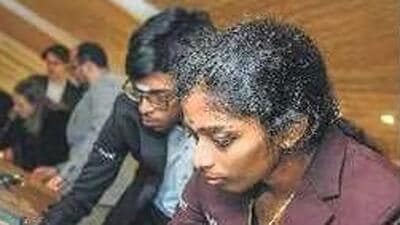
Vaishali Rameshbabu’s love for watching cartoons on TV prompted her parents to enroll her in after-school chess lessons as a healthy diversion. Within six months, they were looking for a coach. Her younger brother, Praggnanandhaa, was around two and a half years old at the time. The chessboard and pieces seemed like intriguing toys to him, so to keep him from disturbing his sister (she was six-and-half years old) while she practised, his parents bought him a chess set too. Praggnanandhaa went on to become the youngest-ever International Master at 10, a Grandmaster at 12, and broke into the world’s top five last year.
As for Vaishali, she recently made history, becoming only the second player from India to qualify for the Women’s World Chess Championship.
“I took up chess because I watched my sister practise at home and found it interesting,” Praggnanandhaa told HT. “I later began participating in the tournaments my sister played, but in higher age categories. So, when I was seven, I played the Under-15 state championship. It was difficult to compete in them, but I gained exposure in my early years because of my sister.”
Initially, their playing styles were almost identical, Praggnanandhaa points out: aggressive and attacking, weak in openings but capable of winning games through tactics. This stemmed from their lessons with coach S.Thiagarajan at the Bloom Chess Academy, where they trained in their early years. “I remember we didn’t have a computer or laptop for a long time,” Vaishali told HT. “We studied chess through books. Coach Thiagarajan showed us many games of greats like Mikhail Tal and Garry Kasparov. It had a deep impact on us.”
On a rainy day in Manhattan some seventy-seven years ago, a sister went hunting for a game that would keep her hyperactive six-year-old brother occupied. She ended up sparking something far bigger. Shortly after Bobby turned six, his sister, Joan, picked up a $1 plastic chess set from a candy store. The set came with a folding cardboard chessboard with red and black squares, and they learned the game by following the instructions printed inside the box, with eleven-year-old Joan guiding her brother as she worked out the rules for herself.
With schoolwork demanding her attention, Joan drifted away from chess. But Bobby, who had a knack for picture puzzles, mazes and word games, became hooked to the game.
Some twenty years after he first moved the pieces on the plastic chess set that his sister bought him, Bobby Fischer became the first American world chess champion and one of the greatest players the game has seen.
Henrik Carlsen taught his son chess when he was five years old, but Magnus – who was more interested in Legos, math, and flags – didn’t find it “fun.” It was only a couple of years later, when he began sitting in on the chess sessions his father had with his older sister Ellen, that he developed an interest. His primary motivation to play the game was to beat his sister.
“I really, really wanted to beat my sister, at generally everything. From there on, it just became my thing,” said five-time world champion and world No. 1 Carlsen, on The Joe Rogan Show.
In many ways, the early chess journeys of Fischer, Carlsen, and Praggnanandhaa were shaped not only by their prodigious talent but also by their sisters, who played a quiet yet pivotal role – introducing the game, shaping early experiences, and fostering curiosity, competition, and support at home. They acted as catalysts for paths that would go on to define modern chess.
Viswanathan Anand was six when he saw his elder siblings play chess and pestered his mother, Sushila, to teach him the game too. Before long, he was beating everyone at home. It was his sister Anuradha – older than him by eleven years – who bought him his first chess books, spotted the Tal Chess Club on her way to college, and thought it would be a good idea for him to join. She would take him there on Thursdays and weekends, and it became the starting point of his journey toward becoming a five-time world champion and a towering name in chess.
Fischer’s sister, Joan Targ – who opened the door to what would become his life-long obsession – went on to become an early proponent of computer literacy in America and initiated peer tutoring programs for students of all ages. Ellen Carlsen, who represented Norway in the European Team Championship twice before quitting competitive chess, is a medical doctor.
Vaishali, a grandmaster, is an exception to this list.
In 2024, Vaishali and Praggnanandhaa became the first brother-sister duo to play in the Candidates Tournament. On their second appearance together this year, Vaishali won the Women’s Candidates, which gives her a shot at every chess player’s greatest dream — to become a world champion.
It’s the dream the siblings set out to chase as children, while studying the games of past champions with wide-eyed wonder.
And fittingly, Vaishali is the first of the two to move a step closer to that dream.