
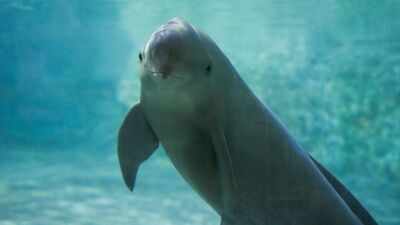
Human and natural pressures both have had an impact on the survival of not just humans, but other living creatures too. By the time we started to focus on conserving and protecting animal species from dangers to their survival, some of them had already disappeared from the face of this planet. The Yangtze River lost its dolphins in 2007, thereafter, Dr. Wang Ding ensured the survival of another smaller dolphin of the river- Yangtze finless porpoise.According to the IUCN SSC Cetacean Specialist Group, the baiji, or Yangtze River dolphin, was declared functionally extinct in 2007. However, another small cetacean living in the river, the Yangtze finless porpoise, was also heading the same way.Wang Ding, a professor at the Chinese Academy of Sciences’ Institute of Hydrobiology, had been working on freshwater cetaceans long before the baiji’s loss. His career in this field now spans over four decades. As per the official press release, Dr. Wang Ding received the 2026 Wolfgang Kiessling International Prize for Species Conservation. It was awarded by the Global Humane Society, which is the international arm of the American Humane Society. The organisation created the prize to honor Wolfgang Kiessling who founded the Loro Parque zoological park in Tenerife, Spain. The award is intended to recognise the efforts of leading conservation scientists making meaningful contributions to conservation and species preservation.
The numbers behind the prize
According to the IUCN Cetacean Specialist Group, the wild Yangtze finless porpoise population was estimated at 1,012 animals in December 2017. By 2025 the estimate stood at 1,426. That is a 40% increase over eight years, or roughly 414 more porpoises swimming in the river.Dr. Robin Ganzert, President and CEO of Global Humane Society, credits Wang’s conservation work with reversing the decline that scientists had claimed was “irreversible.” The award announcement states this is the world’s only successful recovery of a critically endangered small cetacean population. “The Yangtze lost one cetacean on our watch. Dr. Ding Wang made certain it would not lose a second,” said Dr. Ganzert, describing Dr. Wang’s dedication.Among Wang’s other works is a breeding program, which now supports 13 porpoises and serves as a base for research, conservation experiments and public education. He is also credited with building China’s first multidisciplinary cetacean conservation team. He has also mentored more than 100 graduate students.
Taking the playbook abroad
The award also recognizes the approach that worked on the Yangtze as it is now being tried on other rivers. According to the IUCN Cetacean Specialist Group, Wang’s team adapted its methods for endangered river dolphins in two countries.First, in Bangladesh, the team worked with Jahangirnagar University to use real-time acoustic monitoring, which picks up dolphin sounds underwater, to estimate Ganges River dolphin numbers in the Jamuna and Padma rivers. And, in Cambodia, the team worked with the country’s Ministry of Agriculture, Forestry, and Fisheries and with WWF Cambodia. Together they trained local staff to monitor Irrawaddy dolphins by sound and to watch fishing activity using cameras and drones.
What the prize money will do
Along with the award, Wang will also receive an $80,000 grant, which is to be utilised to expand wild release programs for the finless porpoise, implying moving porpoises into the river. Moreover, it will be dedicated to research and education across China and Southeast Asia for the secure future of freshwater cetaceans.As per the award announcement, Wang called the prize a “great honor” and congratulated the other finalists on their work.Wolfgang Kiessling said the prize is about the people who win it and ensuring their work is seen, recognized and supported. He also described Wang’s long commitment to the porpoise as an example of what perseverance can achieve in conservation, according to the announcement.