
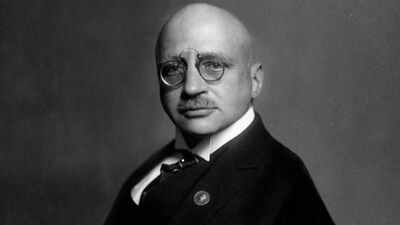
In the closing years of the 19th century, German chemistry was moving between lecture theatres, factory floors, and military laboratories with an ease that feels strange in hindsight. Fritz Haber entered that world as someone who never quite settled into a single direction, drifting between academic curiosity and industrial usefulness. His work would end up shaping agriculture, warfare and modern chemical engineering in ways that were not fully visible at the time, even to those working alongside him. There was nothing especially linear about his path. He moved institutions, changed interests, and often returned to problems he had previously set aside. What emerged from that restlessness was a career that linked basic science with large-scale production in a way few others managed. The consequences of that link would stretch far beyond laboratories, into fields, factories and battlefields across the 20th century.
Fritz Haber: Early years in Breslau and a taste for experiment
Fritz Haber was born in Breslau in 1868 into a merchant family with deep local roots. His childhood was shaped less by scientific ambition and more by exposure to trade, routine, and the expectations of a respectable household. School came at St. Elizabeth’s gymnasium, where classical education still held its ground, though he found room in between lessons for small chemical experiments carried out with improvised equipment.It was not a childhood marked by dramatic turning points. More a gradual accumulation of habits. A tendency to test things, to see how substances behaved when pushed or combined. That curiosity followed him into higher education, where chemistry stopped being a private fascination and became a formal discipline.
Academic journey across Heidelberg, Berlin, and Charlottenburg
The Nobel Prize official website states that, between 1886 and 1891, Haber moved through several German universities, absorbing different approaches to chemistry. Heidelberg brought him into contact with experimental traditions shaped by Robert Bunsen’s legacy, while Berlin introduced him to a more theoretical atmosphere under August Wilhelm von Hofmann. Later, at Charlottenburg, the emphasis shifted again towards the applied chemical industry.He did not remain fixed in any one intellectual camp. That movement mattered. At a time when chemistry was still dividing itself between pure research and industrial application, he drifted across that boundary repeatedly. After finishing his studies, he even stepped away from academia for a period, working in his father’s business and spending time in Zurich with Georg Lunge, whose work focused on technical chemistry.There was uncertainty in these years about what direction he would ultimately take. Physics, chemistry, industry, research. None of them fully settled.
Karlsruhe years and the formation of Haber’s academic and industrial identity
A more stable phase began in Karlsruhe, where Haber joined Hans Bunte’s group in 1894. The environment there was strongly oriented towards combustion and industrial processes, influenced also by Carl Engler’s interest in petroleum chemistry. This setting suited him more than he might have expected. It combined theoretical questions with problems that had immediate practical consequences.He completed his qualification as a Privatdozent in 1896, focusing on hydrocarbon decomposition and combustion. His early academic work already showed a concern for how chemical reactions behaved under controlled conditions rather than in abstract isolation.Karlsruhe became a long stay. Over time, he shifted from assistant roles into a professorship in physical chemistry and electrochemistry. It was here that he began to develop the dual identity that would define his career: academic scientist and industrial problem solver.
Development of electrode science and its lasting laboratory impact
By the late 1890s, his attention had turned to electrochemical reactions, particularly how electrical potential could guide chemical change. He worked on oxidation and reduction processes, exploring how substances behaved when subjected to controlled electrical conditions.Some of his contributions from this period became quietly foundational. Work on electrode systems influenced later developments in measuring acidity, including tools that would become standard in laboratories. The glass electrode, developed with collaborators, emerged from this phase of experimentation.He was not only interested in isolated reactions but in systems that could be scaled or adapted. Steam engines, fuel efficiency, combustion losses. These were not purely academic questions for him. They were tied to industry, energy and engineering limits of the time.
Understanding atmospheric nitrogen and the limits of natural fertilisation
By the early 20th century, one scientific and industrial problem was becoming increasingly urgent: nitrogen fixation. Atmospheric nitrogen was abundant but chemically inaccessible to most organisms. Plants depended on limited natural processes, particularly soil bacteria and lightning-driven reactions, to convert nitrogen into usable compounds.Agriculture had already begun to strain against this limitation. Natural fertilisers such as guano were being imported from distant sources, and their supply was neither stable nor infinite. The idea that crop production could eventually be constrained by chemistry rather than land alone was no longer theoretical.For chemists like Haber, this posed a technical challenge with enormous practical weight. If nitrogen from the air could be converted into ammonia efficiently, it would reshape farming and food supply on a global scale.
From laboratory discovery to the development of the Haber–Bosch process
Around the first decade of the 1900s, Haber returned to the nitrogen problem with renewed focus. Earlier experiments had shown that ammonia could be produced, but only in tiny amounts under extreme conditions. The difficulty lay in breaking the strong bond between nitrogen atoms and then stabilising the resulting compounds.Through a combination of high pressure, elevated temperature and suitable catalysts, he eventually demonstrated a workable method of producing ammonia from nitrogen and hydrogen. The process did not remain a laboratory curiosity for long. Industrial chemist Carl Bosch later adapted and scaled it using engineering techniques capable of sustaining the required pressures.The result became known as the Haber-Bosch process. It moved rapidly from experimental chemistry into large-scale production, forming the basis of synthetic fertiliser industries. The implications for agriculture were immediate and long-lasting, even if they were not fully grasped at first.
War, chemical weapons and personal strain
When the First World War began, Haber’s work took a different direction. His expertise in gases and reactions at scale made him a figure of interest to military authorities. He became involved in chemical warfare research and deployment, work that placed him at the centre of one of the conflict’s most controversial developments.Chlorine gas was among the early substances used, released in battlefield conditions where wind and timing determined its effect. The outcomes were unpredictable, but often devastating. Later developments included more persistent compounds that caused prolonged injury and suffering.The personal cost of this period is often linked to his private life. His marriage to Clara, herself a scientist, deteriorated under pressure from his wartime work and political alignment. Her death by suicide in 1915 marked a rupture that has remained closely associated with his biography ever since.Even during the war, he continued to argue that chemical weapons might shorten conflict by forcing faster resolution. That view was widely disputed, both then and later.
Scientific recognition and controversy in the post-1918 years
In the years after 1918, his reputation became divided. The ammonia synthesis work was celebrated for its role in agriculture, while his wartime activities were condemned in many circles. He received major scientific recognition, though public reception was mixed and at times hostile.He spent part of the 1920s working on varied projects, including attempts to extract valuable materials from seawater, a concept driven partly by Germany’s post-war economic pressures. Most of these efforts did not produce practical results, but they reflected his continuing interest in large-scale chemical systems.His institute in Berlin became a hub for research in physical chemistry, hosting several scientists who would later become influential in their own right.
Final years and uneasy legacy
By the early 1930s, political changes in Germany affected his position. Despite his earlier standing, he eventually left his post following the enforcement of racial laws that targeted members of his institute. Exile followed, first to England and then to Switzerland.His health had been declining for some time, particularly his heart condition. He died in Basel in 1934 while travelling, away from the institutions he had once shaped.His legacy remains difficult to summarise in simple terms. The same chemical process that helped sustain global agriculture is linked to a career that also intersected with industrial warfare. His work sits in both domains, neither fully separate from the other.