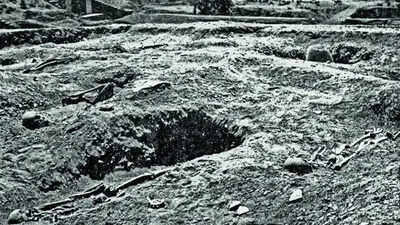
BHOPAL: Face down. On their backs. Seated. Twisted. Legs raised and folded. Children and adults. Males and females. Some buried, others cremated.Imagine Pompeii without its volcano, bodies caught in curious positions, a vanished community leaving behind fragments of their final rites on a hillock in western Madhya Pradesh.At Kumhar Tekri in Ujjain, 42 skeletons unearthed nearly nine decades ago are waiting for answers.Who were these people? Why were they buried in such strikingly different positions? Were they from different communities? Shell jewellery, urns containing ashes and bones, cups and dishes lay among the remains, adding more pieces to an archaeological puzzle that began in 1938-39 and may now get a fresh turn.The skeletons, unearthed during a trial excavation by Gwalior State’s archaeological department during British rule, are believed to date to around the 3rd century BC, though an earlier date has not been ruled out.
DNA tests may solve the skeletons mystery
The better-preserved remains were sent for anthropological examination after the excavation and are now with ASI in Kolkata.ASI’s regional office recently sought permission from its headquarters to dig adjoining Vaishya Tekri, about 2km from Kumhar Tekri or Potters’ Hill.The site is home to a stupa nearly three times the diameter of the Sanchi stupa, and archaeologists believe it could supply missing context to the burials.Veena Mushrif-Tripathy, associate professor of biological anthropology at Deccan College Post-Graduate and Research Institute in Pune, who worked on the material in 2007-08, recommends re-examining the remains using modern methods such as AMS (advanced radiocarbon) dating, DNA analysis, and isotope studies to clarify age, sex, ancestry, and diet.Further study of their distinct morphological features and shell jewellery could also test the original excavators’ theory that the site belonged to a separate community.“It is difficult to confirm cultural identity just from burial positions, most probably, these were people from different groups or communities,” she said, adding that burials and cremations at the same site support the possibility.ASI’s Bhopal circle superintending archaeologist Dr Shivakant Bajpai said excavation at Vaishya Tekri could place Kumhar Tekri’s skeletons in a wider archaeological context and help investigators understand who they were.