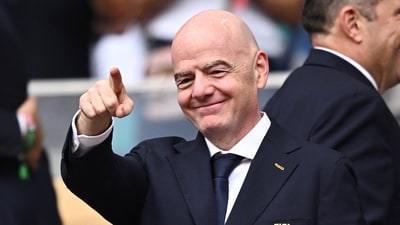
In a major claim, FIFA president Gianni Infantino revealed that the World Cup could expand to a 64-team format. The ongoing 2026 World Cup has been expanded to 48 teams for the first time. Initially, the decision was heavily criticised, with many feeling that it would be way too easy for strong nations.
But the World Cup in Canada, Mexico and the USA has proved critics wrong, with teams like Cape Verde and DR Congo punching above their weight.
Also Read: Erling Haaland’s father accuses referee of ‘robbing’ Norway after England FIFA World Cup heartbreak
‘Every nation should be allowed’
Speaking to Swiss television outlet Blue Sport, Infantino said, “These are all issues that we will be examining after the World Cup.”
Without giving a clear explanation, he continued, “I think it is important that when you want to organise a World Cup, you do it for the whole world — not just Europe and South America, but effectively the entire world.”
“Every nation should be allowed to dream of participating in the World Cup. You can see that the quality of the teams is extremely high and it’s getting higher and higher, all over the world.
“If you don’t give smaller countries a chance to participate in the World Cup, they’ll lack the incentive to keep improving.”
Pointing out the performance of African teams in the 2026 World Cup, he said, “Nine out of 10 African teams reached the knockout stage. At the last World Cup, there were only five teams from Africa. That just goes to show how important it is to include all teams, to give them this opportunity to participate.”
There has also been criticism thrown at the hydration breaks during the matches. Each half has one hydration break, for a total of two per match. Critics have felt that it is FIFA’s way to generate advertising revenue.
“This is a topic that sparks a lot of debate. After all, we don’t want to get everything perfect; we like to give everyone something to disagree with… no, joking aside. Last year, during the Club World Cup in the USA, there were cooling breaks whenever it was very hot,” he said.
“These short breaks occurred in about 60% of the matches but not in the other 40% because the temperature wasn’t as high. There were many complaints, as the feeling was that all teams should face the same conditions.”
Also defending the high ticket prices, he said, “Experts determined the ticket prices before the tournament. Our experts worked on that and told us: ‘These are the prices you can go with’. We see the proof now: prices that some people claimed were too high are being resold on the secondary market —which is perfectly legal here — for four or five times the original cost.”