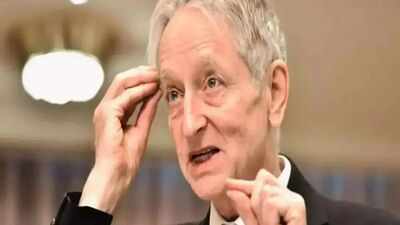
Godfather of AI Geoffrey Hinton says it is “not unreasonable” to predict that artificial intelligence (AI) could wipe out humanity within the next decade. The Nobel-winning computer scientist puts the probability at around 10%, while acknowledging there is no reliable way to predict it. Hinton said the window in which AI could pose an existential threat to humanity is also shrinking.“A 10% chance seems not an unreasonable estimate to me, but nobody really knows how to give a sensible estimate,” Hinton said during a recent interview on the BBC’s Newsnight. He explained that it is difficult to put an exact figure on the risk because society has never encountered a technology that “could soon be smarter than us.”He added that dismissing the possibility would be a mistake. “It would be very foolish to say there was like a 1% chance,” he said. “Nobody knows how to estimate it.”What he believes is clearer is that the timeframe for such a catastrophe has shortened. “I used to think like 30 to 50 years, then I reduced it to 10 to 20 years,” he said. “Now, I think maybe 10 years, maybe less. And other people think much sooner than that.”His assessment came after the show’s host pointed to a similar warning from a former Anthropic researcher Jacob Coxane, who estimated that there is a greater than 10% chance that AI could kill all humans “within the next decade.”Hinton did not explain why he has shortened his estimate for when AI could pose an existential threat. However, companies including Anthropic and OpenAI have continued to invest heavily in developing larger and more capable models, with newer systems showing rapid improvements over versions released only months earlier.
Hinton calls for global regulation
Hinton said the future could still take different paths. Humanity could move towards an outcome in which AI contributes to its destruction, or find ways to manage the technology’s risks while benefiting from its capabilities.He again called for international regulation, arguing that countries share an interest in preventing AI systems from taking control away from humans.“For things like preventing AI from taking over from people, the interests of all the countries are aligned,” he said. “So they will eventually collaborate on that. The question is, will they do it in time?”
Anthropic researchers have raised concerns
Hinton’s comments came after former Anthropic researcher Jacob Coxon resigned and warned that major AI companies were taking serious risks. Coxon, who had previously worked at OpenAI, said AI developers were effectively “gambling with our lives.”Coxon argued that people working on advanced AI genuinely believe the technology could eventually kill everyone, saying some executives and researchers privately express greater concern than they do publicly.Evan Hubinger, alignment science lead at Anthropic, backed Coxon’s assessment. He said the company does believe AI could potentially kill all humans and personally placed the probability at more than 10% within the next decade.Hubinger also said Anthropic was trying to address the problem but did not yet have a solution for aligning a superintelligent AI system with human interests, adding that the company was not clearly on track to solve it.He later clarified that Anthropic considers the risk from current AI models to be low. The larger concern, he said, involves the possibility of superintelligence emerging through recursive self-improvement.
What is recursive self-improvement
Recursive self-improvement refers to a theoretical scenario in which an AI system could improve its own capabilities, potentially helping design or train more capable versions of itself.If such a process became possible and accelerated, AI development could move faster than researchers currently expect. That is one reason concerns about future, more capable systems differ from the risks posed by today’s models.