Speaking to CNBC-TV18, Hansen, Head of Commodity Strategy at Saxo Bank, said the global oil market remains tight as the West Asia conflict drags into its fourth month, keeping Brent crude above the $110-a-barrel mark.
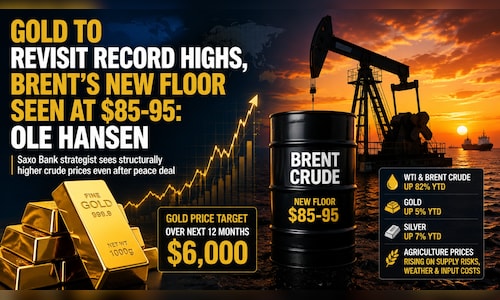
“If we should get peace, then the new floor in the market, which was $60-70 in Brent, will most certainly have moved higher by at least $10 to $15. So $85-95 could be the new floor in the market for the foreseeable future when we get the reopening of the Strait of Hormuz,” Hansen said.
He added that while the market has avoided a sharper spike in prices due to rising US exports, lower Chinese imports and demand destruction, global inventories remain depleted and would take months to rebuild even after a peace deal.
Commodity prices have surged sharply in 2026 amid the West Asia war and the Strait of Hormuz crisis. WTI crude and Brent have rallied 82% so far this year due to supply concerns, while Russia’s Urals crude has doubled in value.
On precious metals, Hansen said gold continues to face near-term pressure from rising bond yields, a stronger US dollar and inflation worries, but maintained a bullish long-term outlook.
“I think we’re just in a situation right now where high oil prices in the short term mean lower metal prices, simply because of the inflationary impact and what it does to central bank thinking and bond yields,” he said.
Despite that, Hansen said the broader drivers supporting gold remain intact, including de-globalisation, de-dollarisation and concerns over rising fiscal debt levels.
“Over the next 12 months, I think we could get back to new record highs and potentially as high as $6,000 per ounce,” he said.
Gold prices have gained around 5% this year as investors moved towards safe-haven assets amid geopolitical and economic uncertainty, while silver is up about 7%.
Hansen said he prefers gold over silver from a long-term investment perspective because silver is more exposed to industrial demand, which could weaken if prices rise too sharply.
He also retained a constructive long-term view on copper and aluminium despite the recent correction in base metal prices. Aluminium has risen 20% this year, zinc is up 13%, while copper has gained 10%, supported by demand linked to the global energy transition.
“We’ve got an energy shock right now, which is once again highlighting the reliance on fossil fuels. That basically means the energy transition will continue to move forward,” Hansen said.
Also Read | Gold crosses ₹1.59 lakh per 10 grams; silver prices retreat on MCX
At the same time, he warned that agriculture could emerge as the next major source of inflationary pressure globally. Prices of wheat, soybean, palm oil, corn and cotton have risen sharply amid supply disruptions, extreme weather and higher input costs.
Hansen said rising fertiliser and diesel prices were already squeezing farmers and could eventually lead to higher food prices later this year.
“Potentially, and unfortunately, agriculture could become the next major inflation driver in the second half of the year,” he said.