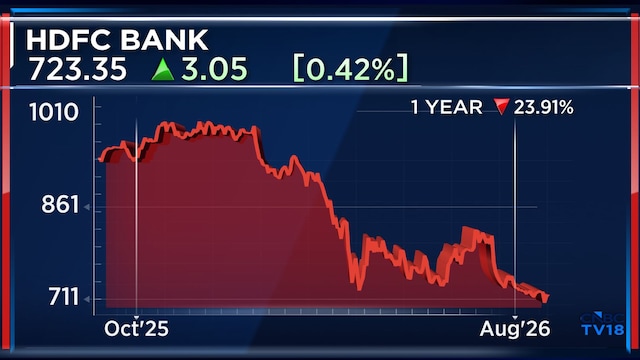
Suresh Ganapathy, MD and Head of India Research at Macquarie Capital, said the stock could stay in a ₹700-₹750 range if an internal candidate is picked, but could move higher if a well-regarded outsider takes the job, since markets are always forward-looking and would price in a turnaround years ahead of results.
SS Mundra, former Deputy Governor of the Reserve Bank of India, said the board should weigh any internal candidate against an external benchmark and should be looking for the next HDFC Bank CEO, not merely a replacement for Sashi Jagdishan.
The two disagreed on direction. Mundra said building an institutional framework at a bank the size of HDFC Bank takes 10 to 12 years, so a candidate already familiar with the bank needs less time to deliver results.
Ganapathy pointed to the bank’s retail growth and CASA — current account and savings account deposits, a low-cost funding source — as areas needing attention, and said a fresh pair of eyes coming in with a good mandate is in a better position to address some of these issues.
Both agreed HDFC Bank remains fundamentally sound, with the debate centred on whether continuity or a new mandate serves it better.
HDFC Bank share were trading at ₹723.65 as of 11:42 am on the NSE. The company, which has a current market capitalisation of ₹11,15,148.71 crore, has seen its shares decline more than 31% over the last year.
In a separate interview with CNBC-TV18, Ashvin Parekh, Managing Partner at Ashvin Parekh Advisory Services, said the lender’s governance framework puts it in a strong position for the next phase of growth. “I would not take them as challenges; I would take them as an opportunity for the new leader,” Parekh said, adding that while both internal and external candidates have their merits, an insider may have an edge because of familiarity with the bank’s processes and culture.
Deepali Pant, former Executive Director at the Reserve Bank of India and macroeconomist, said the succession process should be assessed through the lens of institutional stability rather than individual leadership. “There is no crisis in the bank as such. The bank is strong, stable, well-capitalised, systemically important,” she said. Pant added that the RBI would focus on professional competence, governance and succession planning while evaluating the eventual candidate, while the next CEO would need to address governance, deposits, post-merger execution and investor confidence.
This is an edited transcript of the interview.
Q: After Bank of Baroda, you served at the RBI and then at the BSE. You’ve handled Indiabulls. You’ve worked across the private sector, public sector, policymaking, everything. Do you think an external candidate will face problems, or will he or she be able to manage such a large bank like HDFC Bank?
Mundra: I fully agree. HDFC Bank today is a ₹30-trillion-plus balance sheet. That is not to deny that it is a complex bank. It is very important to understand the institutional culture, risk management practices, the technology architecture, people, and all that.
To be very precise about it, my own sense is that, at this point in HDFC Bank’s journey, the ideal choice would be an internal candidate, but not just for the sake of choosing an internal candidate. The internal candidate should be benchmarked against an external candidate. And the board should ask itself whether the new incumbent would have the commercial aggression to take the bank to the next level, whether he or she would be able to challenge the senior management.
So, the simple point I want to make is that the board should be looking for the next HDFC Bank CEO, not merely a replacement for Jagdishan. There are, no doubt, capable people available in the external world, but the question to ask would be whether such a person would be able to run HDFC Bank from tomorrow morning without needing a couple of years to really settle down in the system.
So, my take is that it should be an internal candidate, provided he or she proves to be the best choice against a very rigorous external benchmark.
Q: I take your point that an internal candidate has a better chance of understanding the organisation, no matter how great the external candidate may be. Suresh, do you think an external candidate will be received well by the market? After all, this is a sourced story that Mr Dinesh Khara could be such a candidate.
Ganapathy: No, look, I’m not going to delve into any specific names and speculate about who could become CEO and who may not. But I have a slight difference of opinion from Mundra ji. Of course, it’s all quite a subjective assessment at this point in time.
The two structural challenges for the bank are that retail growth has been underperforming, and the bank needs to move into higher-yielding segments to give a push to its margins. There are a lot of things that have to be done in terms of technology, service culture, and at the same time, arresting the deterioration in CASA.
Now, I’m not saying that there aren’t any internal candidates to address some of these issues. But sometimes, a fresh pair of eyes coming in with a good mandate would be in a better position to address some of these issues. We have seen that happen at various banks in the past.
It’s not that HDFC Bank is a beleaguered bank in any way. It still remains one of the best-run banks in the system from a fundamental standpoint. But in order to take it to the next level, sometimes it becomes very essential that a new pair of hands could be a little bit more capable.
While it may take a little time for him or her to settle into the bank, I still believe that, in order to avoid the politics of the organisation, an external candidate would be the more suitable candidate at this point in time.
Q: My sense is that I disagree with Suresh on the point because I think HDFC Bank is an extremely well-run bank. They were given ₹7 lakh crore of assets, and they brilliantly managed the deposits and liabilities to match them in just two years. It’s a Herculean task. There has been no problem with their asset quality, in spite of all this. So the machine runs well, but it is these soft issues, such as leaks. So, do you think, in this particular context, the machine doesn’t need another pair of hands; rather, it needs someone with a good reputation? So, will a very well-regarded external candidate be a good one?
Mundra: Exactly my point. Let’s be very clear. As you also mentioned, it is not a rescue operation, unlike in some of the other cases. Moreover, there is nothing wrong with the bank. Fundamentally, it is a very strong bank.
The need is that, if you look at it, it had been a Puri model for a very long time. Again, it had been a Jagdishan model for a very long time. It is now time for the bank to move to an HDFC Bank institutional framework, rather than revolving around very strong personalities.
If we reflect back, sometimes there is a problem with charismatic leaders and very strong personalities because, as they say, no other tree grows under the banyan tree. That becomes a problem. Going forward, the bank has to move away from that.
But one important point will be the regulatory acceptance. There could be another possibility. When I talk about an internal candidate, there are people who were part of HDFC Bank and then moved out. I mean to say they can also be considered quasi-internal candidates.
So, the simple point is that, in a bank like HDFC Bank, if a new person has to come in and put an institutional framework in place, it really needs 10 to 12 years. It takes time to understand the people, the business model, and then the strengths and limitations of the model.
So, whenever we are talking about a candidate, I think it also needs to be judged whether this kind of time horizon is available or not. Whereas, for a candidate who is already familiar with the bank, even a shorter time frame can produce the same result. That was my point.
Q: More importantly for investors, what could be the trajectory of the share price itself? We will get an answer by October 2026, maybe even earlier. We may probably get an answer by October 20 or October 15. What do you think the stock will do? Do you think it does better because there is certainty? And how will it react if it’s an internal versus an external candidate?
Ganapathy: This is strictly based on the feedback that I’ve received from a lot of investors. We have spoken to almost 25 to 30 investors over the course of Saturday, Sunday, and, of course, even this morning.
In our view, we do believe that if any internal candidate gets appointed, the stock can remain range-bound between ₹700 and ₹750.
Because what would happen here is that the market would want the internal candidate to start delivering. There are structural issues, as we have already pointed out. It takes time for CASA to go up, and it takes time to have a tilt towards the retail franchise.
So clearly, from a stock market perspective and from an investor confidence perspective, any internal candidate is not going to result in the stock going up 10% or 15%.
But having said that, if an excellent external candidate with a strong track record and pedigree is appointed—and I’m not going to take any names here — there are some star leaders out there in the market.
If such a name gets announced- someone with a very successful track record and fantastic performance in his or her current job, and who is willing to join HDFC Bank- the market will reward that.
Clearly, markets are always forward-looking. While Mundra ji is right that it takes a lot more time to change the culture of an organisation, stock markets behave differently. They will start pricing in the next two or three years before the actual turnaround happens because a star leader has come in.
So that’s the upside risk for the bank if a star CEO gets appointed from outside.
Q: I do want your word of advice on this. Handing over the baton has been so smooth in a much larger bank like SBI. On the other side, we have a person like KV Kamath, who has not only created a smooth leadership pipeline in his own bank, but also provided leadership to half a dozen NBFCs and banks outside it, and done it well. What model should private sector bank boards follow? Where are they missing the point?
Mundra: So, just two or three things. Number one, it would not be easy to compare PSBs with private sector banks. In public sector banks, the institutional framework works. But as I mentioned, in private banks, somehow it has been about individual leaders, or charismatic leaders. So, the important point is to look for an institutional framework rather than a personality. And that would be very important.
And I would not be so concerned about what is happening in the market in the immediate term or over the next year or two. We are talking about a very important institution in the country, which has a global ranking, and we have to look at what is going to happen over the next five to ten years.
That should be the worry, and that should be the goal with which the person should be selected, not what is happening to the stock price tomorrow, or one week or one month from now.
For the full interview, watch the accompanying video

Catch all the latest updates from the stock market here