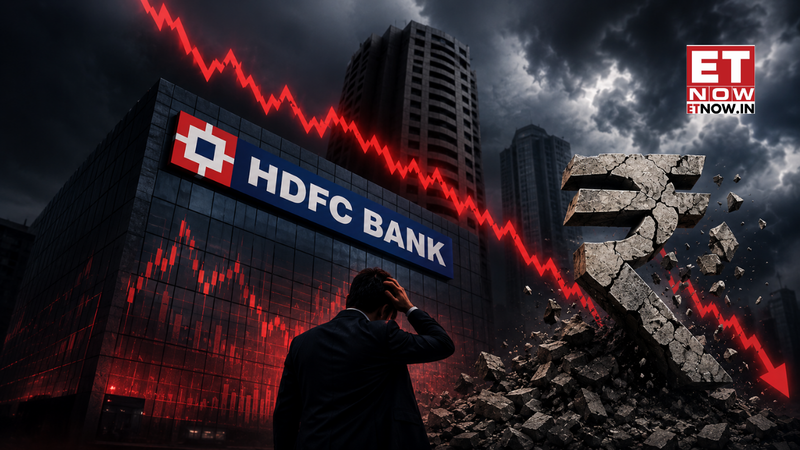
HDFC Bank Share Price Falling: For decades, HDFC Bank, India’s largest private sector bank in terms of market capitalisation, has been the crown jewel of the country’s banking sector – a symbol of rock-solid stability and predictable returns. However, 2026 seems to have shattered that narrative of the stock market investors and enthusiasts.
On Wednesday, India’s top private sector lender and heaviest weighted stock suffered another bruising blow, with its shares declining 2.54 per cent to close at Rs 759.15, on the NSE. This single-day dip is merely the latest tremor in what has become a seismic year-long collapse.
HDFC Bank share price down 23.44% on a YTD basis
HDFC Bank’s market capitalisation: Investors lose Rs 3.58 lakh crore since January 1, 2026
For retail investors and institutional giants alike, the damage is staggering. On January 1, 2026, HDFC Bank’s market capitalisation stood at Rs 1,526,007 crore, and its share price was Rs 991.
Following Wednesday’s decline, the private lender’s market cap has dropped to Rs 1,167,812 crore, while the stock is currently trading at Rs 759.15.
This means, in less than five months, around Rs 3.58 lakh crore of investor wealth has simply vanished. In terms of share price, this translates to a drop of Rs 232. Consequently, investors have suffered significant losses.
The BIG question for investors now
Major decline witnessed at the start of the year
The trouble began quietly in January this year. Financial markets, which had long valued HDFC Bank for its aggressive expansion, grew increasingly uneasy over the sluggish deposit growth. As savers looked for higher returns elsewhere, the bank’s core engine began to show friction.
At the beginning of the year, the stock was trading around Rs 991. Since then, the shares of HDFC Bank have fallen by over 23 per cent year-to-date (YTD) and were currently trading near Rs 759.15.
Liquidity concerns caused the stock to shed 6 per cent early in the year, slipping to Rs 931. While concerning, it was a hiccup that most analysts believed the bank could navigate. They were, however, wrong.
HDFC Chairman Atanu Chakraborty’s sudden exit – A shocker for Dalal Street!
The true inflection point arrived on March 18, with a boardroom bombshell that sent shockwaves through Dalal Street. Atanu Chakraborty, the bank’s Part-Time Non-Executive Chairman, abruptly resigned, citing ethical concerns.
That was the first time that the part-time chairman of HDFC Bank left mid-way, raising concerns over its functioning.
“Certain happenings and practices within the bank, that I have observed over the last two years, are not in congruence with my personal values and ethics. This is the basis of my aforementioned decision,” Chakraborty said in his resignation letter dated March 17.
In a letter addressed to the Chairman of the Governance, Nomination, Remuneration Committee, H K Bhanwala, Chakraborty said that “There are no other material reasons for my resignation other than those stated above.”
In a corporate culture known for tightly scripted public relations, Chakraborty’s resignation letter was a tactical missile, and Dalal Street too could not digest it.
The company’s market valuation eroded by Rs 65,176.48 crore to Rs 12,31,666.45 crore. By the beginning of April 2026, it had hit a low of Rs 726.65.
The RBI further stated that, based on its periodic assessments, there are no material concerns regarding the bank’s governance or conduct. It added that the lender remains well-capitalised, with sufficient liquidity and a satisfactory financial position, and that the regulator will continue to engage with the bank’s board and management going forward.
Payment irregularities allegations against HDFC Bank
Just as the stock was attempting a fragile recovery, a new crisis erupted on Wednesday, May 27. HDFC Bank shares came under pressure today following a news report alleging irregular payment practices and raising concerns around the bank’s internal governance processes.
It further stated that the payments were allegedly linked to differential interest offered on deposits maintained by MSRDC with the bank.
However, instead of being directly credited to the state agency as interest payments, the funds were allegedly routed through the bank’s marketing department and shown as contributions towards a road safety awareness campaign through four local vendors, according to the report.
In addition, the report alleged that the arrangement was discussed at senior management levels in the presence of HDFC Bank MD and CEO Sashidhar Jagdishan.
The report also linked the developments to the abrupt resignation of HDFC Bank’s non-executive chairman Atanu Chakraborty on March 18. He had stepped down, citing differences over values and ethics, though the bank management later said it was not informed of any specific concerns despite repeated requests.
HDFC Bank rejects allegations
HDFC Bank, meanwhile, has rejected the allegations of wrongdoing linked to reported payments worth Rs 45 crore allegedly routed through its marketing department to the Maharashtra government agency.
The bank’s spokesperson, in a statement, said its internal oversight and audit mechanisms are robust and that all matters are handled as per established procedures.
All issues are dealt with in accordance with the bank’s established norms, and the full process is always followed before final determination post any internal review, the statement said.
“We strongly reject any assumptions of wrongdoing or culpability based on selective material,” the statement added.
HDFC Bank Q4 results FY26
For the quarter ended March 31, 2026, HDFC Bank reported a 9 per cent year-on-year increase in its standalone net profit, reaching Rs 19,221 crore, up from Rs 17,616 crore in the corresponding quarter of the previous year.
The bank’s interest income was down 1.1 per cent YoY to Rs 76,610 crore in Q4 FY26 compared to Rs 77,460 crore reported in the year-ago period.
In normal times, a 9 per cent jump in net profit would be the cause for celebration. But 2026 has proven that the stock market values governance and transparency just as much as balance sheets. As long as the questions loop back to ethical alignments and internal audits, HDFC Bank’s financial fortress will remain under siege by its own shareholders.