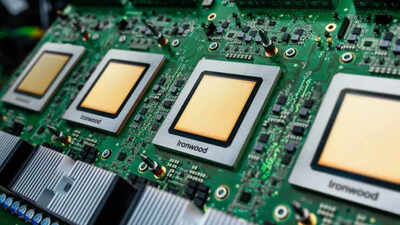
Google is quietly trying to sell its homegrown AI chips to a new class of cloud providers, and Nvidia has apparently noticed. According to a report from The Information, Google has been pitching its Tensor Processing Units to so-called neoclouds—specialist cloud firms that rent out AI computing power—in a bid to break into a market Nvidia has owned almost from end to end.The wrinkle is what happened next. The Information reports that Nvidia heard about Google’s talks with one such provider, Nscale, and has since floated some financial sweeteners of its own. One person close to the situation said those incentives looked designed to make Nscale less keen on working with Google. Nscale’s spokesperson pushed back hard, saying Nvidia offered the company no financial incentives in exchange for skipping TPUs. An Nvidia spokesperson declined to comment.
Inside Google’s TPU pitch to Nvidia’s neocloud customers
Neoclouds are the fast-growing middlemen of the AI boom—companies like CoreWeave, Nebius and Lambda that buy chips in bulk and rent the capacity to AI labs and enterprises. Nvidia already has close ties with nearly all of them, which is exactly why Google’s outreach matters. Break into the neoclouds, and Google gets its chips in front of customers who don’t own their own silicon.Nscale is a telling target. The provider is already deep in Nvidia’s camp—in March it announced it would be among the first companies globally to deploy Nvidia’s next-generation Vera Rubin platform, bringing more than 100,000 GPUs online across Europe from 2027 in one of the region’s largest AI compute rollouts. So it’s no surprise Nscale has stuck with Nvidia so far. Its spokesperson said all active contracted clusters and active discussions are for GPU capacity, not TPUs—and there’s no sign Nscale is moving ahead with a TPU deal for any future data centre.Google, for its part, has been sweetening its own pitch. Two people with knowledge of the discussions said Google offered to financially backstop TPU data centres neoclouds might want to build, helping them raise money for chips and equipment, then rent the TPUs back for its own AI work, Search and ads, or lease them to Google Cloud customers.
The GPU rent-back playbook, now aimed both ways
The rent-back arrangement isn’t new. Nvidia leases billions of dollars’ worth of its own GPUs back from neocloud partners too. But that setup makes less sense for Nvidia’s business, since it needs far fewer AI chips for itself than Google does—Google being one of the world’s biggest model developers and cloud operators.This all builds on a rivalry that’s been heating up for months. Google designs its TPUs specifically for AI workloads and has spent the past year selling them harder, both through Google Cloud and, more recently, by shipping chips directly into customer data centres. It already counts Anthropic, Meta and Apple among TPU users, and has struck a $5 billion deal with Blackstone to build a TPU-based neocloud that starts renting capacity next year.
What Nvidia said about Google’s AI chips
Nvidia isn’t rattled, at least not publicly. Last fall it said it was “delighted by Google’s success” while calling its own technology a generation ahead of the industry, with greater performance, versatility and fungibility than custom chips. Its GPUs still hold north of 90% of the AI chip market.The financial-incentive question is a different beast, though. Backstopping data centres to win business is one thing—both companies do it. Quietly paying a customer to stay away from a rival is another, and it’s the kind of manoeuvre that tends to draw regulatory eyes. Whether Google and Nvidia’s fight over the neoclouds stays a pricing war or becomes something messier may hinge on exactly what changed hands, and what didn’t.