
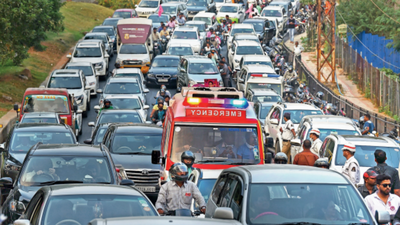
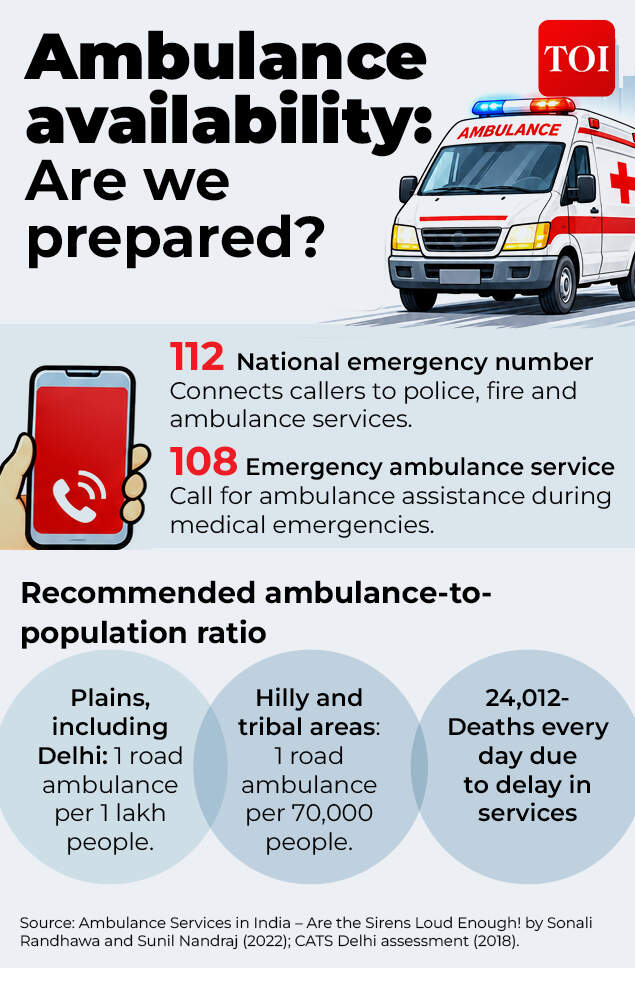
“Repeated calls went unanswered,” recalls Kishan, describing his family’s experience during a medical emergency involving his parents.A medical emergency rarely comes with a warning. A sudden cardiac arrest, a road accident or a stroke can turn an ordinary day into a race against time, where every passing minute can mean the difference between life and death. In such moments, one call for help is often the first and most critical step.But what happens after that call is made?From the moment someone dials 108 or 112 to the ambulance reaching the patient and transporting them to a hospital, multiple layers of emergency response are expected to work seamlessly. The call must be answered, an ambulance dispatched, first responders equipped to handle the crisis and hospitals prepared to provide immediate treatment.Yet, delays at any stage can cost a patient their chance of survival.The 2022 review article Ambulance Services in India – Are the Sirens Loud Enough! by Sonali Randhawa and Sunil Nandraj estimates that approximately 24,012 people die every day in India due to delays in receiving timely medical assistance.
Ambulance delays
Why every minute mattersThe term ‘golden hour’ is often used in emergency medicine to describe the importance of getting patients appropriate treatment quickly. But the urgency can be even greater in some conditions.“In a cardiac arrest, the chance of survival falls steeply with every minute that passes without CPR,” says Dr Rajiv Jain, HOD and consultant – Emergency Medicine, Gleneagles BGS Hospital. In a heart attack, delays can cause further damage to the heart muscle, while a stroke requires timely treatment to reduce the risk of lasting brain injury.He adds that in trauma cases, studies suggest only about 20% of accident victims reach medical care within the golden hour. Delays can affect not just survival but also the extent of disability a patient may face.Calling an ambulance early is important because trained crews can begin treatment during the journey and alert the hospital before arrival.
Health Emergency system
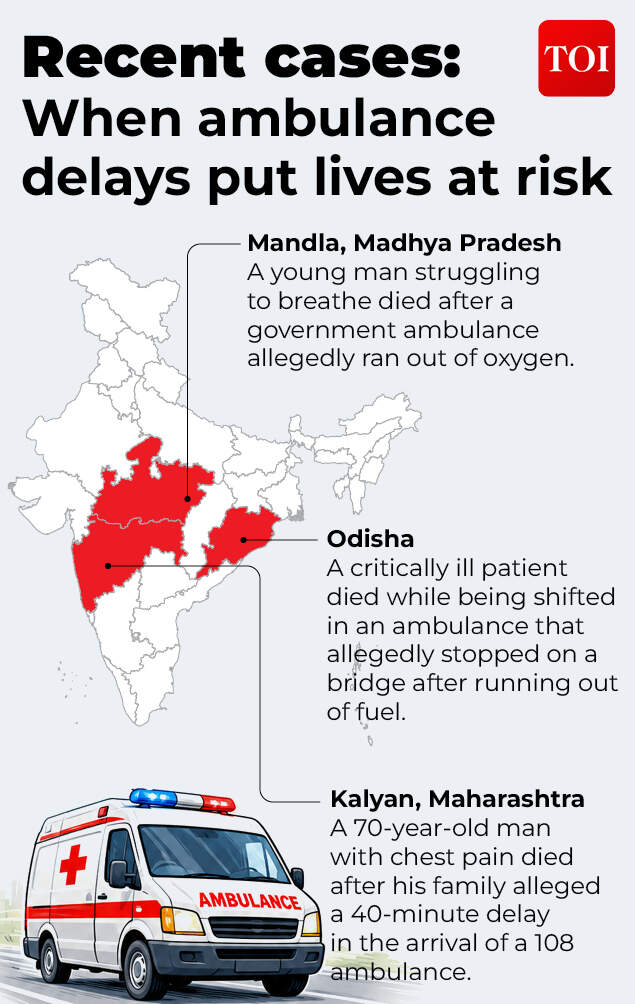
The first response: What should you do when an emergency strikes?Knowing what to do while waiting for professional help can make a crucial difference.Dr Jain says the first step is to stay calm, call emergency services and clearly communicate the location and nature of the emergency. The caller should put the phone on speaker so that the operator can guide them.“If they aren’t, start chest compressions at once. Push hard and fast in the centre of the chest, at about 100 to 120 compressions a minute, and keep going until help arrives or the person starts to respond,” he says, referring to a person who is unresponsive and not breathing normally.For heavy bleeding, firm pressure should be applied to the wound. An accident victim should not be moved unnecessarily, particularly if a spinal injury is suspected. Food or water should never be given to an unconscious person.“Those first five minutes belong to the bystander, and they often decide the outcome,” Dr Jain says.But what happens if help arrives late?Recent cases: When ambulance delays put lives at riskIndia has expanded its emergency ambulance network, but how effectively does it function when lives are on the line? Recent incidents from across the country have once again raised questions about the reliability of emergency transport.In Madhya Pradesh’s Mandla, a young man struggling to breathe died after a government ambulance allegedly ran out of oxygen.In Kalyan, a 70-year-old man with chest pain died outside a railway station, with his family alleging that the 108 ambulance took around 40 minutes to arrive.In Odisha, the family of a critically ill man alleged that the ambulance transporting him from Cuttack to a private facility in Bhubaneswar stopped on a bridge because it had run out of fuel.While the circumstances differ, these incidents point to a common concern: a delay or failure at any stage of emergency transport can put an already vulnerable patient at greater risk.
The gap in calling and receiving the help
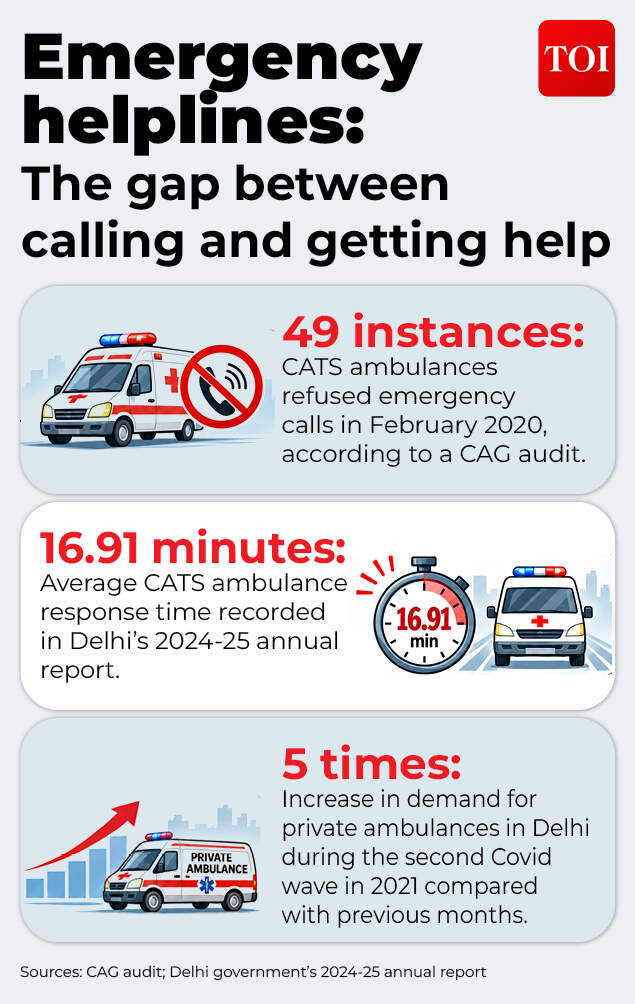
According to Dr Jain, delays are often caused by a combination of factors: traffic, difficulty locating the patient, lack of advance communication with the hospital, registration queues and waiting for a specialist.“The right hospital matters as much as the nearest one,” he says, adding that sending a patient to a facility without the required treatment can lead to further delays.Dr Anshul Kumar Jain, Director – Cardiology, CK Birla Hospital, Delhi, also stresses the importance of choosing a hospital that can provide immediate stabilisation and life-saving treatment. It may not always be necessary to travel to a bigger hospital if an appropriately equipped facility is closer.Are India’s ambulances and emergency services adequately equipped?India has multiple emergency numbers, including 108 and 112. The latter brings police, fire and ambulance services under one platform. However, the time taken by a first responder to reach a location should not be confused with the time taken by a medically equipped ambulance to arrive.The 2022 review article also mentions that the recommended ambulance-to-population ratio is one road ambulance for every 1 lakh people in the plains and one for every 70,000 people in hilly and tribal areas.However, assessing India’s actual ambulance availability remains difficult, as government data from different sources appears inconsistent. The availability of ambulances also does not automatically mean that patients will receive the required level of care.The review cites a 2018 assessment by Centralised Accident and Trauma Services (CATS) Delhi, which found that out of 265 state-run ambulances, only 31 had advanced life support facilities such as defibrillators and ventilators. Around 60 were non-operational due to mechanical faults, while nearly 155 were more than six years old.Dr Rajiv Jain says India’s ambulance coverage may appear close to international benchmarks on paper, but vehicles are unevenly distributed and many are basic life support ambulances rather than advanced life support vehicles.During the second wave of Covid-19 in 2021, the demand for private ambulances in Delhi increased fivefold compared with previous months, amid a shortage of adequately equipped public ambulances. Private ambulance operators also charged higher rates, according to the review.Are emergency helplines working when people need them most?The gap between having an emergency helpline and getting timely assistance is also reflected in Delhi’s ambulance services.A CAG audit recorded 49 instances in February 2020 when CATS ambulances refused emergency calls. Reasons included a lack of staff, unavailability of oxygen and vehicles being unfit to drive.The Delhi government’s 2024-25 annual report, meanwhile, recorded an average CATS ambulance response time of 16.91 minutes.The growing use of app-based ambulance services has also brought the issue into focus. Blinkit ambulances have featured in accounts of people turning to private platforms when conventional options appeared slow or unavailable.In one instance reported in November 2026, a Delhi man said he opted for a Blinkit ambulance after waiting for a response to his call to 112 during his grandmother’s medical emergency. The ambulance reportedly reached his home in eight minutes.In another case, a woman said her family struggled to arrange a cab during an early-morning emergency involving her aunt, who had suffered a seizure. They eventually booked a free ambulance through Blinkit.
Ambulance availability
Covid exposed the gaps: What India has learnt?The Covid-19 pandemic exposed how quickly emergency healthcare systems can become overwhelmed when demand rises sharply. Ambulances, hospital beds and oxygen became difficult to access, while families struggled to identify facilities that could admit patients.“Covid showed that our system was built for routine demand, not for a surge. Oxygen, beds and ambulances all became scarce at the same time,” says Dr Rajiv Jain.Dr Anshul Kumar Jain says the pandemic showed that emergency healthcare cannot function as a collection of independent hospitals and ambulance providers. It needs to operate as a coordinated network, where ambulance crews can identify which hospital has the required facilities and capacity before transporting a patient.Recalling her family’s experience during the Covid-19 pandemic, Kishan, a Delhi resident, said arranging an ambulance during a medical emergency was a major challenge.“Repeated calls went unanswered as the lines remained busy, putting the patient’s life at risk.”“It is the responsibility of the authorities to ensure that emergency helpline numbers remain functional and accessible to everyone, especially during a crisis. It is their failure when they cannot provide even basic facilities inside an ambulance. There was no bed inside the ambulance. We keep coming across reports of patients losing their lives because essential facilities are not made available in time. These delays can prove fatal,” he said.What needs to changeFor Dr Jain, improving emergency response requires more than adding ambulances.The system needs quicker dispatch, trained crews, advance alerts to hospitals, real-time information on facilities and clear accountability when delays occur.“What we need now is accountability: published response times, GPS-tagged ambulances, hospital capability grading, trauma registries, and a review of every preventable death as a system failure, not just bad luck,” he says. “When a life is lost in transit, the question must be what failed, not who was unlucky.”Dr Harshitha Sridhar, HOD and Consultant – Emergency Medicine, Manipal Hospital Millers Road, says strengthening the culture of first responders is equally important.“We also need to strengthen the culture of first responders. Police personnel, traffic police, security guards, teachers, public transport staff and even ordinary citizens should receive basic CPR and first-aid training.“India needs to move from a predominantly ambulance-transport model to a prehospital emergency medical care model. An effective emergency response system must be capable of saving lives before a patient reaches the hospital.”For Kishan, who lost a family member, the experience remains a reminder of how helpless families can feel when every minute matters.
Share your thoughts in the comments
Be respectful · TOI community guidelines
He suggests people to keep emergency contacts handy and ensure that family members are prepared to act quickly.“Family members should also know how to drive, preferably more than one person. During an emergency, we cannot always depend on ambulances to arrive on time,” he says.An emergency call should bring assistance, not leave them waiting and wondering if help will arrive in time.