Industrial facilities typically command a 10-15% premium over warehousing, while in-city assets can generate 2.5-3 times more revenue, making the shift in product mix an important growth driver.
“Going ahead, not only this goes linearly, but I think goes a little bit exponentially because the product mix also continues to diversify,” Rambhia said.
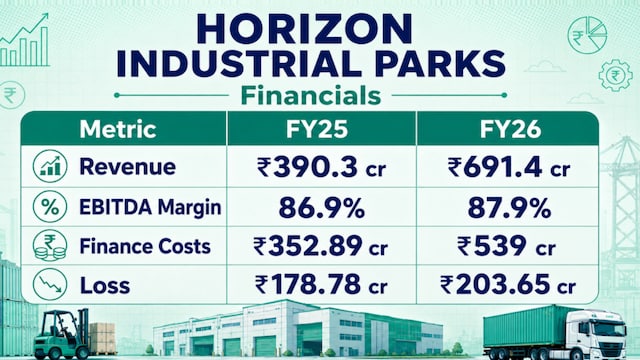
Horizon currently has a total network of 61 million square feet across 46 assets in 10 key markets. Around 29 million square feet is built today, while the remaining 30 million square feet is expected to be developed over the next four to four-and-a-half years. The company ended 2025-26 (FY26) with revenue of around ₹760 crore from a portfolio of about 25 million square feet.
The company is also entering the in-city segment with a 6.5 million square feet platform. Rambhia said this business can significantly improve the revenue mix as Horizon expands its presence in locations closer to consumers and businesses.
Industrial customers are already becoming a larger part of new business. While the current revenue mix is roughly 50:50 between warehousing and industrial, around two-thirds of incremental business over the last two to three years has come from industrial customers, supported by trends such as China Plus One, Make in India and production-linked incentives.
“Two-thirds of our incremental business in the last two, three years has come from the customers from the industrial segment,” Rambhia said.
Once the full portfolio is developed, Horizon expects roughly one-third of its business to remain in warehousing, around 40% to come from industrial facilities and about 25% from its in-city network. The company is also building an ecosystem around its parks, including blue-collar housing, renewable energy, hospitality and skill centres, which could add to revenue over the next two to three years.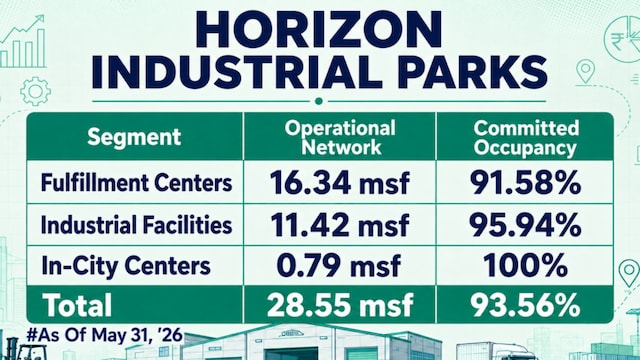
Despite reporting losses, Rambhia highlighted the company’s high operating margins. Asset-level earnings before interest, taxes, depreciation and amortisation (EBITDA) margins are above 90%, while corporate EBITDA margins are above 80%. He said reported losses are largely due to book depreciation of around ₹250 crore.
“Once you eliminate the biggest expenditure on our books, the depreciation, you’ll see we are already profitable in all of our past years,” Rambhia said.
The ₹2,600 crore initial public offering (IPO), along with ₹1,650 crore raised before the prospectus filing, will bring total primary capital raised to ₹4,250 crore. The funds are expected to reduce net debt to around ₹2,500 crore and cut the company’s interest burden by nearly two-thirds.
Watch the full conversation here

Horizon currently has a borrowing cost of around 8.1-8.2%, with another 50-75 basis points of like-for-like reduction expected as leverage falls. Rambhia expects the company to turn profitable at the net level around 2027-28 (FY28).
Catch all the latest updates from the stock market here