
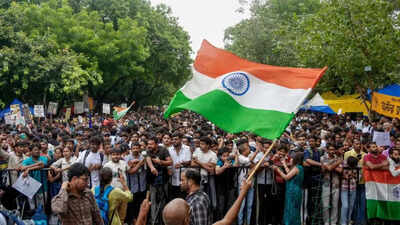
For a very long time, anyone considered particularly good at studies in India was almost automatically tipped to become a doctor or an engineer. 3 Idiots made a joke of that national fixation years ago, showing a world in which parents and professors seemed convinced they knew what success ought to look like.Alternative streams of education have slowly gained popularity since then. The race to become a doctor or engineer, however, has hardly become easier. As the pool of aspirants expands beyond the metros, competition for a coveted seat has only become harder. Many tuition centres, almost like factories, in Kota and other places train students rigorously to pass these coveted exams.The May 3 NEET-UG examination was cancelled after the paper-leak controversy and nearly 20 lakh candidates returned for a re-examination on June 21. The anger travelled from coaching rooms to Jantar Mantar and towards Parliament, propelled by the youth-led Cockroach Janta Party. Dharmendra Pradhan resigned as education minister on July 25. The CBI chargesheet has since named 13 accused, including three subject experts associated with NTA, while CJP has demanded that the testing agency itself be replaced. Similar protests over exam leaks have now erupted in Jharkhand.The anger that erupted at Jantar Mantar after the leak is merely a reflection of the deeper anxiety over competition for quality jobs and the yearning for a stronger CV, which for many begins with studying at a hallowed institution. How difficult, then, is it to get into a top-tier engineering or medical college in India?
The IIT-NIT funnel
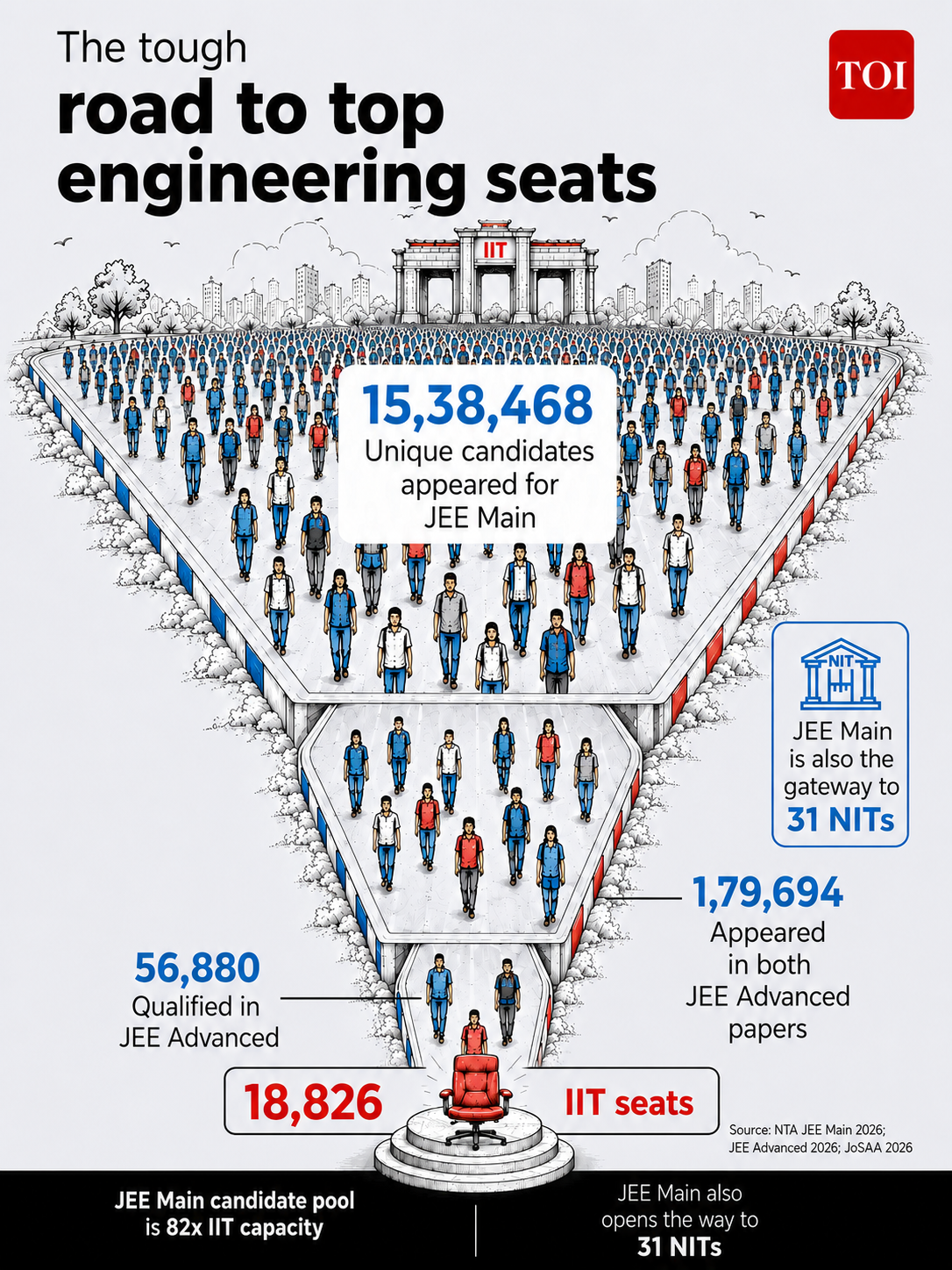
Engineering here means the route to the country’s most sought-after public engineering institutions, particularly the IITs and NITs, not every engineering college.The pathways are slightly different. JEE Main is the direct gateway to the 31 NITs participating in JoSAA 2026, while it also acts as the screening stage for candidates hoping to reach the IITs through JEE Advanced.NTA recorded 15,38,468 unique candidates appearing for JEE Main 2026. Of the 1,87,389 who registered for JEE Advanced, 1,79,694 appeared in both papers and 56,880 qualified. The JoSAA 2026 matrix provides 18,826 IIT seats.Put another way, the original Main candidate pool is roughly 82 times the number of IIT seats. Even after reaching JEE Advanced, there were 9.5 test-takers and almost exactly three qualifiers for every IIT place.
How competitive is the field
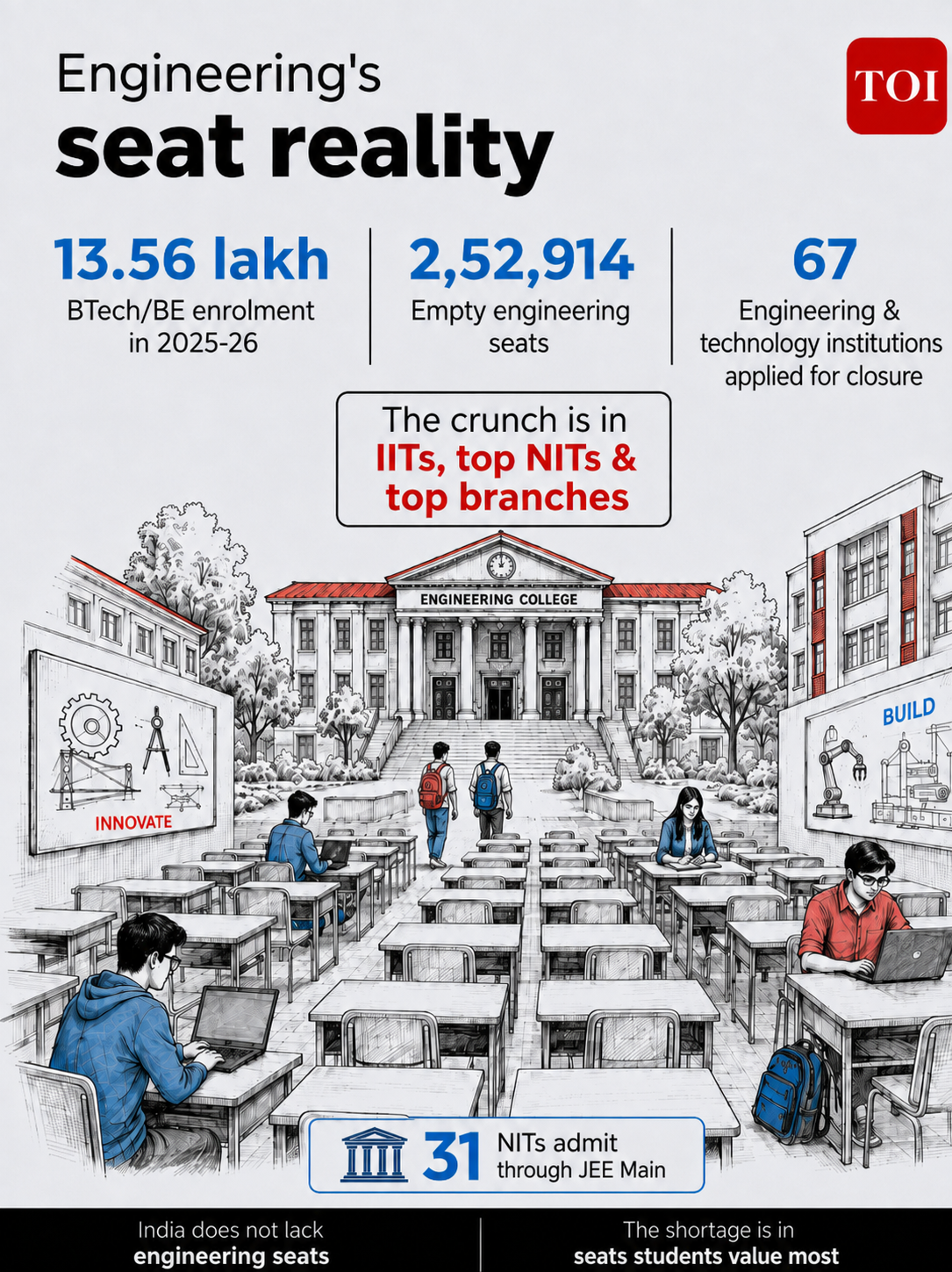
Not every JEE Main candidate is a serious IIT contender, so the 82-to-one comparison is largely academic. It is a measure of the scale of the pool, not an individual’s admission probability. Seats are allocated across categories and other reservation rules. But in both IITs and NITs, the fight is not only for a seat, but also for a preferred stream and college.Interest in admission wanes considerably as one goes down the value chain. That distinction becomes clearer when one looks at the rest of India’s engineering system. The latest Rajya Sabha disclosure by the ministry states that BTech/BE enrolment in AICTE-approved institutions rose to 13.56 lakh in 2025-26. Yet adding up the state-wise vacancies in the same annexure produces 2,52,914 empty seats. In the same year, 67 AICTE-approved engineering and technology institutions applied for closure or were listed as closed. So India does not lack engineering seats. What it lacks are the seats students value most in IITs, top NITs and other highly sought-after institutions.
What government told in Parliament
The engineering race does not necessarily end with a BTech for all. For those aiming for an MTech from an IIT, NIT or another premier institution, GATE becomes another competitive gate.The numbers are substantial. In GATE 2026, 2,11,020 candidates appeared for the Computer Science and Information Technology paper, while 95,752 appeared for Electronics and Communication, 76,385 for Civil Engineering and 69,242 for Data Science and Artificial Intelligence.Those figures cannot simply be converted into applicants-per-MTech-seat ratios. Candidates can sit more than one GATE paper. For NITs, the pool is still broader. CCMT 2026 accepts valid GATE scores from 2024, 2025 and 2026. So candidates for these seats can effectively be competing with more than one year’s GATE cohort.
Medicine has its own hierarchy
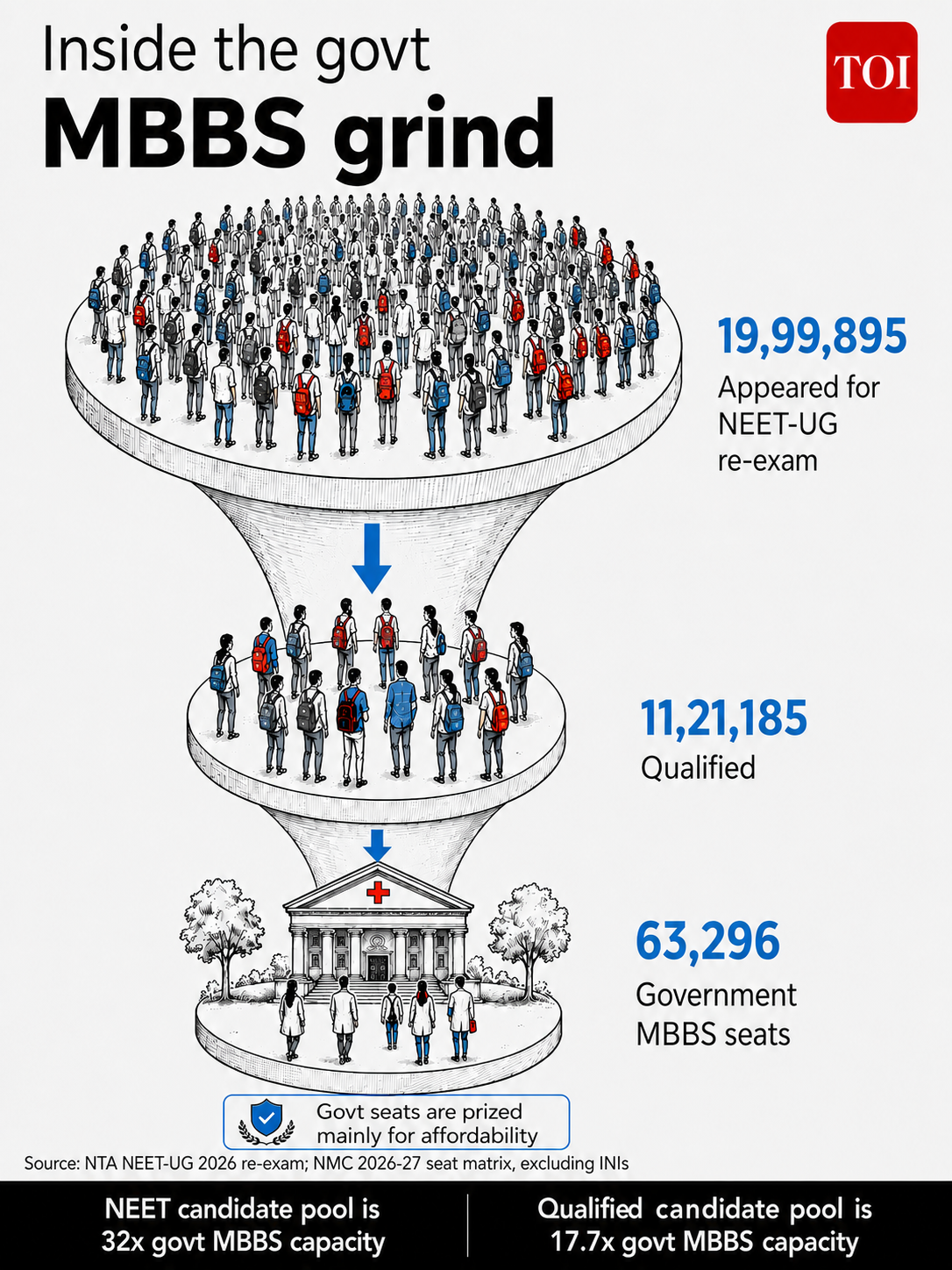
Medical education runs on the same preference for high-value seats.For the valid June 21 NEET re-examination, 22,79,743 candidates were registered, 19,99,895 appeared and 11,21,185 qualified. The cancellation itself affected the denominator, with 2,79,848 registered candidates not sitting the re-test.Against this pool, the NMC’s July matrix lists 1,36,939 MBBS seats for 2026-27, excluding Institutes of National Importance such as AIIMS. The NEET test-taker pool is about 14.6 times the listed MBBS capacity, while the number of qualified candidates is about 8.2 times the capacity. These are broad national comparisons, not individual admission odds, since seats are divided across quotas, categories and state eligibility rules. But the headline number conceals another hierarchy.Of those 1,36,939 NMC-listed seats, 63,296 are in government colleges and 73,643 are private. Private colleges account for about 54% of the listed capacity. If we compare the NEET re-test pool only with NMC-listed government seats, the candidate pool is roughly 31.6 times the available government capacity.
Level of competition
Government seats are prized because of substantially greater affordability, the reputation of established institutions and, in many large public hospitals, the prospect of extensive clinical exposure. This year’s expansion makes that distinction sharper. NMC approved 9,911 additional MBBS seats for 2026-27. Of these, 7,800 are private and only 2,111 government.
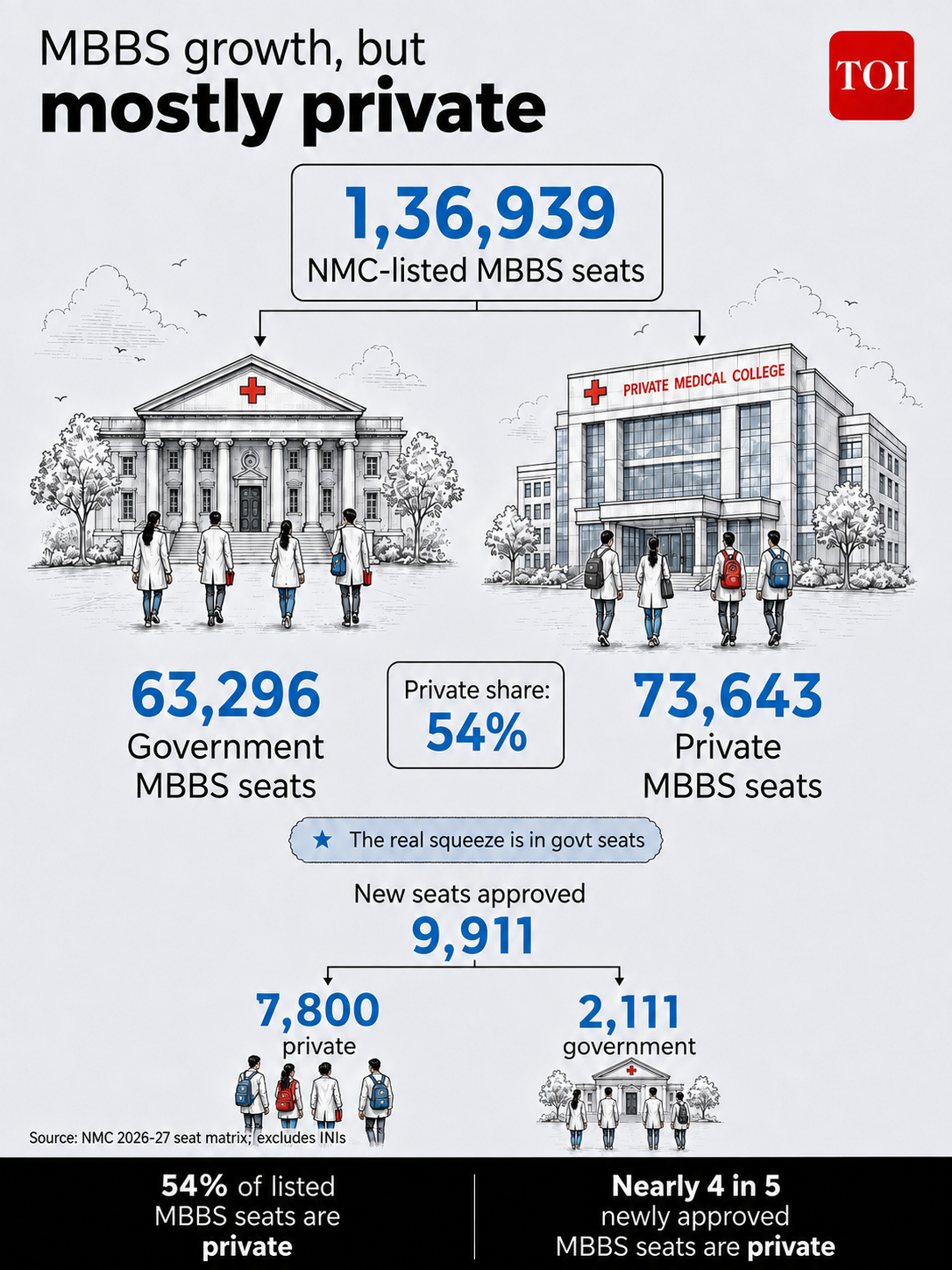
Skewed nature of growth of MBBA seats
Nearly four out of every five newly approved seats were added on the private side. So medicine and engineering are more alike than they look. In both, the real contest is increasingly over which seat, in which institution, and at what cost. There is, however, an important difference between the engineering and medical journeys.An engineer can enter another fierce competition through GATE for MTech, but postgraduate study remains an optional route for most. For doctors who want to specialise, postgraduate training is much closer to another necessary career gate.The latest completed NEET-PG examination makes the scale clear. More than 2.42 lakh candidates appeared for NEET-PG 2025, according to the National Board of Examinations in Medical Sciences. NEET-PG 2026 is yet to be held and is scheduled for August 30.And the postgraduate pool is much smaller than the undergraduate universe. The Centre said in July that India had 86,360 postgraduate medical seats in 2025-26. Earlier this year, it said 8,967 additional PG seats, including those in AIIMS and other Institutes of National Importance, had been approved for 2025-26. For some who pursue super-specialisation, there may still be another competitive gate beyond that.
Governments have tried to build capacity
Governments have tried to accommodate more students in quality institutions. Seven IITs have been established since 2014, while approved expansion at five newer IITs is intended to create capacity for another 6,500 students. In medicine, 157 government medical colleges have been approved under one central scheme, with 137 already functional. Separate government programmes have also expanded undergraduate and postgraduate capacity.But adding seats does not automatically solve the problem. The latest figures placed before Parliament show 15.35 lakh registered allopathic doctors and 7.52 lakh AYUSH practitioners and, assuming 80% availability in both groups, a government-estimated combined practitioner-population ratio of 1:778. Yet the existence of incentives for hard-to-serve areas underlines another problem. Doctors and specialists are not distributed evenly. So hierarchy exists beyond educational institutions too, which makes the work of policymakers even harder in a large country like India.
How other countries filter their best
In the US, 54,699 people applied to MD-granting medical schools in 2025 and 23,440 matriculated, but candidates generally apply after or during undergraduate study and typically take the MCAT. In England, medicine remains one of the most competitive university routes, with a sizeable socioeconomic gap in acceptance rates.France pushes much of the filter inside university, with two in five students entering its PASS or L.AS health routes in 2022 reaching medicine or another major health discipline within two years. China’s Gaokao had 1.29 crore registrations in 2026, but admissions are distributed across provinces, universities and programmes rather than through a single NEET-style medicine pool. Russia uses another lever altogether, with targeted state-funded medical training linked to future employment and workforceEvery country has tried different approaches based on the reality of the land.
Share your thoughts in the comments
Be respectful · TOI community guidelines
Whether a test like NEET is the best way forward is still being intensely debated. However, for policymakers, the only feasible solution seems to be building more institutions of comparable quality, ones students believe can offer strong education, credible employment prospects and a better quality of life. Simply multiplying seats is unlikely to be enough if aspirants continue to see only a small proportion of them as worth fighting for.