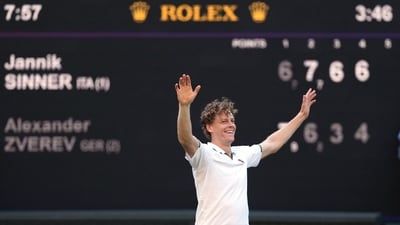
Jannik Sinner outlasted reigning Roland Garros champion Alexander Zverev 6-7(7), 7-6(2), 6-3, 6-4 on Sunday to retain his Wimbledon title and lift his first Grand Slam trophy of the year. The defending champion, who had knocked out Novak Djokovic in the semifinals, entered the final as the slight favourite. Yet, for almost two hours, it was Zverev who looked the more convincing player.
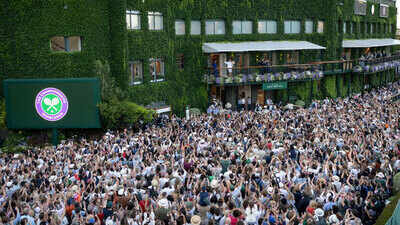
In front of a packed Centre Court, the German bullied Sinner from the baseline, forcing the Italian into uncomfortable positions and repeated tactical adjustments. But what followed was another reminder of why Sinner has become the sport’s most complete player. He solved one problem after another in real time, while Zverev gradually ran out of answers.
The nearly four-hour final, which even saw both players slip during the third set, ultimately became a contest of adaptation rather than power.
The forehand battle that gave Zverev the first set
Across their previous 14 meetings, Zverev has usually been the counter-puncher while Sinner dictated play. For almost an hour on Sunday, those roles were reversed.
Although Zverev committed 15 unforced errors in the opening set compared to Sinner’s seven, the more telling statistic was forced errors. Sinner was pushed into 20 forced mistakes, while Zverev made only six.
The biggest culprit was Sinner’s forehand. He sprayed 10 unforced errors from that wing, allowing Zverev to dictate rallies and eventually dominate the tiebreak with fearless shot-making.
Zverev’s willingness to keep pulling the trigger despite the errors proved decisive. It was controlled aggression, and it paid off.
The return adjustment that changed everything
This was arguably the defining tactical shift of the match.
For much of the opening two sets, Sinner constantly experimented with his return position. At times he stood on the baseline, at others he retreated almost four metres behind it in a Daniil Medvedev-like position. Neither approach consistently disrupted Zverev’s rhythm.
Heading into the second-set tiebreak, Zverev was serving at 83% and had won 70% of his first-serve points.
Then Sinner found his “Sheldon spot” (for The Big Bang Theory fans): planted close to the baseline. He stopped retreating. During the tiebreak, four of his five returns came from within two metres of the baseline, winning four of those points. That single adjustment helped him steal the set, and perhaps the final itself.
The unforced-error gap that kept growing
Once Sinner settled on his return position, the gap between the two players steadily widened.
By the end of the match, Sinner had committed just 25 unforced errors compared to Zverev’s 45.
His serve also became increasingly effective. Sinner won 80% of his first-serve points and 65% behind his second serve, compared to Zverev’s 72% and 59%.
The break-point numbers summed up the difference. Sinner converted two of five opportunities, while Zverev failed to convert his lone break point all afternoon.
The knee slip that changed the match
There was also a physical turning point.
Serving at 3-4 in the third set, Zverev slipped while chasing a drop shot and immediately clutched his right knee. It brought back memories of his horrific ankle injury against Rafael Nadal at Roland Garros four years earlier.
Although he resumed play after treatment, he never quite looked the same.
His movement became noticeably slower, particularly into the backhand corner, while he struggled to generate the same drive through his service motion.
The statistics reflected it. In the third set, Zverev’s first-serve percentage remained healthy at 74%, but he won only 29% of his second-serve points. Sinner, meanwhile, won 63%.
Sensing the opening, Sinner capitalised on the only break point of the set before closing it out 6-3.
Sinner’s greatest weapon delivered again
Throughout his title defence, Sinner’s serve repeatedly rescued him whenever his baseline game wavered. It did so again in the final. His forehand misfired for long stretches early on, but his serve prevented Zverev from breaking away before his groundstrokes finally clicked.
The numbers explain why it has become arguably the best serve in men’s tennis. Among the ATP top 10 this season, Sinner’s average first serve is tied for the fastest at 125 mph, just behind Zverev’s 126 mph. More importantly, his first serve lands closer to the lines than anyone else’s, combining elite pace with unmatched precision.
That blend of speed and placement once again proved decisive. On Sunday, Sinner landed 76% of his first serves and won 80% of those points, giving himself the breathing room needed to solve the tactical puzzles elsewhere in his game.
The difference
In the end, Zverev played the best version of himself for almost two sets. He was bold, committed, and willing to live and die by the forehand. But Sinner’s in-match engineering separated a great challenger from a five-time major champion.