

Gratuity has long been seen as a quiet but meaningful reward for years of service. It is not something employees think about every month, but at the time of leaving a job, it often becomes one of the most valuable components of the final settlement.With the implementation of the new labour codes, particularly the Code on Social Security, the way gratuity works is beginning to evolve. While the basic structure remains familiar, a few key changes could influence how much employees receive and who becomes eligible.For most individuals, the impact is not immediate – but understanding the shift can help in long-term financial planning.A benefit linked to continuity, still largely intactAt its core, gratuity continues to be a statutory payment made by an employer when the employee exits after meeting certain conditions. In most cases, employees need to complete five years of continuous service with the same employer to become eligible.In practical terms, the “five years” requirement is often interpreted based on days actually worked. Broadly, this means that an employee working a five-day week may be considered to have completed five years if they have worked about 4 years and 190 days, while for a six-day week, it is typically 4 years and 240 days.This principle remains unchanged. The qualifying events – such as resignation, retirement, or superannuation – also continue as before. At the same time, the law continues to make an exception in sensitive situations like death or disability, where gratuity becomes payable regardless of length of service.For employees, this means that gratuity is still a long-term benefit, closely tied to continuity with an organisation.A broader net: impact on fixed-term employeesOne of the more noticeable changes under the new labour codes is the inclusion of fixed-term employees in the gratuity framework.Earlier, many employees on short-term or project-based contracts often did not qualify for gratuity, simply because they did not meet the five-year requirement. The revised approach narrows this gap by allowing fixed-term employees to receive gratuity on a proportionate basis where they work for one year or more.In practical terms, this means that individuals working on defined contracts, including those in project roles or specialised assignments, may now have access to a benefit that was earlier limited to longer-term employment.For a workforce that is increasingly mobile and project-driven, this is a gradual but important shift.The formula stays, but the base changesInterestingly, the method of calculating gratuity itself has not been overhauled. The well-known approach – based on last drawn salary and years of service continues.In simple terms, gratuity is payable at the rate of 15 days’ wages for every completed year of service, and even part years beyond six months are typically counted as a full year for this purpose.For monthly-rated employees, this is generally calculated by dividing the last drawn monthly wages by 26 and then multiplying by 15 to arrive at the 15-day equivalent.However, what goes into that “salary” has been redefined. Under the new framework, the concept of wages has been standardised, closer to the definition used for other social security benefits. In simplified terms, a larger portion of the overall pay package may now be considered when calculating gratuity.For employees whose compensation structure earlier leaned heavily on allowances, this could result in a higher base for calculation. Over time, this may translate into a higher payout at the time of exit, although the actual impact will vary depending on individual salary structures.A simple illustration of how payouts may differTo understand this better, consider an employee earning Rs 1,00,000 per month.
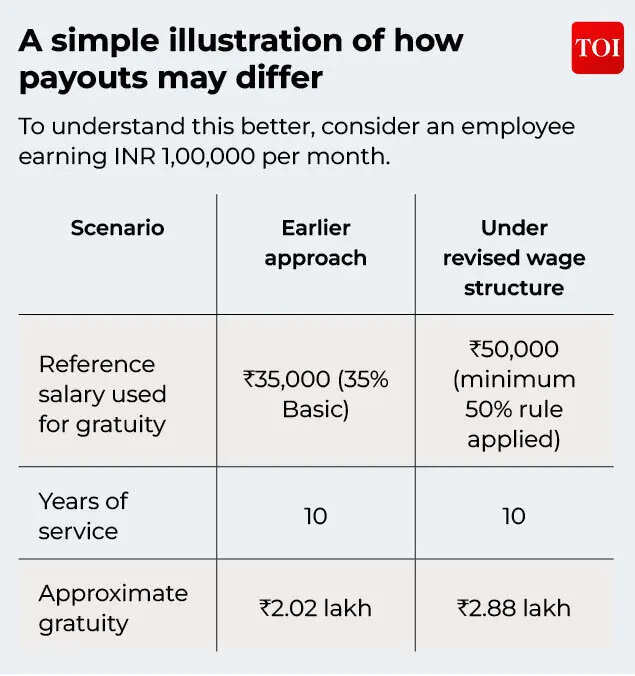
While the formula itself has not changed, the expanded wage base can make a noticeable difference to the final amount.The cap continues to applyEven with these changes, gratuity payments are still subject to an upper limit. For most private sector employees, the statutory ceiling currently remains at Rs 20 lakh.This means that beyond a certain level of salary and service, the payout does not increase further under the law. Some organisations may choose to offer higher amounts, but that typically depends on internal policies rather than statutory requirements.The law recognises that organisations may offer better gratuity benefits under employment contracts or company policies. Where such favourable terms exist, employees can continue to receive those benefits.A subtle but important shift from the earlier regimeFrom a broad perspective, the changes introduced by the labour codes are more about expanding coverage than altering the structure.
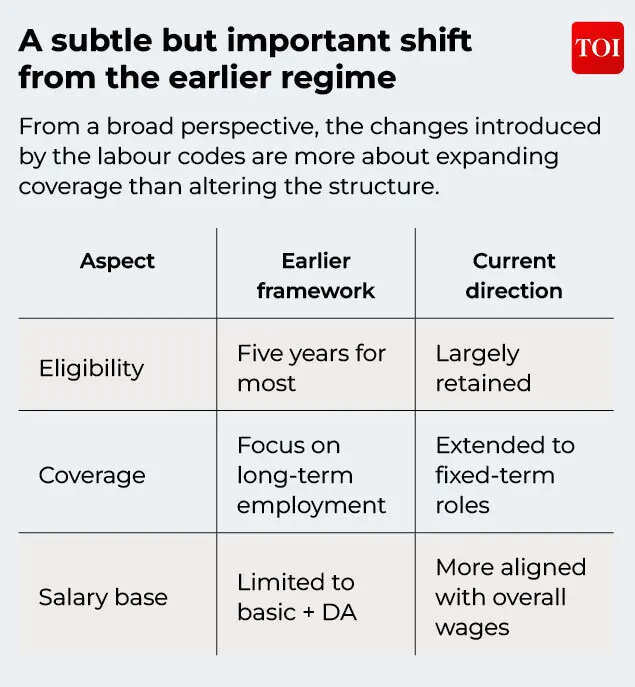
This suggests that while gratuity continues to reward long service, it is gradually adapting to a workforce that no longer follows a single employment pattern.Why gratuity still shows up in CTCMany employees notice gratuity being included in their Cost to Company (CTC), which can sometimes create confusion.In practical terms, this inclusion is a way for employers to account for the future liability. It does not mean the amount is paid monthly. Instead, it accumulates over time and becomes payable only if the employee meets eligibility conditions and exits the organisation.For individuals, this means gratuity should be viewed as a deferred component of compensation, not an immediately accessible benefit.When is gratuity paid?Another commonly asked question relates to timing. Once gratuity becomes payable – typically upon exit – employers are expected to settle it within a defined timeline.In most cases, this is within a month from the date it becomes due. Delays may attract additional costs for the employer, which helps ensure timely payment.For employees, this provides some certainty around when to expect the amount after leaving a job.In cases where an employee passes away, the gratuity is paid to the nominee. If no nomination has been made, it is paid to the legal heirs. Where the beneficiary is a minor, the amount is typically safeguarded and invested through an authorised mechanism until the minor becomes an adult.Can gratuity be forfeited?While gratuity is a statutory right, it is not unconditional. There are situations where it may be reduced or withheld – usually if the services of employee have been terminated for riotous or disorderly conduct or any other act of violence on employee’s part or if the services of employee have been terminated for any act which constitutes an offence involving moral turpitude, provided such offence is committed in the course of employment.Such cases tend to be specific and depend on circumstances. For most employees, however, gratuity is paid in full once eligibility conditions are met.Tax treatment: why gratuity remains attractiveGratuity also continues to benefit from a favourable tax treatment. For private sector employees, the amount received is exempt from tax up to Rs 20 lakh, subject to prescribed conditions. For government employees, the exemption is broader.As a result, gratuity often forms a relatively tax-efficient component of exit compensation. For individuals planning long-term finances, this can make a significant difference.Behind the scenes: how employers manage this liabilityFrom the employer’s perspective, gratuity is a long-term financial obligation. To manage this, many organisations create dedicated funds or insurance-backed arrangements so that the liability can be met when required.While this is not something employees directly deal with, it plays a role in ensuring that the benefit is backed by adequate funding.What should employees take away?For most employees, the message is simple. Gratuity continues to be a long-term benefit linked to service, but it is slowly becoming more inclusive and structured.Those in traditional long-term roles will see continuity. Those in fixed-term or project-based roles may see expanded coverage. And in many cases, the way salary is structured could influence the final payout.It may not change how employees think about their monthly pay – but it could certainly affect what they receive at the end of their journey with an organisation.(The author, Puneet Gupta is Partner, People Advisory Services Tax at EY India)